
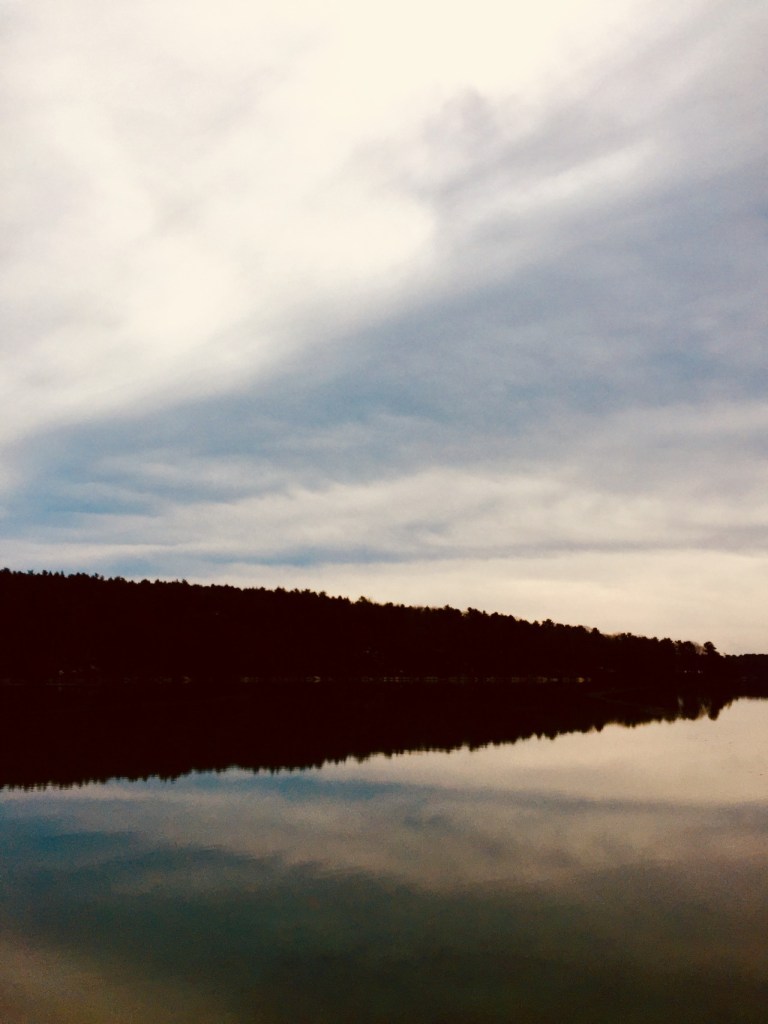
Cancer is a sort of middle-ground between what was and will eventually be. This middle ground is unstable and forever shifting and changing — often daily. As unstable as it is, it also acts as an anchor. With a diagnosis and subsequent treatment, with life revolving around clinics and tests, trying to grapple with the “new normal” post-cancer, as well as the shift in perspective of life when the dust settles, patients seek refuge on this ground.
This middle ground, however, cannot hold, nor is it meant to.
To acknowledge that one is in remission is to become aware that the steps, however frightening, must be taken to move away from the middle ground to step forward. I have kept myself there in this gray area.
I can stay here forever. There is safety here. I’ll live here. I’ll build a life here.
This middle ground, however, cannot hold, nor is it meant to.
As horrifying as they were the circumstances in France rattled parts of me, they forced me to bear witness to the events that had taken place over the years. I was unprepared to handle the deluge of emotions from observing this. The events snapped me into such intense awareness of all that had come to pass, each and every brutal moment of my journey. The emotional scars became apparent. The physical scars radiated, and I could not look away from either or turn my attention elsewhere. My emotional being couldn’t hold out any longer; I was shedding layers, and the feeling of emotional nudity was unbearable. I was losing the self I had been constructing; who was Jeremiah now? This identity was slipping, try as I might I couldn’t hold it. Everything came to a grinding halt; I was literally and figuratively unable to take another step. Brain surgery had to occur during active treatment; there was no question about the procedure. When everything started to rise to the surface, when the layers were dropping away, the physical and psychological acknowledgment of this particular scar was the trigger that sent me into a tailspin.
I have been able to meditate on some of the imagery and hallucinations I experienced during my breakdown. There are some images that, until now, have remained mysterious or so tangled in metaphor that I couldn’t decipher them. One in particular was pulling a hair-like substance from my chest. This unnerved me, and I wasn’t ready to interpret it. I had been building an identity around cancer; it engulfed my entire life for so long that I took on that persona, that of a patient. ‘I have cancer’, I’d say to myself, or I speak about it as though it was current, that I still had it, that I was still in the place of treatment. Neither is true. This gesture of pulling this substance from my chest is so clear to me now, so obvious. I was trying to extract this identity, this version of myself that has since passed. The transient persona that I had outgrown yet was fiercely holding onto. From within me, from my core, I was trying to haul this out, to unburden myself of it. Not to rid myself of the memories, good or bad, nor the lessons learned, as there are numerous — a lifetime’s worth! I was trying to purge myself of all that didn’t serve me, holding me back from stepping off the crumbling middle ground.
I had to return to France; Golinhac was calling me. All this came about there; all that dormant within me rose fully to my attention — glaringly so! In return, I would leave the remanence of this deteriorating middle ground and my meticulously crafted persona. I’d keep the new awareness and lessons from the incidences experienced there and feel a sense of certainty in stepping away.
I put a ticket on my charge card and began packing. Just a few weeks after I left France, a complete emotional and psychological mess, I was going back.
Everyone expressed their concerns. They were worried that I was still very vulnerable and returning so soon, in a fragile emotional and psychological state, would be very unwise. Why, after such a short period of time, would I want to return to the site of my breakdown? To the place where, just a few weeks ago, I was admitted to the emergency room after being found screaming and howling in the middle of a footpath just outside of Golinhac. These questions started building in my mind, too. Why would I want to do this? The entire way to Boston, which on the bus felt like an eternity, I was wondering what on earth I was doing. What was I hoping for? I didn’t know the answer to anything. Even during my layover in Lisbon, I still wondered and questioned everything.
I admitted to a dear friend who has been an incredible support this entire time and someone I feel safe confiding in,
“I don’t know what I’m searching for.”
“I don’t either,” she replied.
This is the uncertainty that keeps a cancer survivor remaining in the middle ground. Not only the uncertainty of life, as explained, but that of oneself, the question of who one is — who is this Jeremiah? How has he arrived here?
I don’t need an identity here. I can stay here forever. There is safety here. I’ll live here. I’ll build a life here.
This middle ground, however, cannot hold, nor is it meant to.
I walked east out of Golinhac with ever-increasing anxiety. I had to stop and gather myself to go on a few times. At one point, I even considered returning home, admitting it was too soon for such an undertaking. But I was still drawn onward and slowed considerably, taking deep, slow breaths with each step. I stopped at a certain point, put down my pack, and started emulating the gesture of pulling the hair substance from my chest. Gently, slowly, without the frantic haste of my hallucination, I mimicked the action, one hand then the other in a rhythmic fashion as though softly pulling one long, continuous thread from my chest. The action became ritualized in its repetition, fluidity, and symbolism, bringing a deep sense of peace. I envisioned dismantling the persona that had been constructed around cancer, the identity that no longer served me. Bit by bit, as if pulling a single thread that unweaves a tapestry, I unraveled an identity. I simultaneously entwined a new Jeremiah, no longer the patient, yet holding the memories and lessons – the same thread yet a different weave pattern.
I stood still in the silence of the location and continued taking long, slow breaths. Dusk arrived, and with it, a chill. I retrieved my pack and walked westward back towards Golinhac.
The peace I felt there has remained. Returning to France, which consisted only of four full days, left me feeling as though I had undergone years of psychotherapy. It isn’t so much that I am thankful for the breakdown itself, as it was terrifying, rather, that I am thankful for that which it revealed to me and the metamorphic shifts that have since followed.
This is not to say that I have stepped entirely from the teetering middle ground, but I have one foot firmly planted on the other side.
I can build an identity here, one that is linked to (the) cancer via memories and life lessons and not one that is torn between two worlds, two worlds that ultimately hinder the desperately needed stability required for reconstruction.


 healing is a circular path