
i waited for you in the park.
when you arrived,
you held me,
and your cold nose pressed against my neck.
you nuzzled me,
and our skin quickly
adapted to one another;
mine cooled, or yours warmed
i’m not sure.
i was happy and
excited about what we might become.
the sun and an early spring day
marked the passage of time
and life moving forward.
these were early days—before
waiting became an annoyance,
before illness,
when i didn’t understand what
holding my breath truly meant.
the anticipation of test results slowed time,
and hours in the treatment chair
felt like lifetimes.
after my first seizure,
when the illness forced my world apart,
time shifted.
you found me
coming to the emergency room
to gather the pieces.
fresh from outdoors,
from the chill of an early
chicago spring day,
remembering this:
your cold nose
pressing into my neck,
i can still feel it as time slowed.
and why can’t these moments
be eternity?
when two bodies
seek a common temperature,
can’t this search last forever?
Tag: cancer day
The wind through an open door
At night, lying on my back, I stay awake and listen to the rattling of my lungs.
A wheeze, a strange resonating noise—like damp leaves—if mold had a sound, if abandoned rooms with winds spoke.
I insist I am okay.
I’ve always said, “I’m okay.”
From my youth, my father’s glare, to now, the groan of my lungs.
But I knew now I wasn’t; my body was revealing signs of sickness.
When had climbing a flight of stairs become a challenge?
Why was I losing weight?
Why did I wake up in the morning without the will to start the day?
The cravings of a young man—sexual longings, morning erections, and pleasuring myself in the stillness of the night—these were memories.
Someone my age shouldn’t be dealing with these issues, right?
I am a young man, strong and proud with rugged New England blood, generations of good health, and a life without doctors.
I kept telling myself, ‘Everything is okay.’
I kept repeating, “Everything will be okay.”
But it was never just an irritation in my throat.
The cough wasn’t just spring allergies.
“Hello,” I say.
“You are closer now.”
The wind through an open door has achieved form.
You have become a presence, a physical form I can’t ignore.
“Hello, Jeremiah.”
You’re in the hallway as a guest now, and you’ve even taken off your shoes.
How could I not welcome a guest?
A caller who had been inside, who had been within, was now at my door.
Cradling me as I sit on the shower floor, coughing blood into the drain.
Wrapping me in the steam of a scalding shower that never warms.
You are the fading winter, the arriving spring, and the buds on trees along West Thorndale.
You’re sitting next to me on the L.
Threads


My sister purchased sweatpants and a cozy sweatshirt for me during the first few weeks of my initial treatment in mid-April 2016. Initially, I didn’t want to wear them to treatment; I wanted to attend each grueling session dressed in a button-down collared shirt and trousers that blurred the line between dress and casual. I liked to look presentable—I needed to.
I arrived at the treatment clinic directly from Chicago, where I worked on completing an MFA, actively attended daily classes, wrote my thesis and art history paper, and generated visual work in general. As such, I consciously dressed in a way that, I hoped, exuded professionalism and spoke to my qualities. There was, however, another very conscious act; I wanted to maintain this daily dress code as a ‘fuck you!’ to cancer.
My work week was, in fact, a full-time job; I was in the treatment center Monday through Friday from 8 am to 4:30 pm. I often arrived before my oncologist and was in my chair, books, and laptop set up and ready to power ahead and finish an art history paper while they were still mixing up my toxic chemo cocktail. On one occasion, I heard my oncologist ask my nurse, “What is he doing over there?” she replied, “he’s working.” As I said, it was my full-time job; I was going to dress the part, grind away, and flip the bird to cancer.
But treatment took its toll.
The nurse who at one time informed my oncologist I was working was now mainlining me with Ativan because the 40-hour week was causing such severe panic attacks.
“It’s Friday; we expect you to be like this,” she said.
Was that a carte blanche to unhook my IVs and run screaming from the clinic? Perhaps, but I didn’t have the energy to do so. Instead, I requested a blanket from the warmer, curled up, and cried.
The following week, I began wearing my new sweatpants and sweatshirt.
No one took a second look at my attire. In fact, I received more attention when I showed up for treatment dressed like I was going in for a day as a data analyst than when I appeared in sweatpants, prepped for an 8-hour treatment cycle. The clothing I usually would only sleep in became my new go-to look on most days.
But it was more than a look, obviously, and more than physical comfort, which became increasingly important as the weeks dragged on. The ease of shedding one pair of sweatpants for another can’t be overstated when depleted of all energy sources.
Since 2016, I have worn the same few pairs of sweatpants to bed when lounging around the house and even while walking on the treadmill. After each washing, I am surprised that they remain intact.
Recently, when I visited my sister, she saw the state of my sweatpants and immediately ordered new ones. She’s like that; without hesitation, she will act in a way that might be simple but can change a person’s entire day – usually for a lot longer.
When I returned home from my visit, the package arrived within a day with various items, and yes, including sweatpants.
With their arrival, I knew it was also time to part with the old pairs. I folded them neatly, ceremoniously, as if I were going to lay them to rest somewhere sacred and not put them in the trash as I did. When I returned to my room, I saw the new sweatpants and, though I partly expected this, became incredibly emotional. For undeniable reasons, there is an aspect of sentimentality brought about by years of owning something. However, when a particular thing has wrapped you up, encased you, and held you literally in its fibers during your most vulnerable times, its presence surpasses sentimentality. That, paired with the endless generosity of my sister, made giving up the old apparel and welcoming the new bittersweet.
It is human nature to want the reassurance that something or someone will catch us if we fall; if we stumble, somebody will help us. The unconscious knowledge comforts us on some primordial level, that a hand will reach out and grasp us and that we can let go.
After trying on my new sweatpants, feeling that strange pleasure of fabric that is both too crisp and refreshingly new, I understood that the garments my sister initially gave in 2016 were indeed that hand reaching out. Somewhere between ceremoniously discarding the well-worn apparel and snipping the tags off the new threads, I understood that the tiniest gesture holds the most significant importance.
I had to remain in the car when my sister purchased the first set of various items for me. I was too ill to go into Old Navy. I sat curled up on her car’s front seat, craving the comfort of my bed, the relief an anti-nausea medication would bring. Her return with multiple bags containing an assortment of clothing was her way of offering me comfort; it was one of many, but this particular gift came during the first stages of my treatment when I felt particularly rough.
We arrived home, and though it was several years (and another lifetime) ago, I can remember the comfort of my new sweatshirt. Though I have since parted with the pants, I refuse to leave behind the sweatshirt and all the memories, good and bad, that it conjures up.
National Cancer Survivor Day

Today is National Cancer Survivor Day.
I have been compiling some comparison photos. The ones of me during treatment, which were taken during my inpatient stay at Mass General, were so hard to look at for the longest time. It is still unnerving. When I upload and then delete photos from my phone these photos, as well as a few of my family, are the ones that always remain.
In the last several months, I have only been able to pause, look at them, and consider who that person was and what aspects of him still remain. The shift in this ability, that of being able to witness this previous Jeremiah, came after my psychological and emotional hardship experienced while abroad in the fall ‘19. Since then, things have started to dissolve, things that have been carried and dragged too far for too long. Perhaps this is why I can look at this photo with more compassion and kindness. Yes, there is still fear, of course there will always be fear.
During these years of survivorship, some people have drifted out of my life, as any path to any destination worth arriving at isn’t free of bramble and vexation. Others have grown increasingly closer to me, and in sticking with the path analogy, our comradery has strengthened, allowing us to work together through the dense underbrush that is life.
Things change so quickly

I can’t help but look back. It is torture, I know… but I’m still trying to figure things out. If I keep repeatedly playing things in my mind, something will pop up, make sense, and be clear.
This photo (4/4/16) is after being discharged from the hospital. I had my orchiectomy, was diagnosed, had my apartment packed up, and was about to return home to New England for treatment. How did I manage all this? I didn’t notice until looking at the photo that I was still wearing the bracelet from the hospital.
Things change so quickly.
My eyes are so tired in this photo. I looked worn out and worried – naturally, I was. I wanted to smile for my girlfriend, it was her birthday. Considering life’s drastic change, I wanted to act as normal as possible.
I am not sure why I return to these images. Maybe it is the stark contrast between the two; a casual day at the nature museum was only a matter of days before my life fell apart.
What am I seeking here? What do I hope to find in the words written upon my face, within my tired eyes?
I notice my left hand is gripping her shoulder so tightly. Is it because I’m leaving? Is it to thank you for being there for me, coming to the emergency room, and staying with me there for days? Is it that I’m trying to hold on with all my strength because this is the last refuge, the last fragment of normalcy that I will have in a long time?
I will turn these questions (and many more) over and over in my mind. There has to be reason within them… they have to make sense.
Check-in
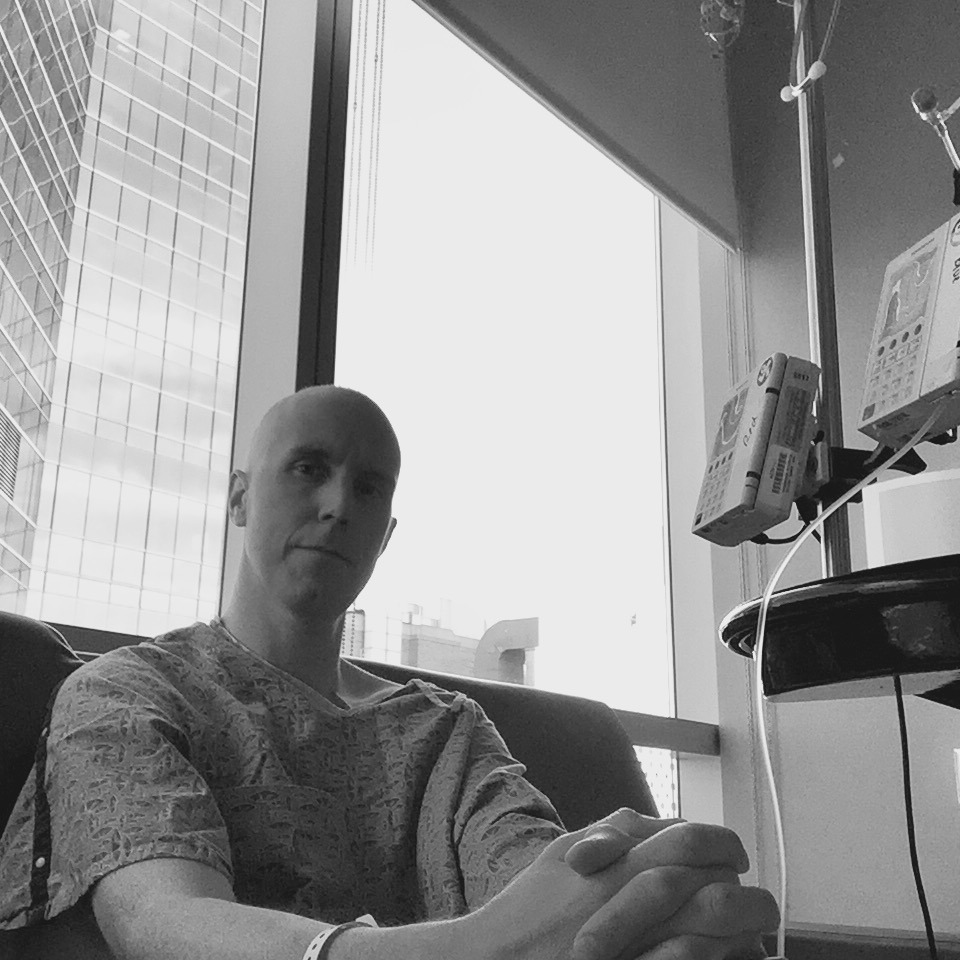
I checked into Mass General today for what will be 1 of 2 stem cell transplants.
This will be a long summer & the realization of what I’m in for struck me when I started unpacking and settling in.
 healing is a circular path