
i waited for you in the park.
when you arrived,
you held me,
and your cold nose pressed against my neck.
you nuzzled me,
and our skin quickly
adapted to one another;
mine cooled, or yours warmed
i’m not sure.
i was happy and
excited about what we might become.
the sun and an early spring day
marked the passage of time
and life moving forward.
these were early days—before
waiting became an annoyance,
before illness,
when i didn’t understand what
holding my breath truly meant.
the anticipation of test results slowed time,
and hours in the treatment chair
felt like lifetimes.
after my first seizure,
when the illness forced my world apart,
time shifted.
you found me
coming to the emergency room
to gather the pieces.
fresh from outdoors,
from the chill of an early
chicago spring day,
remembering this:
your cold nose
pressing into my neck,
i can still feel it as time slowed.
and why can’t these moments
be eternity?
when two bodies
seek a common temperature,
can’t this search last forever?
Tag: cancer diagnosis
The wind through an open door
At night, lying on my back, I stay awake and listen to the rattling of my lungs.
A wheeze, a strange resonating noise—like damp leaves—if mold had a sound, if abandoned rooms with winds spoke.
I insist I am okay.
I’ve always said, “I’m okay.”
From my youth, my father’s glare, to now, the groan of my lungs.
But I knew now I wasn’t; my body was revealing signs of sickness.
When had climbing a flight of stairs become a challenge?
Why was I losing weight?
Why did I wake up in the morning without the will to start the day?
The cravings of a young man—sexual longings, morning erections, and pleasuring myself in the stillness of the night—these were memories.
Someone my age shouldn’t be dealing with these issues, right?
I am a young man, strong and proud with rugged New England blood, generations of good health, and a life without doctors.
I kept telling myself, ‘Everything is okay.’
I kept repeating, “Everything will be okay.”
But it was never just an irritation in my throat.
The cough wasn’t just spring allergies.
“Hello,” I say.
“You are closer now.”
The wind through an open door has achieved form.
You have become a presence, a physical form I can’t ignore.
“Hello, Jeremiah.”
You’re in the hallway as a guest now, and you’ve even taken off your shoes.
How could I not welcome a guest?
A caller who had been inside, who had been within, was now at my door.
Cradling me as I sit on the shower floor, coughing blood into the drain.
Wrapping me in the steam of a scalding shower that never warms.
You are the fading winter, the arriving spring, and the buds on trees along West Thorndale.
You’re sitting next to me on the L.
Discourse
I had a recent and brief exchange with my uncle after a recent post about life, its potential pointlessness, and the struggle to find meaning.

(Chris)
Interesting ruminations! I think that Tolstoy’s outlook is pretty pessimistic. I believe that life has a purpose, but I don’t necessarily
believe that your illness has anything to do with it. Your purpose may be to help someone later in life, maybe to have kids, work with people experiencing poverty, invent, write, or draw something important. Maybe this three-year period is just a detour that has nothing to do with that. I don’t know!!!
much love,
(Jeremiah)
His outlook certainly was pessimistic… but I feel that was the impetus for his spiritual pursuits/awakening. He had to fall into that place of despair to arrive. I guess, the way I look at it, I was already en route to these things; in my last semester of grad school, I was going through interviews with the Peace Corps to work (with people with low incomes, perhaps) in Albania. I was writing … I was drawing. I think that a detour that goes on for three years is a bit excessive. It isn’t the physical journey but that of the mind, psyche, etc. As I have written, the toll that all this has taken is very significant. Yes, my oncologist can say, “You look great!”
But he doesn’t see the damage on the inside. Of course, his objective is to treat the patient, so externally, I look “great.” I don’t know where I am going with this. I do that this illness, and the longevity of it, MUST have something to do with it / with life. I have to think like this; otherwise, what’s the point? If all my struggling physically and psychologically was all for naught … I can’t go that route in thinking… I spiral out of control…
Chris
Naturally, everything we go through leads us to be who we are at any moment. So you are, and will be, a very different person than you would have been had you not gotten cancer. But that doesn’t mean (in my mind) that it is directly related to your purpose in life.
“The only absolute knowledge attainable by man is that life is meaningless.”
The irony of being diagnosed with advanced cancer on April Fools’ Day doesn’t escape me. Though I had been told I “might have” cancer several days prior, the diagnosis didn’t actually arrive until this day in 2016. The doctor at the walk-in clinic said that it might be cancerous, but I would need a biopsy to be sure. It wasn’t denial so much as prioritization; I had a thesis to write, a show to install, exams to finish, etc. I assumed a biopsy could wait. Several days later, I woke up in the back of an ambulance, completely disoriented and unaware of my own name. After multiple tests, surgery, etc., I was informed that, yes, it was, in fact, cancer. After such news, under such circumstances, priorities change; a thesis, exams, papers… these would have to wait. Obviously.
I replay this scenario again and again. All of it, not just the initial diagnosis… but every aspect of the last three years. It’s not so much rumination as it is an attempt to understand and make sense of it all. I am looking for something tangible, some meaning…
The truth is, there is none.
Tolstoy said, “The only absolute knowledge attainable by man is that life is meaningless.”
Initial consideration of this philosophical mindset might lead one into deep despair. However, I must agree wholeheartedly.
Tolstoy, however, did find meaning in his life. After publishing Anna Karenina, Tolstoy slipped into a great existential crisis and became increasingly paralyzed by the fear of death. This fear was all-consuming, but perhaps it was a catalyst, pushing him toward finding meaning. He pursued religion and spirituality with the same intensity and fiery passion with which he wrote. His beliefs leaned towards Christianity, but he found that the church, which in his eyes was a corrupt institution, was falsifying the teachings of Jesus. He was inspired by many saints, notably St. Francis of Assisi and others who forsook wealth and worldly goods to pursue a deeper kinship and connection with god.
I want there to be meaning within this, within my journey. I want to find meaning. Looking back over these three years, I am not in a good place tonight. Sitting here trying to pull a couple threads of sense out of the insane tapestry draped before me. That’s all I want; a couple of strands to grasp hold and say, “Look here, I found two reasons! Here are two reasons why!”
I suppose, like Tolstoy, I will have to find my own meaning within all this — to make meaning from it. Maybe one day, when time has softened all this, I’ll find those two strands of meaning and begin to weave my tapestry.
Medical Alert ID
One of my biggest fears now, and since my diagnosis, is having a seizure. Obviously, I don’t want to have one anywhere/anytime, but my fear is that of having a seizure in public.
The vulnerability I feel when in the post-seizure state (“postictal”) is horrific. I don’t know where I am, who I am, who the people are around me, etc. Once, after a particularly intense seizure, both my mother and sister were sitting on my bed. Luckily, I was in bed at the time, so I didn’t hurt myself after losing consciousness. I frightened my sister so much and undoubtedly saddened her as well because, for the longest time, I just stared at her, unable to recall who she was.
A lot of the trauma I am currently working through with the help of my psychologist is the initial seizure. Currently, I can feel a seizure coming on. There are indications I’ve learned to recognize, often referred to as auras; these help me to take precautions so as not to fall and injure myself. In Chicago, when the first seizure occurred, I had no idea what was happening. I simply hit the deck. When I awoke, I could feel a rocking sensation and the hum and vibration of what I had come to understand as an engine. This knowledge didn’t help, as I had no sense of identity.
The paramedics had rummaged through my belongings and found my ID. This helped them understand who I was, but when they said “Mr. Ray,” I was unsure who or what they were referring to. “Mr. Ray, have you been doing drugs?” They asked this question repeatedly. I struggled, as I often do when regaining consciousness, and since they had no idea if I was, in fact, on drugs, they had me strapped down to the ambulance stretcher. Later, when in the ER, I discovered the cuts on my wrists from having struggled so much while in transport to the hospital. Again, they asked, “Mr. Ray, have you been doing drugs today?” I began to cry. “Mr. Ray, do you know what year it is?” I mumbled something, but I was unsure of what year it was. When I began to come around and gain a greater sense of who I was and where I was, I told them I was a graduate student studying in Chicago. I am sure the latter was evident in Chicago, but this helped them understand more. Finally, one of the paramedics said, “Ok, Mr. Ray, we’re going to untie your arms, ok?” Sometime later, well after I was in The ER, one of the paramedics came to see me. I didn’t recognize him, obviously. “Hi. Mr. Ray,” he said. I am sure he had found out, after inquiring about my toxicology report, that the only drug in my system was caffeine.
I currently wear a medical ID. This simply states that I suffer from grand mal seizures. This isn’t enough for me; I want it obvious that my medical condition is such that I was a cancer patient, and one of the ongoing ailments, perhaps an ailment for the remainder of my life, is seizures.
… I purchased the credit card-sized ID badge and a lanyard. As I gain more emotional and psychological confidence and the much-needed physical stamina, I hope to continue my walking routine, an oft-daily event that I greatly miss, which helps me process much of the events that have occurred over the past few years. I want the ID to be so evident that, should I have a seizure when out and about, my medical condition will be event, glaringly so. I have faith in my fellow man/womxn that, in such an event, I will be comforted and cared for until I regain a sense of who I am…
The thought of waking without knowing who I am, or even what I am, haunts me. The fear of being strapped down during this postictal time is even more so. The vulnerability, as mentioned, is so great that this prevents me from my outings — any outings, be they a trip to a cafe, to take in a movie, etc. I don’t want this fear to become so great that I avoid leaving the house. Currently, I can see this is where my fear and the ever-growing feeling of vulnerability are leading me.
The aluminum, bright red ID card, which I’ll wear around my neck on the outside of my clothing, will hopefully let me inch out more and more and break this paralyzing fear encroaching upon my life.

A Return

I ventured to the woods the other day. These were the woods wherein my seizure occurred last March.
My mother waited in the car. I had to go alone. I needed the time to be there, process, and allow whatever might arrive.
The season had changed since my last visit. The snowmelt was no longer pooling here and there along the trail, and neither was the chilly bite in the air that remained for some time, even after spring’s arrival. The summer passed without a visit, and I was too frightened to be in the woods — particularly these woods. I was worried a panic attack might trigger a seizure.
When last there, the trees held tiny buds awaiting the perfect, though often invisible, moment to arrive. They had blossomed and were beginning to turn, on the verge of exploding with such vibrant colors as they do so beautifully here in autumn months in New England. Had it indeed been so many months since I was here?
I felt annoyed that the seasons had passed so quickly, but more so that fear had prevented me from returning here — to MY woods. The day was overcast, and I thought it might rain. I was alone with just my thoughts and memories.
After maybe a ½ mile, I rounded the bend in the path and came upon the place where my seizure occurred. Before this, when I walked in, I tried to stroll and be calm, though I could tell my heart rate was increasing steadily; a thin layer of sweat sprouted on my forehead even on this relatively cool day. I nearly turned around and headed back to the car, to the safety it represented, to my mother, and to the security she conveyed.
Ever-present change is more evident in the woods than most anywhere. This may be why I love the woods; perhaps this is why I am in love with the woods. In March, when I last visited them, they exposed themselves openly. The barely present buds left them almost entirely bare, letting the eyes easily pass through the thickets, thin conifers hoping to grow as tall as their brethren, and a few deciduous trees here and there that seemed out of place. Then, in March, just off the footpath, the untrodden snow still lingered, allowing the shadows of the trees to fall upon the ground, shifting with the daylight. These skeletal structures made them appear even more vulnerable. Soon, they will again return to this place of nakedness, letting their leaves blush and climax in such a way I oft wonder if one is worthy enough to witness it. The autumn rains, winds, or the process of the seasons will again reveal the depths into which one can peer… if one is so inclined.
I have not let the woods teach me anything. Instead, I let them teach me everything and then discarded this knowledge. I’m too damn stubborn to accept the reality and pure honesty of it; Nothing. Remains. Constant. Everything. Changes.
It took me several months to return to the woods, to MY woods. I almost forgot their ability to adjust so quickly to change and what message this might hold for me should I be a willing pupil ready to accept the wisdom I desperately seek. I held onto everything cancer had taken away from me; I roped in everything I could think of, from my first seizure in Chicago to the most recent setback, and said, “This is why I can’t return to you!” The woods seemed like the most logical entity I could blame; after all, who else could I point the finger at?
The woods graciously accepted my anger and sadness, my bitterness and tears. They held no hard feelings. When I walked into them and found the location of my seizure, a soft breeze moved through the branches, showing signs of the fast-approaching season. The gentle wind amongst the trees spoke softly, never demanding to know where I had been. Instead, as the wind tossed the branches, they said, “Welcome back, we’ve been waiting for you.”
I lit some sage, pulled the tendrils inward to my being, and then pushed them away to the woods, trying to cleanse something inside me.
Things change so quickly

I can’t help but look back. It is torture, I know… but I’m still trying to figure things out. If I keep repeatedly playing things in my mind, something will pop up, make sense, and be clear.
This photo (4/4/16) is after being discharged from the hospital. I had my orchiectomy, was diagnosed, had my apartment packed up, and was about to return home to New England for treatment. How did I manage all this? I didn’t notice until looking at the photo that I was still wearing the bracelet from the hospital.
Things change so quickly.
My eyes are so tired in this photo. I looked worn out and worried – naturally, I was. I wanted to smile for my girlfriend, it was her birthday. Considering life’s drastic change, I wanted to act as normal as possible.
I am not sure why I return to these images. Maybe it is the stark contrast between the two; a casual day at the nature museum was only a matter of days before my life fell apart.
What am I seeking here? What do I hope to find in the words written upon my face, within my tired eyes?
I notice my left hand is gripping her shoulder so tightly. Is it because I’m leaving? Is it to thank you for being there for me, coming to the emergency room, and staying with me there for days? Is it that I’m trying to hold on with all my strength because this is the last refuge, the last fragment of normalcy that I will have in a long time?
I will turn these questions (and many more) over and over in my mind. There has to be reason within them… they have to make sense.
Birthdays
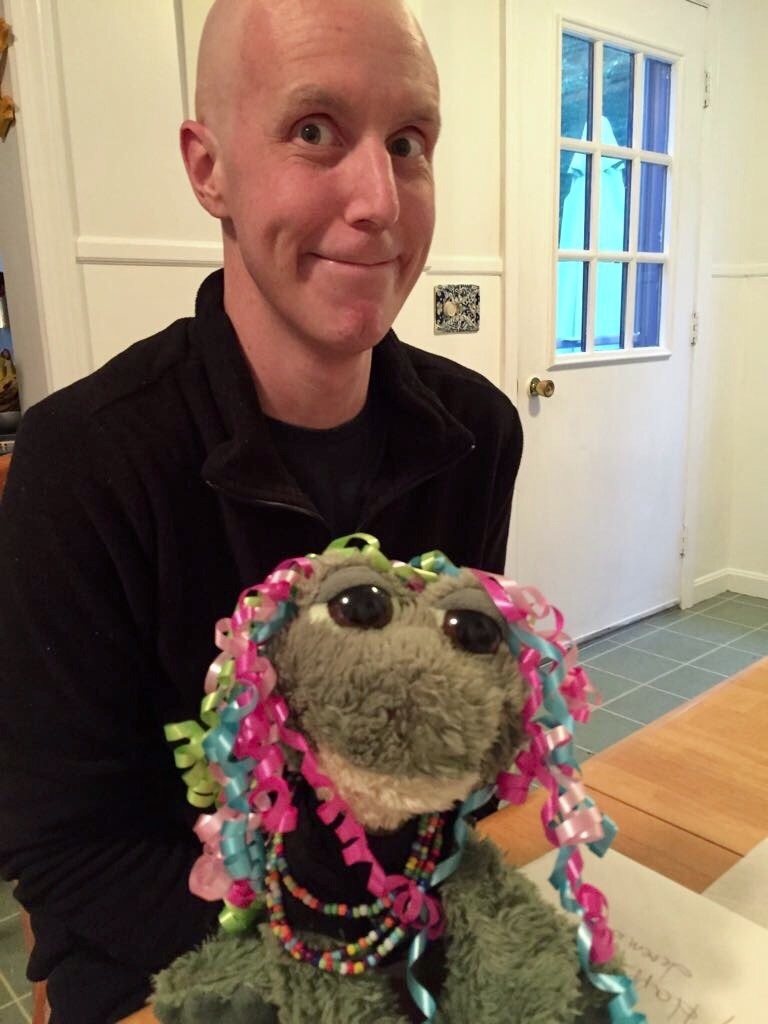
Birthdays are always an interesting point of reference to look back at time. They make a good starting place to look at a swath of years and note changes, growth, etc., to take one birthday, jump backward to the previous year, and look at the space in between.
On September 18, 2017, I turned 35 years old. Initially, I was not excited about the approaching birthday as the years from 33 ½ to 35 (from diagnosis to present) were lost for lack of a better term. This was my mentality leading up to the day — that that time was irreplaceable, gone, etc.
There are two ways to view this: as time being lost, with those years and months of being sick and in and out of treatment, or as something relative. I wasn’t even sure I would live to see my recent birthday. During the last round of high-dose chemo, when I was at the lowest point imaginable, I asked the night nurse if I was going to die. Feeling as I did, I was sure I wouldn’t live to see the following day, let alone my 35th birthday, which was only a matter of weeks away. Thus, the relativity of age, years, and time.
I awoke on my 35th birthday feeling more positive and ready — I had lived to see the day.
I’ve been trying to avoid dwelling on the past and revisiting the years before my diagnosis. However, I can’t help but remember significant moments, like birthdays, that were not overshadowed by poor health. Time now feels like it’s split into two distinct sections: before and after my diagnosis. But in reality, time doesn’t work that way; life is a mix of moments and events that all come together. Focusing on the present and fully embracing our current moments is essential. While there are events I wish I could erase from my memory, it’s impossible to pick and choose our experiences selectively. Who would we be without these moments, both good and bad? Who would we be without the nights we thought we wouldn’t survive and the mornings that surprised us by arriving?
High-dose chemotherapy with (tandem) stem cell transplants

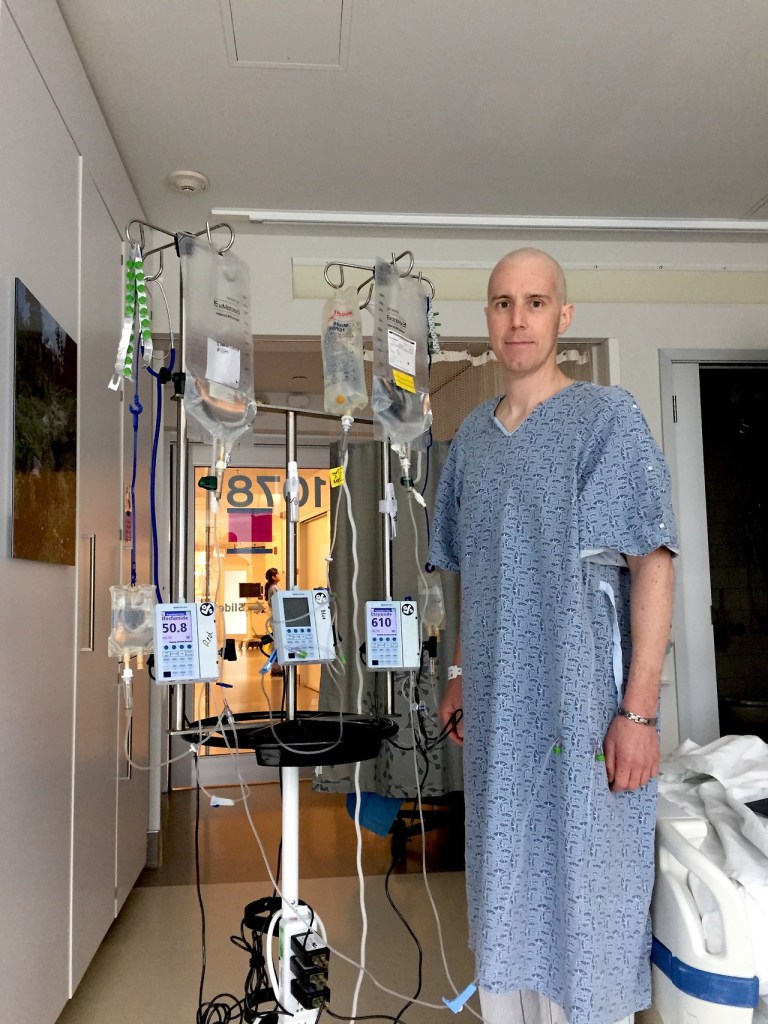
Where and how do I begin explaining high-dose chemotherapy with (tandem) stem cell transplants? I have been considering how I should go about describing the process. However, I wasn’t even sure I understood it correctly.
In my case, and this might be the same for other patients, I am not sure, but upon admittance, the clock starts at “day -5” (day negative 5). so “day 0” is when I return my stem cells. Days -5 — 0 are, as you might have guessed, chemo days. By this, I don’t mean normal outpatient days that, in my case, lasted several hours, depending on the regimen. No, I am talking about round-the-clock infusions, IV bags of chemotherapy drugs that run for 24 hours and then are switched out for new bags that run the same length for days and days. The intention, with such long days filled with heavy-duty chemo, is to destroy the current stem cells/marrow & annihilate the existing cancer and then replenish my system with untouched (by high dose chemo) stem cells from which my body will reconstruct itself literally from the ground up.
Along with the continuous stream of chemo, I have also been receiving liters upon liters of fluids. This is to prevent any damage to the liver, kidney & bladder. However, it is often uncomfortable, and, according to the nurse, I am currently retaining 8lbs/3.6kg of excess liquid. Needless to say, I feel uncomfortably bloated.
Between days -2 and 0, I will just be receiving mesna, a chemo protectant, and more fluids to continue to flush my filter organs.
2nd round
Tomorrow, August 4, 2017, I will return to Mass General Hospital for the second stem cell transplant. I am not ready; I want more time to rest and eat good (nonhospital) food to be “normal.” I don’t want to be inside for 2+ weeks, confined to a hospital floor, gazing longingly out of the windows, trying to imagine what the day feels like from a room that is kept at a constant temperature. In the back of my mind is the repetitive voice of reason explaining how this is needed and how “it’ll be over soon!” etc.
My beard is starting to grow again; it is darker and thicker in some areas and others, just thin indications of hair, translucent almost. Once more, I am surprised at how fast cellular regeneration occurs within the body and, as before, how willing it (the body) is to keep going and growing despite the near-constant bombardment of chemicals. I feel bad that, from tomorrow onward, my body will be fed these toxic chemicals and again will shed the newly grown hairs as the (chemo) agents destroy cells — both good and bad — all cells.
Again, the voice tells me it is for the best, this is about healing, “you’ll be well soon,”… etc.
When I was just a small child, I played in the woods near our house. For some reason, I consumed some berries growing wildly in the forest. As innocent as a child is, I just thought they were harmless and would taste yummy. When my mother heard it, she immediately called the doctor, who had the pharmacist deliver (yes, they delivered!) ipecac syrup. This is used to induce vomiting and administered if something potentially poisonous is ingested. Since my mother didn’t know what type of berries I had feasted upon, she assumed the worst. Naturally, she felt horrible when I vomited up what I could barely remember as a colorful, Pollock-like splatter of colorful berries (amongst other things recently consumed). I now feel the way my mother must have when she was trying to explain to me why I would feel poorly – and that it was for my safety – and that she was sorry – and that she loved me.
At night, or when first waking, I scan my body mentally from head to toe and envision myself embracing my own body as I explain why this must be endured – and that I’m sorry – and that I love it.
 healing is a circular path