The Suitcase

I like to start April by reflecting on the day I was first diagnosed, which I always remember—my cancerversary. It’s a significant date, especially since it lands on April Fool’s Day. This year is particularly meaningful; it’s been ten years since that moment. A whole decade has gone by. When I think about this period, I often ask myself, ‘Has it really been that long?’ Then, a small, ordinary event reminds me just how extensive ten years can be.

Recently, I was packing for a trip, and my family’s rolling suitcase was on the floor in my room. While packing, I suddenly remembered a suitcase nearly identical to the one on the floor, which had been in the same spot almost ten years ago.

In April 2016, I returned home for treatment, using a borrowed suitcase. I left Chicago abruptly, hurriedly shoving belongings into a dumpster outside my apartment. My goal was to vacate my room quickly, gather essential items, and go home to my family for treatment. After my orchiectomy, the doctors advised me not to lift heavy objects—though that was far from my mind. With just days to start chemotherapy, I focused on clearing out my room, discarding some items and leaving others outside for passersby. The only things I brought back to Maine were my friend’s rolling suitcase and a backpack I had traveled with many times before. In a few days, my life changed drastically—from living in Chicago to returning to Maine for an uncertain period – from a grad student to a cancer patient.

Once home, I chose not to fully unpack. I unzipped the front flap and propped it against the wall. I told myself that by doing this, staying in this state of not fully arriving, my cancer treatment would be swift and easy, allowing me to return to my life in Chicago. It felt like a hotel stay—being here but not completely. When I did laundry, I put the clothes back in the suitcase, and my toiletries remained there as well. Everything was packed away. I was neatly contained within it. My life, shattered though it was, was secured in this borrowed bag.
It wasn’t mine. That’s another reason I enjoyed seeing it sitting there, its lid open and leaning against my wall—visible when I woke up, went to bed, or left my room early in the morning for treatment and came back later in the afternoon, exhausted, drugged, nauseated, and broken. It belonged to my dear friend. To her, it was simply a container for holding items during moves or transit, moving between points A and B. For me, it always represented point A. I was holding myself there, never fully reaching point B, choosing not to arrive, staying in transit to avoid confronting illness and mortality.
Now, ten years later, as I prepared for a trip, I pause with a bundle of clothing in my arms and see the suitcase, its lid open and leaning against the wall, waiting—a receptacle, nothing more than a container for transporting things.

I have arrived fully here.

I returned the suitcase to her. On one trip, during one visit, I filled it with various things—not only personal items for my journey, but also things for her and her family, keepsakes from Maine, pieces that held me when I left. Gifts.

Still, I prefer my rucksack. I’d rather carry everything on my back, with stuff loaded from the bottom up, making it awkward and frustratingly bulky – perfectly cumbersome, delightfully minimal.

Pericles, an ancient Greek politician and general during Athens’ so-called “golden age,” remarked that “Time is the wisest counselor of all.”

What wisdom has a decade given me? Over 10 years, have I absorbed the kernels of understanding and the tiny trinkets of knowledge tucked away in the crevices and pockets of that suitcase I eventually unpacked? I am not sure.

Some nights, I wake and stare at the corner of my room where the suitcase sat in April 2016. It’s a strange feeling to be awake, staring into the darkness. In that foggy moment, before full awareness hits, I try to determine whether I’m back in 2016, looking out at the night, afraid I have unpacked and accepted the exhausting 8 hours a day, 5 days a week of cancer treatment, or whether I’m in 2026, searching for a bag that isn’t there, probing the darkness as if out of gratitude for being present, healed, and safe.

Consciousness arrives. There is no suitcase. I am neither coming nor going, and right now, that’s okay. Is this wisdom?

The wind through an open door

Discourse

I had a recent and brief exchange with my uncle after a recent post about life, its potential pointlessness, and the struggle to find meaning.

image

“The only absolute knowledge attainable by man is that life is meaningless.”

The irony of being diagnosed with advanced cancer on April Fools’ Day doesn’t escape me. Though I had been told I “might have” cancer several days prior, the diagnosis didn’t actually arrive until this day in 2016. The doctor at the walk-in clinic said that it might be cancerous, but I would need a biopsy to be sure. It wasn’t denial so much as prioritization; I had a thesis to write, a show to install, exams to finish, etc. I assumed a biopsy could wait. Several days later, I woke up in the back of an ambulance, completely disoriented and unaware of my own name. After multiple tests, surgery, etc., I was informed that, yes, it was, in fact, cancer. After such news, under such circumstances, priorities change; a thesis, exams, papers… these would have to wait. Obviously.

I replay this scenario again and again. All of it, not just the initial diagnosis… but every aspect of the last three years. It’s not so much rumination as it is an attempt to understand and make sense of it all. I am looking for something tangible, some meaning…

The truth is, there is none.

Tolstoy said, “The only absolute knowledge attainable by man is that life is meaningless.”

Initial consideration of this philosophical mindset might lead one into deep despair. However, I must agree wholeheartedly.

Tolstoy, however, did find meaning in his life. After publishing Anna Karenina, Tolstoy slipped into a great existential crisis and became increasingly paralyzed by the fear of death. This fear was all-consuming, but perhaps it was a catalyst, pushing him toward finding meaning. He pursued religion and spirituality with the same intensity and fiery passion with which he wrote. His beliefs leaned towards Christianity, but he found that the church, which in his eyes was a corrupt institution, was falsifying the teachings of Jesus. He was inspired by many saints, notably St. Francis of Assisi and others who forsook wealth and worldly goods to pursue a deeper kinship and connection with god.

I want there to be meaning within this, within my journey. I want to find meaning. Looking back over these three years, I am not in a good place tonight. Sitting here trying to pull a couple threads of sense out of the insane tapestry draped before me. That’s all I want; a couple of strands to grasp hold and say, “Look here, I found two reasons! Here are two reasons why!”

I suppose, like Tolstoy, I will have to find my own meaning within all this — to make meaning from it. Maybe one day, when time has softened all this, I’ll find those two strands of meaning and begin to weave my tapestry.

Medical Alert ID

A Return

black and white photo of the woods in the winter

Things change so quickly

I can’t help but look back. It is torture, I know… but I’m still trying to figure things out. If I keep repeatedly playing things in my mind, something will pop up, make sense, and be clear.

This photo (4/4/16) is after being discharged from the hospital. I had my orchiectomy, was diagnosed, had my apartment packed up, and was about to return home to New England for treatment. How did I manage all this? I didn’t notice until looking at the photo that I was still wearing the bracelet from the hospital.

Things change so quickly.

My eyes are so tired in this photo. I looked worn out and worried – naturally, I was. I wanted to smile for my girlfriend, it was her birthday. Considering life’s drastic change, I wanted to act as normal as possible.

I am not sure why I return to these images. Maybe it is the stark contrast between the two; a casual day at the nature museum was only a matter of days before my life fell apart.

What am I seeking here? What do I hope to find in the words written upon my face, within my tired eyes?

I notice my left hand is gripping her shoulder so tightly. Is it because I’m leaving? Is it to thank you for being there for me, coming to the emergency room, and staying with me there for days? Is it that I’m trying to hold on with all my strength because this is the last refuge, the last fragment of normalcy that I will have in a long time?

I will turn these questions (and many more) over and over in my mind. There has to be reason within them… they have to make sense.

Birthdays

High-dose chemotherapy with (tandem) stem cell transplants

Where and how do I begin explaining high-dose chemotherapy with (tandem) stem cell transplants? I have been considering how I should go about describing the process. However, I wasn’t even sure I understood it correctly.

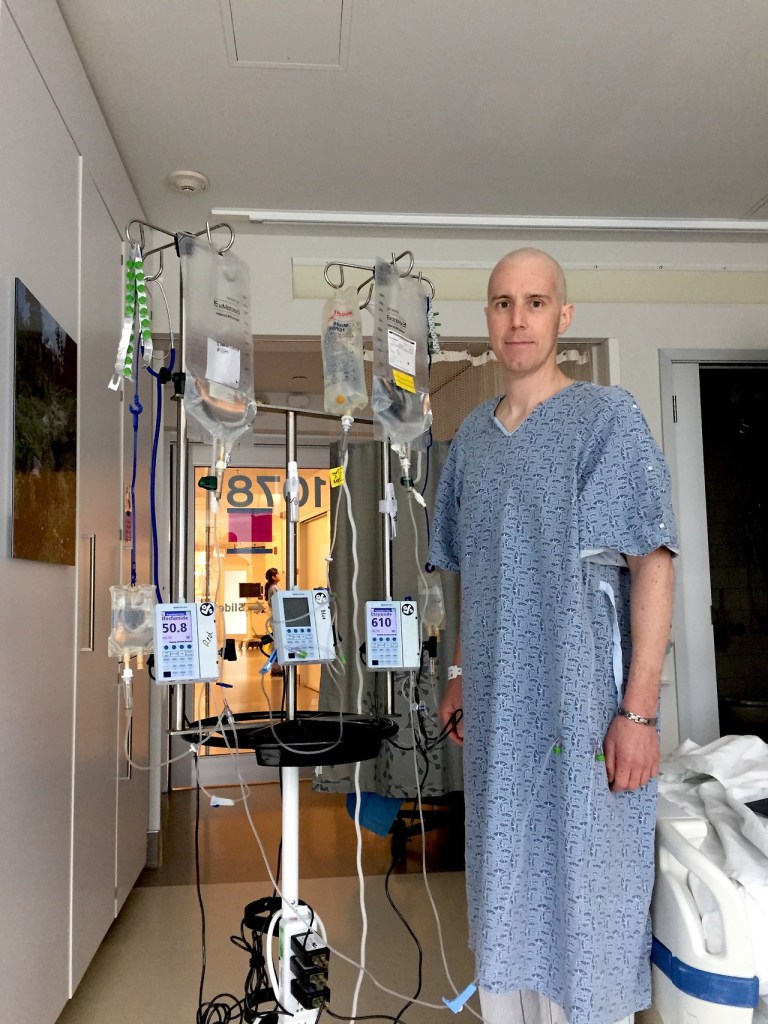
In my case, and this might be the same for other patients, I am not sure, but upon admittance, the clock starts at “day -5” (day negative 5). so “day 0” is when I return my stem cells. Days -5 — 0 are, as you might have guessed, chemo days. By this, I don’t mean normal outpatient days that, in my case, lasted several hours, depending on the regimen. No, I am talking about round-the-clock infusions, IV bags of chemotherapy drugs that run for 24 hours and then are switched out for new bags that run the same length for days and days. The intention, with such long days filled with heavy-duty chemo, is to destroy the current stem cells/marrow & annihilate the existing cancer and then replenish my system with untouched (by high dose chemo) stem cells from which my body will reconstruct itself literally from the ground up.

Along with the continuous stream of chemo, I have also been receiving liters upon liters of fluids. This is to prevent any damage to the liver, kidney & bladder. However, it is often uncomfortable, and, according to the nurse, I am currently retaining 8lbs/3.6kg of excess liquid. Needless to say, I feel uncomfortably bloated.

Between days -2 and 0, I will just be receiving mesna, a chemo protectant, and more fluids to continue to flush my filter organs.