
i waited for you in the park.
when you arrived,
you held me,
and your cold nose pressed against my neck.
you nuzzled me,
and our skin quickly
adapted to one another;
mine cooled, or yours warmed
i’m not sure.
i was happy and
excited about what we might become.
the sun and an early spring day
marked the passage of time
and life moving forward.
these were early days—before
waiting became an annoyance,
before illness,
when i didn’t understand what
holding my breath truly meant.
the anticipation of test results slowed time,
and hours in the treatment chair
felt like lifetimes.
after my first seizure,
when the illness forced my world apart,
time shifted.
you found me
coming to the emergency room
to gather the pieces.
fresh from outdoors,
from the chill of an early
chicago spring day,
remembering this:
your cold nose
pressing into my neck,
i can still feel it as time slowed.
and why can’t these moments
be eternity?
when two bodies
seek a common temperature,
can’t this search last forever?
Tag: cancer recovery
The wind through an open door
At night, lying on my back, I stay awake and listen to the rattling of my lungs.
A wheeze, a strange resonating noise—like damp leaves—if mold had a sound, if abandoned rooms with winds spoke.
I insist I am okay.
I’ve always said, “I’m okay.”
From my youth, my father’s glare, to now, the groan of my lungs.
But I knew now I wasn’t; my body was revealing signs of sickness.
When had climbing a flight of stairs become a challenge?
Why was I losing weight?
Why did I wake up in the morning without the will to start the day?
The cravings of a young man—sexual longings, morning erections, and pleasuring myself in the stillness of the night—these were memories.
Someone my age shouldn’t be dealing with these issues, right?
I am a young man, strong and proud with rugged New England blood, generations of good health, and a life without doctors.
I kept telling myself, ‘Everything is okay.’
I kept repeating, “Everything will be okay.”
But it was never just an irritation in my throat.
The cough wasn’t just spring allergies.
“Hello,” I say.
“You are closer now.”
The wind through an open door has achieved form.
You have become a presence, a physical form I can’t ignore.
“Hello, Jeremiah.”
You’re in the hallway as a guest now, and you’ve even taken off your shoes.
How could I not welcome a guest?
A caller who had been inside, who had been within, was now at my door.
Cradling me as I sit on the shower floor, coughing blood into the drain.
Wrapping me in the steam of a scalding shower that never warms.
You are the fading winter, the arriving spring, and the buds on trees along West Thorndale.
You’re sitting next to me on the L.
A Journey
This is a tapestry woven from the insanity and beauty of life. It represents a journey from hopelessness to hopefulness and the process required to move gracefully, albeit clumsily, from one to the other. While there may seem to be no meaning in my cancer diagnosis and the long recovery journey that follows, I am not entirely convinced of this. We find purpose in the absurdity of life’s events and define our mission through the time we are given and the choices we make along the way. I was diagnosed with advanced testicular cancer in April 2016, and I am currently on a path of recovery and healing—a journey of self-love and self-exploration.
Since my cancer diagnosis in 2016, I have been trying to write a memoir about my experience. However, I have found it challenging to make progress, whether because of the emotional triggers this project evokes or its overwhelming scope. Despite these challenges, I have managed to fill numerous journal pages of varying lengths, exploring topics such as illness, mortality, and personal growth.
These are my journal entries posted here in a blog-like format. They consist of rambling thoughts and reflections. I’ve realized that it’s not possible to start at a specific point, such as the date of my diagnosis, and simply move forward, hoping to understand everything. I had to explore a significant portion of my personal history, engaging in self-inquiry and analysis to truly understand the healing process. Healing itself doesn’t begin at one single point. It is a journey.
Although these posts have a sense of linearity, it might be hard to notice at first. Viewing each entry as an individual event, rather than part of a larger story, will provide more insight into my journey. As the story unfolds, it becomes increasingly clear how my life, physical and mental health, and spiritual growth have evolved.
Exist. Live.

Every year, on the 1st of April, I mention that this is the anniversary of my diagnosis. I talk about the irony of it, being that I was diagnosed on April Fool’s Day. (If you can’t see the incongruous nature of that situation, I’m not sure you’ll make it through life unscathed, my dear.) Today, however, I was thinking about other things, things beyond the absurdity of it all, which, to my pleasant surprise, brought about a giggle or two and not “what the fuck?” moments. You see, life is linear, in a roundabout way. Are you with me? I’ll try not to lose either of us, as I clarify.
We can wake up and go to bed and, in between, either exist or live. I was thinking about this as I stood on a small chunk of land poking out into the Bay of Biscay. Far out, somewhere, a storm was rolling and lurching – as they do. I arrived on foot, having walked from Santander. I knew a storm would come; storms always come; they’re linear – in a roundabout way. I didn’t consider the lightning storm. I was not expecting the hail nor the rapid drop in temperature after that. I thought that I had planned for things… We’re always looking, plotting, and considering ways to plan things. Yes, we’re always planning how to prepare. Things. Things. The linearity, the trajectory. Things. I wanted something to go accordingly. I wanted to exist, plan for hail, and prepare for post-graduate life. Things. Bring my gloves for the drop in temperature, and consider how to outline my resume to make a potential employer go, “He’s our guy!”
Existing. It’s existing.
To exist –
verb (used without object)
to have actual being; be:
The world exists, whether you like it or not.
This isn’t a survival story. Nope. I was freezing to death; I wasn’t lost in the depths of the wilderness. This is about sitting under a tree, stuffing my hands into my armpits to keep them warm while watching a storm pass over a gorgeous seascape. I was existing. I was waiting for linearity to run its course. Yep, I’m just sitting there and waiting it out. Linear. Point A – point B
Cancer and cancer survivorship is not linear. You can stuff your pack with all the shit you can think of, and something will come up, and what was once progression is kicked back to point A. It’s linearity in a roundabout way because it’s progression until it’s not. It’s growth until it’s not. It’s freedom until it’s not.
What truly breaks the cycle is opting to live and not simply exist, being and not endlessly planning to be, enjoying being rather than planning on it. I only realized this…today. However, I don’t know exactly. Sometime between waking up and knowing it was my diagnosis anniversary and accepting the fact that I was actually going to stuff my hands into my armpits because my gloves were sitting on the table at my Airbnb.
To live –
Verb (used without object), lived [livd], liv·ing.
To have life, as an organism; be alive; be capable of vital functions:
All things that live.
Life is Like Jazz
I was asked recently what I thought life “was.” A friend, who is also in a place of stability post-treatment and now trying to navigate the “new normal”, posed the question. It was vague, rather broad, but I knew what she meant.
At the moment, I was working on a lesson plan for a course I’m taking and had Miles Davis’s “Bitches Brew” playing in the background. My knee-jerk response was that life is like jazz.
Bitches Brew sounds as though it’s just about to fall apart, as if it’s always teetering on the edge but somehow manages to hold itself together. I have been listening to it for years and each time I keep expecting it to implode, to crumble inward upon itself in a cacophony of absolute mayhem.
I want it to.
A part of me wants it to. I want to pinpoint the exact moment and exclaim, “See, right there, I told you!” I want it to because then I would feel like I could do the same; I could crumble inward after pushing too hard for too long.
But I don’t, nor does “Bitches Brew”. We both walk that tightrope. Onward. Each and every time I listen, I am awestruck. Not so much by the virtuosic skills of Davis and his co-conspirators that sparked a whole new genre of jazz, but by the fact that it doesn’t fall apart and keeps moving along as if in an act of defiance.
Life is like jazz; have a set idea, a plan to follow, and improvise in any situation that might differ from what was expected or wanted. Life is like jazz, play with band mates who can follow your lead – OR you theirs. Life is like jazz, pay homage to the greats, but add your own ideas; build off of them, respect them and the paths they’ve laid, yet explore what might be jumping off points for your journey. Life is like jazz, play a wrong note and recognize there is no such thing as a wrong note, just an experience had. Life is like jazz, as Davis said, “Anybody can play. The note is only 20 percent. The attitude of the motherfucker who plays it is 80 percent.”
Dépression Nerveuse
Traveling does wonders for the mind and spirit. Each traveler has such a unique and individual experience; this is where the power of exploration lies.
It has always been a way for me to reflect. I can step back and observe my life from a different perspective. It has a meditative quality in that I, from that place of outside observer, can sit with choices made, actions taken, or even, more importantly, choices at hand. It may be because when traveling, I can just be. I can strip away the layers and titles and personas and simply be. In doing so, it is easier to stand back and look at one’s life, the past, and the present. Without the smothering layers of what one is, what & how one should be, etc., things become more straightforward.
My sweet and generous mother lumped my graduation, Christmas, and birthday gifts to allow me to travel a bit. She would say that my graduation gift would be a ticket somewhere- anywhere when all was said and done with my illness, and things stabilized enough. We both held onto the idea of future travel and that I would one day return to the carefree, vagabond lifestyle I once lived. Her gift allowed me to rekindle a sense of independence I was unsure I’d ever have again.
I felt so fortunate; this giddy, childlike joy rose in me. I have a thirst for traveling, and after three years of a life revolving almost entirely around medical appointments and clinics, my great thirst was finally quenched. Naturally, because of said health issues, panic, stress, anxiety, etc., were never too far behind. Mostly, these anxiety and stress issues revolve around my seizure activity. If a place is too busy or overwhelming, I become anxious and, in turn, stressed that the anxiety will trigger a seizure… It’s a bit of a downward spiral unless I catch it beforehand and keep calm. At times, the anxiety levels were rather acute, though certainly a small price to pay for the ability to travel once more.
However, there was also this other feeling, too. Something that had yet to present itself sent a different swell of fear and anxiety through my being. I felt a nervous tingling running alongside the feelings of glee and gratitude. It was an emotion thus far unfelt and one I could not label.
My favorite way to travel is walking. City walking is excellent, but I’m referring to setting out on foot and just… walking. Many of the paths I choose are well-worn footpaths that often pass through many small villages and cities that are well off the tourist itinerary. These, to me, are where the authentic culture lies.
During this trip, I set out from a small city in southern France along a footpath used by pilgrims walking to Santiago de Compostela in northwestern Spain. On other adventures, I have walked different parts of this same route; however, those were within Spain.
The term pilgrim might have been used once to denote a monk or other religious devotee trekking hundreds of grueling miles to reach a small shrine or holy site. The modern “”pilgrim,”” however, is trekking for several reasons and not solely those of spiritual devotion.
I initially went to Le Puy en Velay, a city in southern France, because I had heard about it in 2006 while traveling in Spain. A Frenchman told me, “You must go to my hometown, it is beautiful!” If anyone speaks highly of their hometown, I should visit. While there, I came across a symbol that has guided pilgrims for hundreds of years across various parts of Europe to a city in northwestern Spain. I used the same symbol, a scallop shell, that I followed instead during my many treks to the same destination. The saying “all roads lead to Rome” can easily be said about the numerous footpaths across Europe; all paths lead to Santiago de Compostela.
I believe in such events and other serendipitous occurrences in one’s life. So, with minimal hesitation, as usual with my travels, I packed my rucksack and started walking.
Walking is all about allowing the mind to enter that previously mentioned meditative state. The reflection, at least for me, begins with the rhythmic movement of the physical being. After this, the mind follows suit, and the pattern begins to move in a spiritual direction. It is also about passing through quaint little towns and cities, many of which still need to be jaded by the onslaught of tourists. This is really why I love it.
It is also very hard. I’m not talking about blisters and a sore back; I’m talking about the mental and emotional side effects that the simplicity of walking stirs up. In the past, this was precisely why I would walk. To me, it is a purge. After a long, challenging semester – walk! After a shitty breakup – walk!
However, this time, the difficulties were beyond those of a sore back, and blisters emerged. The darker emotions that ran alongside the glee and gratitude, that which had yet to present itself, the feelings that were thus unfelt … These are inescapable and were in my rucksack.
Somewhere, neither here nor there as these treks often go, those things crawled out of and stood before me, blocking the path, any forward movement, and hindering any advancement of mind and body. Literally, I was unable to take another step. I could feel everything within me shifting and pulsating like I had spent the last several miles ascending a peak. I wasn’t sure how to react or what to do. I began to think I had hit a wall. This would make sense, considering my deconditioned state from my years of relative inactivity. I removed the water bottle from my rucksack’s side holder and had a long drink. After that, I removed my hat to run fresh water over my head, thinking this might revive me and allow me to set out again. As I did so, my fingers ran over the scar, the wrinkled creases and little divots where my brain had been operated on. I paused, then I began howling and screaming, “”I had fucking brain surgery! I had fucking brain surgery!””
I cracked. I broke down. Right there, between somewhere and nowhere in southern France, I broke along an ancient footpath upon which I had spent the entire day briskly walking. I crumbled slightly and then came crashing down! That which hadn’t presented itself stepped forth, looming over me.
The weight of three years fell upon me; fear, pain, both emotional and physical, anger, and despair…
The weight of spitting into the sink and seeing blood.
The weight of the first seizure in Chicago and subsequent diagnosis.
The weight of my MFA studies was disrupted just weeks before graduation.
The weight of endless nights full of fears, of waking from nightmares, of waking up both enraged and saddened simultaneously,
The weight of looking at myself, at my reflection in the mirror, when I was bald and bloated, a gray form with sunken eyes stood there looking back. A figure trying to come to terms with life, trying to put the pieces together in hopes of making sense of everything.
The weight of my girlfriend at the time looking at me with loving and compassionate eyes, but also fear and longing for us to begin something that we had barely just started.
The weight of being told that the cancer had returned only six months after initial treatment, six months after my life was gaining stability.
The weight of postponing a course I was set to teach only days from the news of my recurrence.
The weight of a stroke and the brain surgery that followed.
The weight of an entire summer spent in a hospital room, cut off from the world, spending each day and night in a chemo-induced nightmare, praying I’d make it through two back-to-back transplants.
The weight of the seizures returned shortly after my transplant, rendering me a fear-filled recluse, scared of walking down the street without being full of Ativan.
Right then and there, I fell apart in every way imaginable.
I cried. I cried so hard and wailed so much that my throat hurt. I don’t know how long I cried. I heard myself screaming, but it didn’t sound like me; it was deep and guttural, animal-like and completely unnatural. I don’t know how long I have remained in this state. I was shaking, both from the fast-approaching night and also from the overwhelming emotional release from crying so much.
After that, I must’ve been in a state of delirium because things were hazy and did not add up; time seemed distorted. I’m sure many gaps will be filled with memories over the coming months. I remember an older French couple, Louise and Clément, who must have found me while trekking. I remember Louise was giving me tea and cookies, but I couldn’t hold either down, so I kept getting sick. We had reached one of the many hostels along the route. They had wrapped me in a blanket and dressed me in a thicker woolen shirt. Eventually, I was able to sip tea slowly. It began to warm me, but I couldn’t manage the cookies yet. I just kept hugging Louise and crying. She must have known I spoke sufficient French to maintain a dialogue and told me they had found me only a short distance from the hostel. I was kneeling on all fours, pack still on, in the middle of the path, crying and screaming. Her hand movements and gestures showed me that it was more than just crying.
The tea was warming my body, and my head became more apparent. Things started to make a bit more sense. I remember the invasion of emotions and thoughts and how it felt as if they were choking me; I remember physically gagging.
I remember having this desire to tear open my own body, to open up my chest cavity and remove something, to get it out– to pull out every last bit, piece by piece of it; I envisioned strands of hair-like substance. Though what it was exactly, I didn’t know.
Perhaps it was due to my crying, but it seemed I had reached a sort of hallucinatory state where strange and nightmarish events were happening. I felt like I was falling but never reached the ground; it was this continuous feeling of vertigo and the constant fear and uncertainty of when or if I would make contact with the ground. In another Hallucination, I could barely move my legs, but they were stuck, being held back by something. These hallucinations were broken up by my sobbing as if my crying was holding them back.
I was lost in a terrifying daydream,-state recalling all these events when Clément Sat down beside me and said, in English, “”We go now to the hospital.””
They put me in the backseat of a car, to whom it belonged I did not know, and then they covered me with blankets. I drifted in and out of sleep, only waking now and then to hear them speaking softly. The warmth of the blankets and the sound of French, which I always found soothing, pushed and pulled me from consciousness.
My sleep was tormented by nightmares; however, again, they were filled with strange hallucinations of being in a room where my thoughts were echoing, reverberating within the space. I was not speaking aloud, but I could hear my stream-of-consciousness- thoughts within the room.
Again, I had this desire to break open my chest and pull forth some substance. This was the strangest of all my hallucinations. I could feel my hands both upon my chest and moving within it. I don’t know what I was seeking or hoping to find therein; I just knew I was looking with a frantic desperation for something.
I deduced later that The Louise and Clément found me just outside Golinhac. So it would make sense for us to go to a hospital called Rodez. At the time, however, I didn’t know where I was.
They sat with me in the emergency department until I was admitted. I kept holding Louise’s hand. Now and then, she would give mine a gentle squeeze so I would know she was there.
Nurses drew several vials of blood, and the doctor ordered an MRI. Several doctors came in, shook all of our hands, and then proceeded to ask various questions. Louise held my hand throughout it all and gently squeezed it now and then.
The Psychiatrist introduced herself as formally as everyone else had. We spoke at length about all that had happened, the feelings and thoughts, my health history, life, and family dynamics – it seems the questions were endless.
At this point, I was close to tears and had already broken down several times during the conversation.
Evidently, I didn’t pose a threat to myself or others, so they allowed me to stay in the room I was in. After she left, I heard her speak with Louise and Clément Just outside the door. When they came in, they said they would be back in the morning and hoped I would be able to rest. Clément had family in Rodez, so they wouldn’t be far if I needed anything.
The following day, one of the doctors entered the room. He said the MRI was okay, which I knew as I had one recently in conjunction with my CT scan for routine cancer screening. The bloodwork was also regular. I knew this as well, but I also knew they were screening for illicit drugs. That didn’t surprise me, considering the state I was in upon arrival. Even though many things were becoming apparent, I wasn’t entirely sure what state I was in or how I acted when I arrived the night before. How was I acting? How did I look upon arrival — how did we look upon arrival? This older French couple brings a foreigner into the emergency room at night. A foreigner who was sobbing and describing surreal, nightmarish-like events. A bleary-eyed foreigner undoubtedly speaking a mixture of gibberish, French, and English… It only makes sense that they would order toxicology screening.
I drifted in and out of sleep. Louise and Clément arrived and looked tired; nonetheless, their eyes showed compassion.
Louise Brought in cups upon cups of tea. I don’t know if she really enjoyed tea or if she was still concerned that I needed to be warm.
The Psychiatrist arrived sometime later and, as formally as ever, as though she were just meeting us, said good morning and shook our hands. She asked how I felt and nodded understandingly when I mentioned how tired I was. She spoke at length about her theories regarding the night before and the state I was in upon arrival. Much of it was lost on me as my head was still fuzzy from the previous night’s events and the tiredness that seemed to intensify. She described it as a nervous breakdown, a dépression nerveuse. She studied me as though looking for an understanding of her words. I just nodded. I tend to do this; I just nod when the subject of my health, mental or physical, arises. She nodded as well, and this became the language we shared.
With that, she began asking logistical questions about my stay in France. When I told her I was leaving Geneva on October 23, she looked relieved but a little concerned. Then, she proceeded to ask several questions regarding my travel plans. It was evident her feelings were mixed both about my upcoming travels as well as the fragility of my mental health. She kept her gaze fixed upon me. I remember looking away several times only to look back to find her still staring at me with such intensity. This unnerved me. However, each time my eyes met hers, it seemed as if she was trying to understand something; it was a questioning look more than anything. There is so much haziness around my stay in the emergency department, but I am sure about the depth of her attention on me.
Louise and Clément lived in Lyon and invited me to stay with them until my departure. They were also comforted to hear I would be leaving from Geneva instead of Paris or some other airport requiring a lengthy journey.
Breaking her formal manner, the Psychiatrist placed her hand upon mine, resting in my lap, and said, “It is no wonder this has happened; I am surprised it is just occurring now.” Perhaps that is why she held her gaze upon me with such unwavering intensity; maybe she was trying to find any words that would help explain all of this to me.
Oddly enough, this seemingly simple comment made me feel better. It validated something inside of me. Though unclear, it began dragging things out into the light. Not everything, of course. Events and emotions will present themselves over time, but they will do so nonetheless. They will do so about this particular incident, the illness, and the life I have constructed around it. The wall had been breached, and this breakdown was the catalyst… it only took a horrific experience and the guidance of two strangers who bravely stood by, never once questioning my emotional or psychological state. Two guardians who seemed to understand the screaming, sobbing, and guttural language I was speaking. Two caretakers who continuously brought me an insane amount of tea!
Her comment let me touch down; the continuous fall, the constant vertigo, began to end. The multiple voices within the room – my own unspoken voices — began to speak clearly, presenting as one solitary voice with which I would one day learn to communicate. My legs, incapable of moving, those being held back, shifted slightly – ever so slightly – a barely perceivable amount. The unknown thing I desperately wanted to rip from my chest… this will take more time to understand and come to terms with. I’m okay with that. I’m patient, and I am certainly not going anywhere.
She was tagging them, defining them, placing a label on them.
When we label something, we are forced to recognize it. It is no longer something, but rather, in this particular context of the psychiatrist’spsychiatrist’s comment, a matter of permission. I am permitting this to happen. I am allowing this to take place. I am relinquishing control. I am letting go.
I’ve always perceived letting go as a weakness, the antithesis, of course, being a strength. I would stubbornly hold on; I would not be weak and fight to the bitter end to prove it!
My stubbornness led me to the emergency room in Rodez, France.
She could have quickly said, ”It is no wonder this is happening; I am surprised you’re permitting it to do so now.”
I want labels. I want to define things to recognize, grow, and heal from them. At least then, when I fight to whichever end comes for me, I’ll know what I was fighting for.
My return… How would I make the journey back to the States? Who would I turn to for help and comfort? Who would watch and allow me to open as Louise and Clément had? Now, just two days until my return flight was set to depart, with the recent events still very present and raw in my mind and soul, I felt frozen with fear. I felt alone. I felt alone in so many ways. In the presence of Louise and Clément, I felt safe and comforted knowing, not only that they were there with me at present to protect me but that they had seen me in the state in which they had found me just a few nights before.
I wrote to my older who, thanks to the gods, was also in Europe at the time. She had seen me in tears many times throughout my journey with illness; she had never seen me in my current state. Though the dépression nerveuse allowed the wall to be breached, I was presented with yet another wall. Advancement is happening, but the process is slow.
Within 12 hours, she was in Geneva. She had changed our tickets and arranged everything to ensure our journeys home would be the same. I would have needed help to make the trip. I held her hand the entire way, from Geneva to Heathrow and onward to Boston.
This is a form of letting go. This is relinquishing control. Another part of the wall, or perhaps a wall in and of itself, permits others to offer assistance. I am stubborn; as mentioned, it is hard for me to accept this. I have always relied on myself to manage various situations in life as I find others to fall short when called upon. Louise and Clément showed me that self-reliance isn’t always possible; sometimes, help must be accepted. They showed me that help and care come from a place of unconditional love, too.
Just as Louise held my hand throughout the dark night, gently squeezing it now and then so I would feel her presence, so too did my older sister when she guided me home.
There is sunlight on the wall
There is sunlight on the wall
The wall does not demand that the sunlight stays

I had this thought today. I was gathering my things and packing up my belongings before setting out to do a bit of hiking.
I glanced up at the wall to check the time, and before I commenced packing, I noticed this beautiful ray of sunlight, elongated, stretching from one point to another, almost crossing the entire length of the wall.
Hastily, I resumed packing, letting the moment of awareness slip by, as is their nature.
After what I thought was just a few minutes, I glanced again at the clock. I was once again blissfully ensnared within the moment when I noticed that the thin strip of light had shifted entirely and was just a fraction of what it once was; not only had it diminished, but it was almost entirely gone.
Such is life; fast-moving with little blips of delicious awareness.
Two years ago
Two years ago, I returned from Mass General Hospital (MGH). My second stem cell transplant had wrecked me; it was brutal. “You really trooped through these!” said my oncologist. Though proud to hear such words, I was out of my mind and ready to be home. I spent the last 3 months in a small, sterile, seal-off hospital room, removed from the world (save for nurses and doctors), removed from fresh air, from direct sunlight… I just wanted to go home!
Initially, I met my oncologist at MGH every week. He was keeping a very close eye on me. Then we met every 2 weeks, every month, every 3 months… I have returned to the care of my oncologist here, in Maine, we currently meet every 6 months.
During this time, I was having scans (CT of my chest, abdomen, and pelvis and an MRI of my brain) every three months. Naturally, having experienced a recurrence just 6 months after the original/initial treatment, every set of scans sends me into a downward spiral of fear, anxiety, anger, etc.
Even now, having bumped my scans out to every 6 months, I am still sent into a tailspin when the time draws near for scans/tests. It’s the same with each round; fear, anxiety, anger. This is common, at least I’m assuming it is, for every cancer patient.
Today, however, two years out from my stem cell transplant, I learned that my CT scans (chest, abdomen, pelvis) are still showing signs of stability!
The peace that has set in with this knowledge is immeasurable!
I feel so very blessed tonight.
such silliness
How must one be?
such silliness;
a leaf in a raging river
and on the surface
of a pond.
Lost
Over a decade ago, when life seemed easier in many ways, partly due to blissful naivety, I left Paris en route to Munich. There, I met with German buddies to make our way on another adventure around the British Isles. Though I had been there a few times prior, I hadn’t traveled by car, and I knew this would add a whole new dimension to our journey. The British Isles, namely Scotland, are my ancestors’ land(s). I was keen on getting off the beaten track, so to speak, and really explore.
The year prior, or perhaps two years prior, we met up in Zurich, where I studied then, and set out to explore Italy. Both journeys were full of spontaneity and, naturally, considering our ages, delicious German beers. Heavy drinking aside, each journey graced us with limitless possibilities. Cliche, perhaps, but we each grew throughout our adventures. Of course, this is only in hindsight, as always, and one looks back on such voyages with a sigh and a smile, retracing not only the steps that we took then but the steps that lead each of us to our current places here and now.
There were many laughs along the way, which weren’t due to the beer; in some two or three cases, it took up more space than our luggage. We encountered some caravan-dwelling folks in Calais who seemed to live in a clown car of sorts, as each time we turned around, there was another… and another… and another. Each one disembarked until their numbers were excellent, and we soon realized that their intentions were not as friendly as we had assumed… blessed naivety. When we needed, which was often, we slept on beaches when the weather was “nice,” an” hud” led under the car, an old Mercedes (which is probably still going vital to this day) when the weather took a fowl turn. One of their friends, studying at Oxford, invited us to stay in his dorm room, which made up for the nights sleeping under the car. We cooked white rice over a camp stove and added ketchup to flavor it… a delectable meal, even if the rice was crunchy. We crossed over the Irish Sea on a late-night ferry from Holyhead. The ferry seemed almost empty at this godforsaken hour, and we sprawled out in the passenger lounge on hard plastic seats to catch a little rest. Rest evaded me as the rocking of the ferry made me queasy.
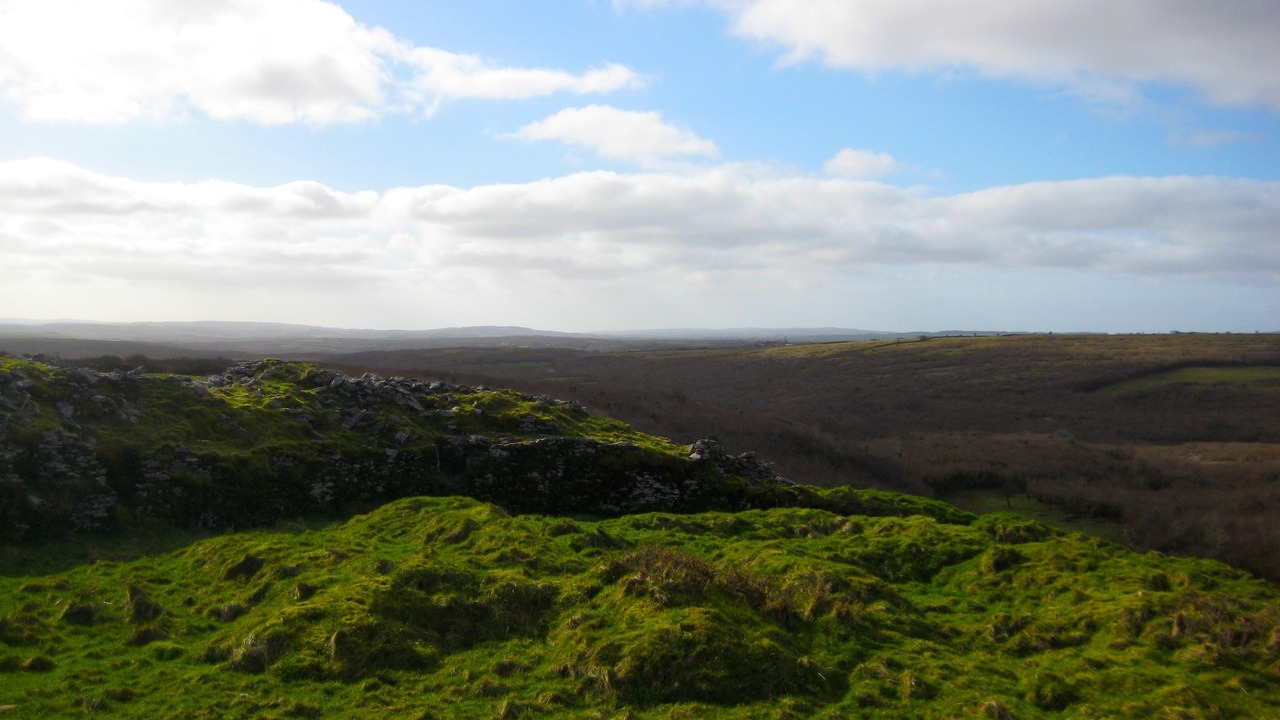
Somewhere well south of Dublin, we were driving along a double-lane highway which, seemingly instantaneously, turned into a sort of country lane just wide enough for two cars to pass. From there, it tapered off into a single lane, then a dirt road, and then a path that, I presume, was made for a tractor or other such piece of equipment. I am not sure if it ended together in pure Irish countryside or not… Had the roadmap been used more regularly, it would have consisted of major roadways, highways, etc. Still, this little dirt track wasn’t wasn’t make matters more interesting; our dual language road map was perfect for a German- or English-speaking traveler wishing to stay on the main autoroutes. Still, it was not helpful in our current situation. All the signs we could see, some just propped up on rock walls, others, which seemed to point in a random direction and undoubtedly acted more as weathervanes, swiveling this way and that even in the gentlest of breezes, were in Irish (Gaelic).
In the middle of seemingly nowhere, we came upon a small cottage. It was an idyllic, postcard-worthy scene. After a brief discussion, it was decided that, since English was my native tongue, I would speak with whoever was there — if anyone at all. After knocking on the door, I paused momentarily to admire the houses. I also wondered how one might live here in what seemed to be the middle of nowhere. When I was about to leave, the door opened, and an older woman greeted me. I can’t imagine how I looked, considering we had been sleeping under a car and consuming white rice with ketchup-washed-down beer for the better part of 2 weeks. But she didn’t seem to notice or care. I presume she had been watching from a window, studying the car with German plates and the three bedraggled boys.
“Good afternoon,” I said, “I’m sorry to bother you, but we’re lost.”
She smiled warmly.
It wasn’t until later that I began considering my comment and her potential interpretation. Here we were in what I called the “middle of nowhere”, but to”her it was home.
Lost
Past and past participle of loss.
Adjective: lost
Denoting something that has been taken away or cannot be recovered, e.g., a lost opportunity.
It isn’t that this opportunity is lost forever; it is simply that such tidbits of wisdom only arrive when one is ready to receive them. The opportunity will repeat itself in various ways and forms until the knowledge is seen and accepted.
This journey of illness and recovery is an opportunity, right? Occasionally, I get glimpses of this, and a blissful warmth runs over me. Then I slip backward and become bitter at seeing something that has caused so much pain and suffering as a chance to learn and grow. Couldn’t I have learned this differently?
I awoke to a text from a dear friend of mine. She has been a source of endless support, care, and love during these years of both illness and recovery. She spoke about the destination and used the analogy of building a stone path and how I’m looking far ahead to some distant point. In turn, the stones I’m laying down to build the path are being overlooked in my haste, in my desire to arrive at some terminus just out of my reach. The task is daunting, too. Building a path that stretches for miles and miles leaves me angry and thus depleted. I realized the stone path I had been laying could barely be considered a path. It’s a twisting and winding mess leading here and there, running wildly in every direction, chasing every possibility, seeking out any and every venue in hopes that one thing, that anything, will relieve me, nourish me, heal me…
I have been wondering about this notion of being lost, of being somewhere neither here nor there and struggling desperately to find the way — any way, for that matter. How might it be if, by chance, I stopped desperately trying to find a way? Or, rather, as it seems, I’m after one in particular. What if I stopped giving a damn about the stone path all together? What if I stopped giving a damn about direction? If I just sat here, then what? To me, the construction of a path is a sign of strength and courage, forging boldly ahead in the face of it all. Even if I see the path as rambling madness running off in every which way, I still view it as such. What if I ceased the exhausting construction of this path? What if I just let it be? What if I just was?
Osho, an Indian spiritual guru and philosopher, said, “Be — don’t try to become.” I have spent far too much becoming. Becoming healthy. Becoming happy after such turmoil. Becoming whole again. Becoming. Becoming. Becoming. All of these are so close, just out of reach — just there.
If I become this, then I’ll have that. What a very strange equation.
This is the opportunity, the tidbit of wisdom that has arrived. Perhaps it has come a few times, and I simply wasn’t ready to be open to receiving it.
The warm smile from the older lady in Ireland was reassuring and comforting. Now, after so many years and countless experiences, I wonder if she was smiling because she knew I wasn’t lost then and that, in actuality, there is no such thing as being lost at all.
 healing is a circular path