“Stress, trauma, and unexpected life developments — such as a cancer diagnosis, a car accident, or a layoff — can throw people off stride emotionally and mentally. Writing about thoughts and feelings that arise from a traumatic or stressful life experience — called expressive writing — may help some people cope with the emotional fallout of such events. But it’s not a cure-all, and it won’t work for everyone. Expressive writing appears to be more effective for people who are not also struggling with ongoing or severe mental health challenges, such as major depression or post-traumatic stress disorder.”
It sounds like I am beating a dead horse when I talk about “getting over” things. In many ways, and I do recognize this, I am. It isn’t that I’m obsessed with this idea, or beating myself up… it is simply that I am trying to come to terms, accept, move onward.
My fear is, and this too might be glaringly obvious, I worry about getting stuck there. Perhaps this is why I’m so keen on stepping forward and into the present.
I ruminate. I think and overthink and re-think… I try to work something out, see it from every angle and point of view. This has served me well and has helped in many ways. However, in regards to cancer and cancer treatment, I worry that it might be too great a focal point.
The above quote, published by Harvard Health, interests me. I fancy myself a wordsmith, even though my spelling and grammar are rather questionable (thank you neurotoxicity!). With writing, especially that which isn’t fiction, I grapple with subjects and, as with my other rumination skills, pick at it, dissect it, scrutinize it.
What I’m beginning to understand, and this quote really gets to the heart of it, is that my trauma from these many experiences had over the past two years, might be hindering me from working through something and thus letting it go. (Perhaps I am even overthinking this…)
“When the mandala is finally finished, however long it takes for the monks to deal in this divine geometry of the heavens, they pray over it — and then they destroy it. They sweep up every last grain of sand and give handfuls of it away to those who participate in the closing ceremony as a final memory of sublime possibility. Then, they throw the rest of the sand into the nearest living stream to be swept into the ocean to bless the world. And that’s it. It’s gone. In an instant, after all that artistry, all that work, it’s over.”
I am burned out.
I have spent the better part of today trying to sift through GoFundMe updates and re-constructing this blog based on them. Gofundme isn’t, as I’m sure many know, a blog, the updates don’t really work/flow like that. I was trying to cut and paste and get the dates in some sort of order so that it made sense – IE, it was chronological, concise, etc. For the most part, the cutting-and-pasting was fine, or at least relatively quick and easy. I would read just a few lines from each update, hunt for the photo contained with it, and then post it. This was like stepping on landmines. I became so triggered. It is a year out from my first transplant, but the memories are so fresh. Even if it were after a decade, I could easily feel this knee-jerk reaction and slip into this state of paralysis.
I don’t know why I keep pushing myself in such a way. I seek to escape to get over things. But I am in a labyrinth, walking around, disoriented, lost. Of course, healing is a maze, and one must work patiently to find the route. More so, which I know logically (philosophically?) but have difficulty accepting, is that one must embrace wherever he/she is – even if it is a confusing, endless maze.
I often think of a mandala. The metaphor is loosely connected to this, but it still stands. I think about these monks working endlessly on this beautiful sand “painting,” fastidiously laboring over it. The attention to detail is of utmost importance, but so is this sense of being present, of working in the moment. The work isn’t seen, or at least I believe it isn’t seen, as a whole. I believe the monks begin and work from breath to breath to breath. The skill they have acquired is so precise that they are masters at work. But the mastery comes with a patience that is only possible from moment to moment, from breath to breath.
Try as I might, I am not in this place. I look in the mirror, and though I see the present Jeremiah, who looks back with brightness in their eyes, I can’t help but see Jeremiah, whose eyes have a vacant and sickly look. These two (and many other forms) stand side-by-side, I can’t.
How do I let this person go? I know it isn’t possible in all aspects; this person has defined me in many ways. But like the mandala crafted by the patient monks who let it go, destroy it by the hand that labored over it, wash it away in a river… how do I let the pale and sickly Jeremiah go, embrace the Jeremiah that is now?
“Nothing ever goes away until it has taught us what we need to know.” Pema Chödrön
Today, I returned to the woods. It wasn’t the same woods where I had my last seizure in March, but nonetheless, it was a nice preserve with winding footpaths that overlook small islands just off the coast and nice, expansive views of water stretching outwards to the open ocean. My mother insists on how healthy this expanse can be for the mind. Often, I forget about the healing quality of this until I am standing on the rocky coastline looking out. It was then that I felt calm, and peace was over me.
It felt good to be back in the woods after weeks of fear of entering them. Whenever I would pass the woods where I had my seizure, I would cry. Depending on who was driving, I would ask them to take an alternative route so I didn’t have to see them. During initial treatment, I often walked in them after my long days in the clinic. If not, I spent nearly every “recovery” day before my next round within them. I found solace there, stillness. I found a sort of peace amidst all the madness and uncertainty of my life.
In March, when the seizure struck and I was in my sacred woods, it was a real blow to my emotional state and my overall well-being. It isn’t that I felt the woods betrayed me or triggered my seizure; it was the realization that there isn’t any escape, for lack of a better word. The woods may have been my refuge but I was naive to think nothing could happen or harm me there.
Ever since I was a boy, I’ve loved the woods. There have been only a few places I’ve lived over the years where I didn’t have access or time to access (the) woods. As a young boy, the woods didn’t necessarily mean a haven, as this concept was far beyond my comprehension then, but they did represent (and still do) a place of magic. Then, when I was younger, they were filled with endless adventures as vast as a young boy’s imagination. Now, as an adult, though still playful on many levels, the woods represent more of a holistic and nurturing environment. When I had the seizure in March, both the lingering playfulness and youthful innocence, as well as the “grownup” seeking to be nurtured and held by nature, were infringed upon.
It was healing to be there. I felt a reconnection and a sort of resurgence of my love for them and the safe feeling they kindle within me. It wasn’t necessarily the young boy who again was filled with innocent wonder that came alive. The grownup craved a sense of normalcy and a reconnection to the simple things in life that can save us from the harshness of it.
I decided to visit the school nurse and ask about the dry cough that had been lingering. There was a sort of clinic located on campus for students. I decided to make an appointment. At this time, the cough was starting to interfere with my daily life; in the morning, after doing my daily pushups, I had to hold my arms above my head to get a lung-full of air.
The nurse practitioner (NP) was a little confused. I was a-symptomatic, except for the cough. When they asked about my health history, I told them I hadn’t been sick a day. They prescribed an albuterol inhaler to see if this would help. It did, but only momentarily. I returned to the clinic, and the NP said I might want to visit a walk-in clinic near the school and see a doctor. So, I did. Again, I’m thinking this is merely a cough due to allergies, maybe I’ve developed asthma, etc. I was a “strapping young man,” and surely it couldn’t be anything more than that.
The Dr. at the clinic was also a little baffled. I had no signs of any illness at all; no fever, swollen glands, nausea/vomiting, etc., and again, no history of ill health. They decided to do an x-ray of my chest, which they could do right there at the clinic. After waiting a considerable amount of time, the Dr. again was a little confused by the x-ray results and wanted something with a more “in-depth” look at my lungs. I was told to schedule a CT scan. Again, I was in school full time, trying to keep up with a considerable course load, getting ready to install my thesis work, working a part-time job, etc. This all seemed like a nuisance. However, I assumed the Dr. would know best, so I scheduled an appointment for a CT scan.
I went to the appointment and was informed that I would have to pay well over a grand ($1,000) for the procedure. I was shocked, naturally. I had very little money, but my insurance deductible was so high that I was paying for the procedure out of pocket. Also, everything was well out of network… which I didn’t understand because I was a “strapping you man” and didn’t ever, ever even use insurance. I basically had it because students must have a plan or buy one from the school. The plan I purchased through the “affordable care” act was a bare-bones plan with a $6,500 deductible. But I bit the bullet and paid for the scan with my credit card,
I left the facility, and even though I just put a “pointless” procedure on my credit card, I was happy as the day was so beautiful. I thought I’d take my habitual long walk and soak in the sun. My cough, though persistent, never prevented me from my daily walk. I needed exercise, and still do, to maintain a clear head, and since my walks have become so routine, I find myself craving them.
The CT scan results would be sent to the ordering physician at the walk-in clinic.
A few days later, the clinic called me and said the Dr. wanted to see me regarding my results. Annoyed again, I left work early and headed to the clinic. I waited long, as it was a walk-in clinic for various ailments and people seeking medical attention. Finally, the Dr. saw me. They said the CT scan was a bit strange and showed my lungs were full of this sort of white, wispy stuff. They said they didn’t want to jump immediately to the idea of it being cancer, but they had a sneaking suspicion it was. They said it wasn’t primary lung cancer, as this would certainly be noticeable, but it could be cancer that had spread to the lungs. I was given a little time to myself in their office as this was “a lot to process.” However, I still assumed it was nothing — I was certain it wasn’t anything to worry about. I was, again, a “strapping young man,” and this was some sort of lung infection or … something else, but not cancer.
The Dr. returned and said I’d need to have a biopsy to determine what it was and, if it was, in fact, cancer, where it originated. They gave me a list of hospitals and local Drs. etc. Told me to contact my insurance about out of network possibilities, etc. Then, with a handshake and a wish for good luck, I was off.
It still didn’t phase me. Trust me, it wasn’t naïvety, I simply didn’t believe that it was cancer of any sorts. On top of that, there was NO way I could have a biopsy done. Though not a complex procedure, it would require time from school, work, etc. Also, now slightly grasping the insanity of the US insurance system, I would have to pay for all, or at least a great portion of the procedure, from my dwindling savings or, again, charge it. If it was an emergent situation (such as after the seizure and being rushed to the hospital). But this wasn’t emergent, not yet, at least. I couldn’t do that; I couldn’t take the time away from school or work. I was so close to graduating, so close to being done. I thought I could just finish up and fly back to New England, once there I could have the biopsy. Yes, that was my plan, and, to me at the time, it made perfect sense. I was only a matter of weeks away from completing my graduate degree and could be back home, back within the network of my insurance plan, and then could have this procedure done. Plus, I was a “strapping you man,” remember, and certainly wasn’t sick — not a single symptom, except for the dry cough.
But I was sick. In fact, I was worse than just sick; it was worse than a dry cough I couldn’t kick. I was told that, in a healthy, young person, cancer can spread far and wide inside the lungs. However, the brain has limited room… about 1.5-2 weeks after I was told I would need a biopsy to understand if this was cancer or not, I had the infamous seizure. The cancer, undoubtedly, was already spreading and had been doing so for months. At the time of my CT scan, there was unquestionably a growing lesion already in my brain.
April is testicular cancer awareness month. A list of symptoms/signs one can have might indicate having it. Be mindful of your body, perform self-examinations at least once a month, etc. — early detection is key. Even “strapping young men” are not invincible or immune.
I had another seizure yesterday. We’re attempting to get the medication right, and I stopped one and increased another. Yesterday, however, I wasn’t at the target dose. That’s the only logical explanation. Regardless, it has left me, as all my seizures have, physically and emotionally worn.
It happened while on a woods walk with my mother. Luckily, she was there. I had enough of a warning that I was able to indicate its arrival. She, in turn, sat me down safely… then it arrived.
I distinctly remember the cold earth underneath me when I started to come around. Though we were in a place along the path with no snow, the earth was cold and damp.
My mind was a jumbled mess, as it always is afterward, but somehow, we managed to walk back to the car. In a post-seizure state, at least for me, nothing adds up for a while.
Today, I realized what was going through my mind as I came to that damp earth: the memory of being a child of about 3 or 4. Evidently, I had asked my mother if, when the snow melted, I could play in the mud. So, I did just that. I sat in this puddle of mud, & plastered it upon my legs. The most vivid part of this is the cool dampness that soaked through the legs of my pants.
I have been told I have the memory of an elephant. Though, I think this was initially meant as an insult, as I tend not to forget things. It isn’t that I choose to remember the positive over the negative, or vice versa, I just remember things. During treatment, the traditional “chemo brain” affected certain cognitive functions, but my memory held strong. They became little islands I could swim to when the storm raged.
I believe in memories and their potent influence to transport someone.
Two years ago today I went to my dear Friend Jose and his partner’s house for dinner. I immediately felt this sense of warmth and comfort in their abode, feeling welcomed. They both exuded this; it came from them as individuals.
I love Chicago. I wish I had left on different terms and not for medical reasons, but such is life. I didn’t, however, enjoy the graduate program I was in there. I feel privileged to have studied there and received my MFA from such a school, but the program, or my home department, didn’t agree with me on many levels.
Jose was one year ahead of me in his studies there, and we became friends. He had a very older brotherly feel, and I felt comfortable sharing ideas and speaking openly about several things. This comfort, naturally, was part of the welcoming energy that greeted me for dinner that night. We sat casually in their kitchen, had delicious homemade vegetable stew, drank sparkling juice, and talked about life and art. I clearly remember walking up several flights of stairs to their condo entrance and, once at the top, wheezing and being winded. It was strange and disconcerting to be so breathless from just a few flights of stairs. The dry cough appeared a few times that night, too. A few weeks before our dinner meeting, Jose and I met at Starbucks and decided to take a little stroll after our tea and coffee. In mid/late March, Andersonville has such a nice feel — spring is just oozing out of everything and ready to pop overnight. The dry cough was present then, and I said I didn’t know what it was from, but I couldn’t get rid of it.
This nagging cough didn’t prevent us from having a lovely dinner a few weeks later. I hadn’t met Jose’s partner, now husband, but I enjoyed his honesty about art. It was a breath of fresh air to step away from the heady, overly conceptual art-school realm and just hear someone speak openly about what they thought and how they perceived the work. We talked about my thesis work, and I was excited to tell Jose how I did, eventually, decide to have this large painting I was working on split into two. I say “painting,” but it was a gestural study that consisted of ritualizing rubbing carbon dust onto linen. When we had last met I hadn’t decided if splitting it into two was the best move for it on a conceptual level. I finally opted to do so because the two, in my mind, divided time, past/present.
The division of time… I haven’t considered this phrase before for the various circumstances that would occur very soon. The following day, the most definitive division of time occurred in my life; I awoke and felt nourished by the delicious soup and conversation, happy that I had discussed my thesis work and received feedback. I was still full, literally and figuratively, from the evening. I felt positive that the end of this chapter in my life coming to a close — I was ready to move on from grad school. However, the cough was more present, and I began to feel worse as the morning went on. It was a bodily feeling, this heaviness, this burden that seemed to rest upon me. This pervasive feeling that something wasn’t right deep inside of me. Sluggishly I prepared myself for the day. Outside, the weather was glorious, and I stood for a few moments in the sun to soak it in. I envisioned the sun’s powerful rays penetrating my being and ousting whatever was causing the cough and the feeling that seemed to weigh on me. I felt even worse as I approached the red-line stop closest to my apartment. I thought it’d be best to return home and rest, to let my body be still for the day, put aside the demands of school and work, and just rest. I turned around and made it just a few paces before my body contorted in a way I had never experienced. This lack of control spread across my face and rendered me incapable of calling for help. It ran down my arm, bent my fingers inward, and took the strength from my legs, and I collapsed, then… darkness.
I hold onto memories as a means of self-preservation. I think, oftentimes, about how I would describe something in a book or how it would appear in a play, how I might see it and hear it from an outside perspective. By description and recall, there is a solidification, a movement from, perhaps, a fleeting moment in time and space to a solid foundation upon which something can grow and be constructed. How would I describe the kindness I felt entering Jose’s for dinner? How would I word the fear I felt when I had my first seizure? In remembering, in actively assisting in the solidification of memories, one can access the warmth during the cold and recreate the laughter during the flow of tears. One can nurture compassion and love for those struggling. Being sick has taught me this. I held onto memories before, well before my original diagnosis, without any real understanding as to why. Like the matriarch of the herd of elephants who leads the other members miles and miles to a certain watering hole during times of drought, memories can save us; they can nourish us.
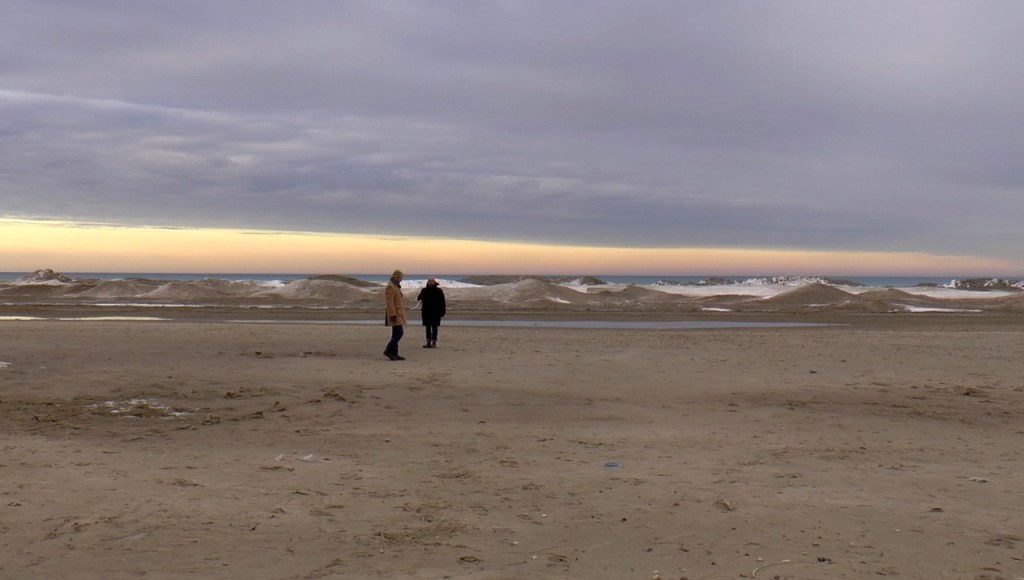
The photo attached is a still from a performance video Jose and I collaborated on. I’ll refrain from drowning you all in the ‘heady, overly conceptual art school” BS I am happy to have left behind. The basic premise; two beings tethered by a length of rope, each takes a turn walking while the other remains the grounding center, a place of pivot. One can walk as little or as much as they wish. The other merely witnesses and rotates with them. It, for me, was about an exchange of guidance and care… it was about trust.
I went to the treatment clinic today for my 6-month post-transplant immunizations. The stem cell transplants wipe the slate clean, literally, and I have to re-immunize myself. The schedule for immunizations is 6 months out, 12 months, and then 18 months out.
Going back to the clinic is so hard, even for something as quick, easy, and relatively painless as 4 injections. So many memories are contained in that building; every emotional and psychological up and down along the seemingly endless journey to getting better is linked to this place. Better, as if ‘better’ was some destination and I knew the general direction but had no map or even a sense of distance to gauge anything… or everything.
My salvage treatment, the chemo that was administered after the recurrence was noted and before the transplants, took place around this time last year. Today, when I entered the actual treatment room, the lighting was very similar; the way it poured through the windows on the eastern side of the building, bouncing off the individual treatment chairs all lined up along the wall… it was almost identical. I could feel my stomach turning with the memories that were percolating.
Time doesn’t seem to change inside the clinic itself. While waiting for my oncologist’s approval of my immunizations, I fumbled with some paperwork, but I was really observing, watching slyly life move around me. All the chairs lined up along the walls were full; each one held a patient. They added more chairs since my last visit. They even expanded the parking lot. If this was a restaurant, one might say, “Business is good”… in this case, the additional seating and parking just seem kinda sad. Some patients had visitors or family members. Some slept. Others stared at their phones, seeking a connection to the world that was, after all, a few paces away, but, as I recall, this proximity seemed like lightyears.
A barely audible playlist was turning out one feel-good oldie after another. The Beatles told me that the sun was almost here and had been an awful, lonely winter. The Beach Boys, singing in their beautiful harmonies, waxed poetic about how it’d be so nice to be older, and then they wouldn’t have to wait so long. Yes, that’s the type of world, so they told me, that they belonged in.
The nurses bless them all, check in on meds, and inform the patients about what they’re getting. They make small talk and tell jokes to keep things seem normal. I keep hearing them remind each patient that today’s the first day of spring.
There was a younger patient there, maybe a little younger than me. The majority of patients were older, so the younger one stood out. I bet I looked like they did; out of place, antsy, already keen on leaving but knowing the long treatment day and week are just beginning. They flipped through a worn-out, well-thumbed magazine, but I could tell, both by their empty gaze at the pages and being in that very same place myself, that their actions were just an empty gesture, a distraction, escapism.
Time may feel constant, or even stagnant, inside the clinic, but it is moving forward. I didn’t recognize anyone except for the nurses, and though I don’t know, I like to think that they, too, are resuming something that resembles a life. I like to think that they finally arrived at ‘better,’ even if, like my journey, they had to stop, ask for directions, change a flat tire, take a few detours, get lost again… Even if, like my journey, they are still en route, they can at least see the city lights on the horizon.
Birthdays are always an interesting point of reference to look back at time. They make a good starting place to look at a swath of years and note changes, growth, etc., to take one birthday, jump backward to the previous year, and look at the space in between.
On September 18, 2017, I turned 35 years old. Initially, I was not excited about the approaching birthday as the years from 33 ½ to 35 (from diagnosis to present) were lost for lack of a better term. This was my mentality leading up to the day — that that time was irreplaceable, gone, etc.
There are two ways to view this: as time being lost, with those years and months of being sick and in and out of treatment, or as something relative. I wasn’t even sure I would live to see my recent birthday. During the last round of high-dose chemo, when I was at the lowest point imaginable, I asked the night nurse if I was going to die. Feeling as I did, I was sure I wouldn’t live to see the following day, let alone my 35th birthday, which was only a matter of weeks away. Thus, the relativity of age, years, and time.
I awoke on my 35th birthday feeling more positive and ready — I had lived to see the day.
I’ve been trying to avoid dwelling on the past and revisiting the years before my diagnosis. However, I can’t help but remember significant moments, like birthdays, that were not overshadowed by poor health. Time now feels like it’s split into two distinct sections: before and after my diagnosis. But in reality, time doesn’t work that way; life is a mix of moments and events that all come together. Focusing on the present and fully embracing our current moments is essential. While there are events I wish I could erase from my memory, it’s impossible to pick and choose our experiences selectively. Who would we be without these moments, both good and bad? Who would we be without the nights we thought we wouldn’t survive and the mornings that surprised us by arriving?
Where and how do I begin explaining high-dose chemotherapy with (tandem) stem cell transplants? I have been considering how I should go about describing the process. However, I wasn’t even sure I understood it correctly.
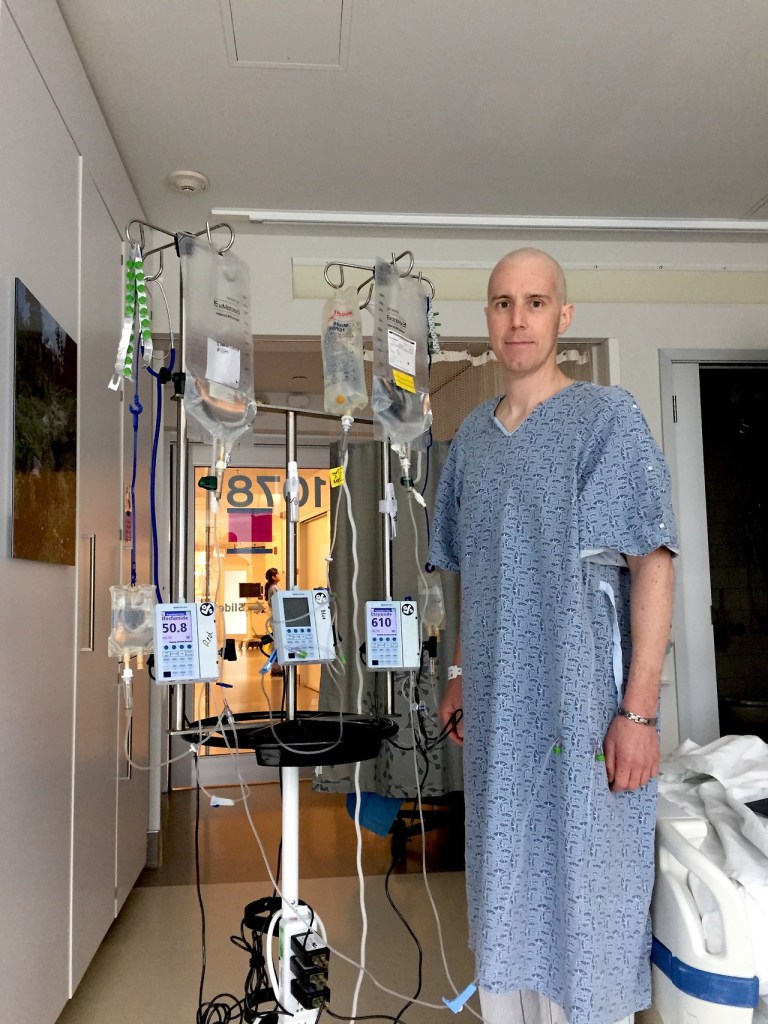
In my case, and this might be the same for other patients, I am not sure, but upon admittance, the clock starts at “day -5” (day negative 5). so “day 0” is when I return my stem cells. Days -5 — 0 are, as you might have guessed, chemo days. By this, I don’t mean normal outpatient days that, in my case, lasted several hours, depending on the regimen. No, I am talking about round-the-clock infusions, IV bags of chemotherapy drugs that run for 24 hours and then are switched out for new bags that run the same length for days and days. The intention, with such long days filled with heavy-duty chemo, is to destroy the current stem cells/marrow & annihilate the existing cancer and then replenish my system with untouched (by high dose chemo) stem cells from which my body will reconstruct itself literally from the ground up.
Along with the continuous stream of chemo, I have also been receiving liters upon liters of fluids. This is to prevent any damage to the liver, kidney & bladder. However, it is often uncomfortable, and, according to the nurse, I am currently retaining 8lbs/3.6kg of excess liquid. Needless to say, I feel uncomfortably bloated.
Between days -2 and 0, I will just be receiving mesna, a chemo protectant, and more fluids to continue to flush my filter organs.
Tomorrow, August 4, 2017, I will return to Mass General Hospital for the second stem cell transplant. I am not ready; I want more time to rest and eat good (nonhospital) food to be “normal.” I don’t want to be inside for 2+ weeks, confined to a hospital floor, gazing longingly out of the windows, trying to imagine what the day feels like from a room that is kept at a constant temperature. In the back of my mind is the repetitive voice of reason explaining how this is needed and how “it’ll be over soon!” etc.
My beard is starting to grow again; it is darker and thicker in some areas and others, just thin indications of hair, translucent almost. Once more, I am surprised at how fast cellular regeneration occurs within the body and, as before, how willing it (the body) is to keep going and growing despite the near-constant bombardment of chemicals. I feel bad that, from tomorrow onward, my body will be fed these toxic chemicals and again will shed the newly grown hairs as the (chemo) agents destroy cells — both good and bad — all cells.
Again, the voice tells me it is for the best, this is about healing, “you’ll be well soon,”… etc.
When I was just a small child, I played in the woods near our house. For some reason, I consumed some berries growing wildly in the forest. As innocent as a child is, I just thought they were harmless and would taste yummy. When my mother heard it, she immediately called the doctor, who had the pharmacist deliver (yes, they delivered!) ipecac syrup. This is used to induce vomiting and administered if something potentially poisonous is ingested. Since my mother didn’t know what type of berries I had feasted upon, she assumed the worst. Naturally, she felt horrible when I vomited up what I could barely remember as a colorful, Pollock-like splatter of colorful berries (amongst other things recently consumed). I now feel the way my mother must have when she was trying to explain to me why I would feel poorly – and that it was for my safety – and that she was sorry – and that she loved me.
At night, or when first waking, I scan my body mentally from head to toe and envision myself embracing my own body as I explain why this must be endured – and that I’m sorry – and that I love it.




 healing is a circular path