
For years, I didn’t like my body. For the majority of my life, there was this sense of guilt or shame about how I looked and felt. As a result or product of, I am not sure, there was an internal struggle, a sort of emotional and spiritual dissonance within that which I can only refer to as the soul.
The body and soul were awkward, each attempting to adjust to one another, the physical and metaphysical working their way into a partnership of sorts. In one’s formative years, this is a time of great physical and emotional/spiritual strife. From my childhood until recently, this lingering sensation of turmoil always seemed to be.
Much of this stems from the labels and ideas thrust upon us by the society and culture into which we are born. It is hard to adjust and figure out our way through the swamp of ideals and morals, beliefs and philosophies that aren’t necessarily our own – in fact, they seldom are, as we soon discover, they are simply handed down piece by piece. In such a way, they become like the game a telephone might play as a child. One person starts a phrase, and it is passed around or down a line. The end product is usually some bastardized version of the initial statement. The awkwardness of soul and body, this feeling of discontent, eventually brings us to the point of either acceptance of the societal and cultural default settings or forces us to step out in hopes of discovering that to which we are drawn by some force and/or inner seeking. Both take courage, neither one can be deemed good or bad, right or wrong etc.
Amid treatment, during the first rounds immediately following my diagnosis, I stepped out of the shower one morning and stood before the mirror fixed to the opposite wall. There, in front of me, was my naked body. My hair had long since fallen out on my head and my entire physical being. I looked like some prepubescent boy with the face of a middle-aged man – a face exponentially haggard by exhaustion, stress, anxiety, etc. My eyes were sunken, tired, and sad. They, my eyes, have always held every bit of my worry, fear, joy, passion, etc. I looked at myself; I stared at the body before me. I stood still and let the feelings and sensations (some of which I haven’t found a suitable word for) pulsate from my core.
It was the first time in my entire that I felt a sort of love, admiration, and acceptance for myself – for both my body and There was an incredible level of sadness and anger, and there still is – of course. Only a fool will tell you that love ousts hate or that bravery trumps cowardice. One cannot exist without the other, and their equality and power are matched 1:1. Ultimately, about all personal decisions.
I stood there. My fingers traced various lines and ran over my bloated body, puffy from steroids and other drugs administered during active treatment.
The orchiectomy incision looked back at me. I hadn’t looked at it since the operation and commencement of treatment. There was a part of me that didn’t want to look at it, to admit that it existed, or to deny the fact the surgery had taken place.
Afterward, I let my fingers wander over my body, from the top of my bald head to the sunken sockets holding my eyes, over my flabby belly, and along the scar that marks the right side of my groin. I let my arms fall to my sides. I remember distinctly looking at myself – really looking at myself. I never wanted to. The body, my body, was just something. Embarrassed as I am to say this, I viewed it as some form that I had been plagued by.
Beyond the fleshy, bloated being is where my gaze eventually fell, where it entered. How could it not? That is where all the lines I traced on my body were leading. As with the physical body, I didn’t think I was ready to honestly look or hold myself in that manner. But given the circumstances, the nand tire situation I was in, how could I not?
I have always been curious about the soul. The notion of it as a thing, for lack of a better word, fascinates me. I see it as something continuous, an ongoing form of energy, something that doesn’t end when the physical body holding it passes. The idea of the soul as something “eternal” stems from my catholic upbringing. As with my physical body and the shame and embarrassment I felt towards/about it, I felt something similar towards my soul. My physical body might lead to sin – to enjoyment and lust. My soul was a mere breath or thought away from damnation. Damned might I be should I enjoy my own flesh, my body – the sacred house of my soul! Damned might I be should I steer my soul on a course of my own choosing to embrace the free will I was taught so much about.
It took me nearly 3 decades to look at myself and appreciate the strength of my body and soul. It took almost 3 decades to look at myself, to behold myself, body and soul, and to give thanks.
Despite the anger and bitterness, and sadness, gratitude exists. Though I might struggle daily with my mental and emotional well-being, I’d be genuinely damned without appreciation.
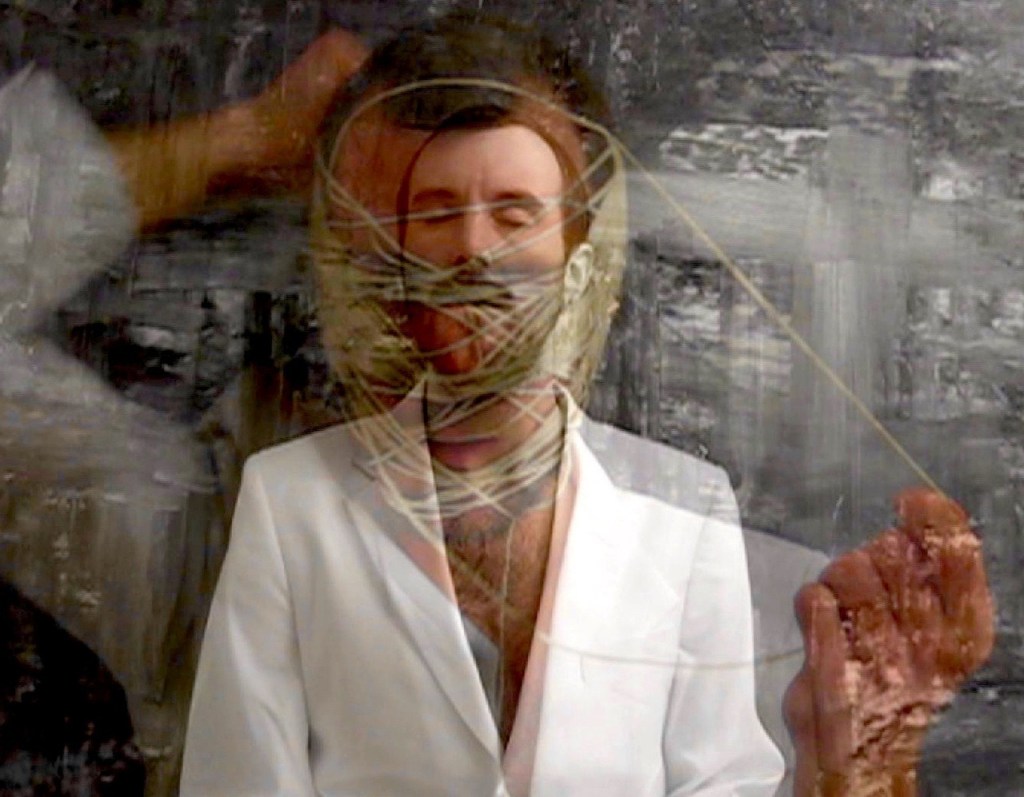
The photo is a still from a performance video I made in 2012. Through my visual art I was always trying to articulate my feelings and beliefs about the physical and metaphysical. Through art I sought to examine this relationship and express that visually which alluded me in every other form of expression and means of communicating. In this video we have two beings; one that remains still, eyes closed. The other worked furiously to wrap and eventually unwrap their head with string. The being with their eyes closed is actually the one seeing, the one that is fully aware of what is going on internally and externally. The other being, the one wrapping their head with the string, is the being trying to figure out their place within everything, to literally untangle the mess and confusion in which they find themselves.

 healing is a circular path