
Between September 2015 and December 2015, I worked as a volunteer fieldhand on Samsø, a small Danish island off the Jutland Peninsula. The island was flat and windswept and, due to the waning tourist season, becoming quieter and quieter. The sun set earlier each day; the island was turning in for the winter. In other words, it was an ideal place for an artist seeking solitude and a reprieve from the hecticness of the city from which I had just left.
On the morning before I left to catch the ferry back to the mainland, which would, in turn, take me back to Copenhagen and onward to Chicago, where I would spend my last semester of grad school, I walked out into a barren field and filled a glass jar with dirt. Though I had only spent three months there, the land had become very important to me, nurturing and fulfilling in a way that so few things had been.
I turned from the field, took the ferry back to the mainland, took the train back to Copenhagen, and took various flights back to the US before commencing what was supposed to be my final semester before completing my MFA.
The jar of dirt came with me.
I left Samsø in mid-December 2015 and was diagnosed in early April 2016.
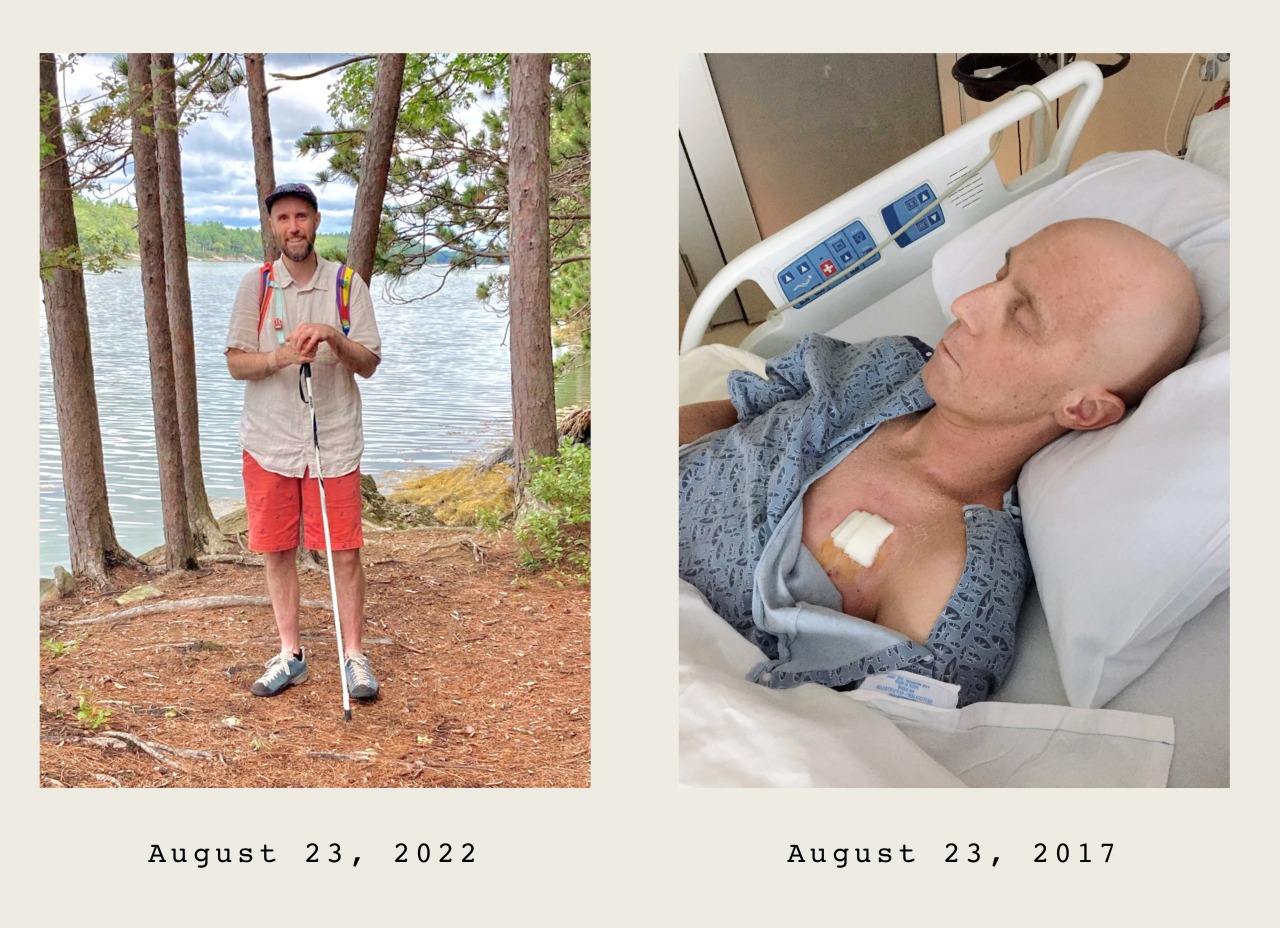
From there, my health story winds through various surreal, horrifying, and alarming circumstances, culminating in two stem cell transplants, the 2nd of which ended in late August 2017. As such, I am fast approaching the 5-year mark of being in remission and cancer-free. Having experienced a recurrence six months AFTER my initial treatment, this is a remarkable milestone.
Five years.
I can’t wrap my mind around it. I can’t process it.
It is shocking to consider all that has come to pass since August 2017. It is beautiful to witness one’s strength and humbling and frightening to be continually reminded of one’s fragility.
But it all doesn’t add up to five years.
I measure time by the jar of dirt in my closet, the container that survived my rapid exodus from Chicago when I scrambled to return home to Maine for treatment. Dazed by the news of my diagnosis, the surgery, the multi-day stay in the hospital, and the concoction of medication in my system, I still made sure to grab the jar of soil off the shelf in my room. So while other things, such as clothing, books, etc., found their way to the dumpster behind my apartment, the jar of earth stayed close at hand.
This is time.
On Samsø, I stopped carrying a phone. Time lost a feeling of importance and urgency. Towards the end of my work-stay, we’d start work when it was barely light and end when dusk was well upon us. I started learning how much can be understood by the land and how the light fell on it. I realized that I was beginning to comprehend the seasonal shifts of the earth, just as I knew the passing of the day by the soil and how my hands and body felt with it.
This is time.
I observe the passage of time by the jar of dirt I keep in my closet. Sometimes I open the lid and inhale the dwindling scent that carries the history of seasons and crops with it. Now and then, I pour a small amount onto my palm and consider how lucky I am to have known time in two drastically different formats; the abstract form that tells the seasons to shift and the crops to grow and the concrete structure that allows me to understand the significance of this five-year anniversary.


 healing is a circular path