“Living one day at a time…”

image

Epilepsy monitoring

After weeks, perhaps months, of trying to decide whether or not to undergo the epilepsy monitoring, I elected to take the needed steps and proceed. Even after registering and meeting the doctor and team of techs I was still ready. Then, however, something shifted and I didn’t feel prepared (emotionally/psychologically) anymore — I even started to wonder if I ever was. Perhaps it was the hospital setting and the rising anxiety that these institutions produce. Or the clinical smell that permeates my unconscious mind, leaving me with a sick feeling in my gut. Or the veggie burger I ate that tasted exactly like the one I would consume at Mass General. Maybe it was the person in the next room who was moaning and crying while amid a seizure and/or experiencing post-seizure horror that caused a terrifying delirium, which is inexplicable. Maybe it was a combination of all these elements, but I decided to postpone the study… in fact, I was almost desperate to leave the hospital as fast as possible.

The process post-study didn’t sound as easy as I hoped. Afterward, Post data collection, I would undergo several neurological tests, i.e., language, cognitive function, etc., to ensure the safety of potential surgical resection. Then, a team of neurologists and neurosurgeons would get together and review ALL the information and decide if I was even a candidate for surgical intervention. This testing/deliberation could take 4-6 months. Though I knew it wouldn’t be so cut-and-dry (no pun intended), I certainly didn’t think it would take that long.

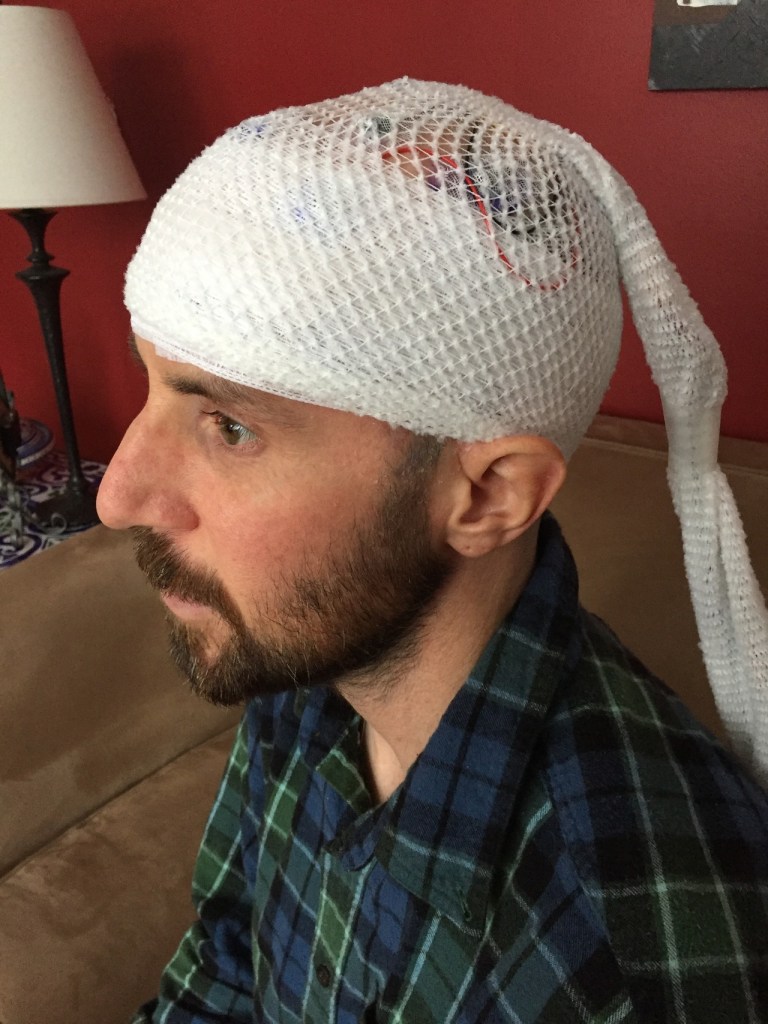
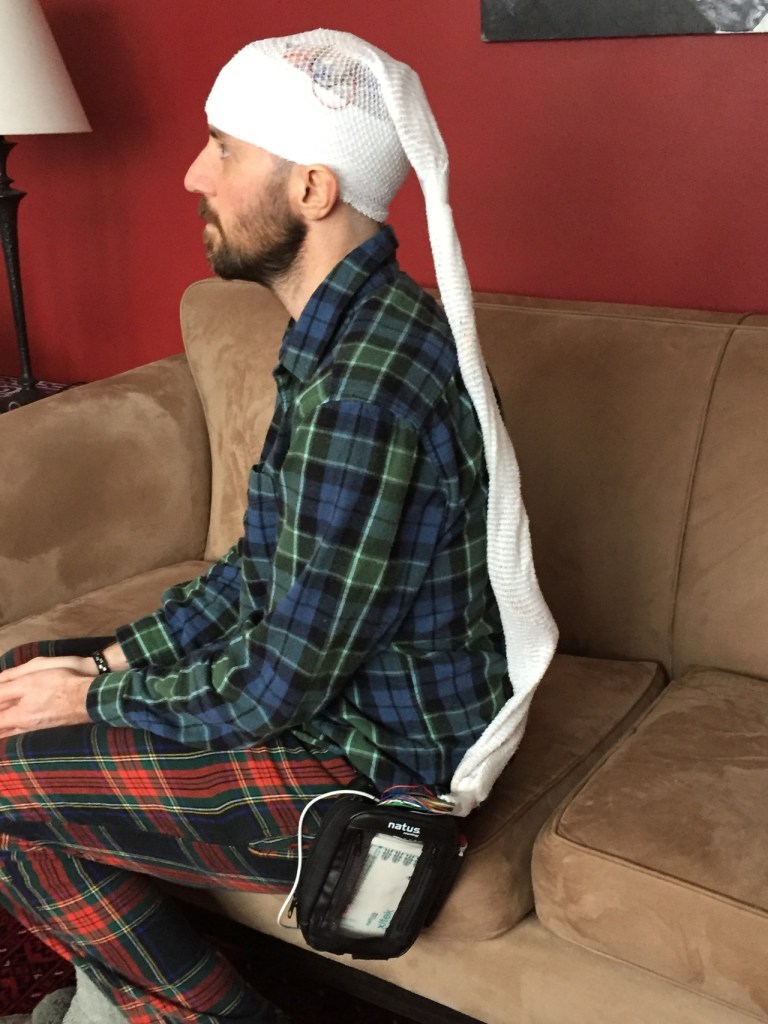
For the time being, I decided to take baby steps. I left the hospital with what’s called an ambulatory EEG. This allowed me to return home to continue resting and healing — both of which are desperately needed after years of treatment and the emotional, psychological, and physical stress this entire ordeal caused. Before leaving the hospital, a dozen diodes were glued to my scalp. These are then connected to a small box that gathers information 24/7. I was also given a camcorder meant to be left on while I’m sleeping, sitting reading, writing, playing guitar, cooking in the kitchen, etc. — basically any place I might be for several minutes. The intention is to capture any possible seizure-like activity via brain waves and on film.
Perhaps this monitoring will shed some light on certain elements and reveal potential seizure activity.

Baby steps. Slow and steady…

I’m trying to race through all these tests, not just those related to the seizures, but every single test (blood labs, CT scans, MRIs, etc.), desperately hoping to return… but to where I know not. There is some kernel of normalcy out there — there must be, right? Although I am trying to find it in the past, I know, beyond a shadow of a doubt, that this normalcy I seek, this peace of mind and, dare I say, acceptance, is found right here and now.

I just haven’t gotten there; I haven’t arrived. Acceptance of what is, that ability to live (more) presently, is just beyond my grasp. I know I could easily take hold it, maybe lean just a little farther out, bravely extending, trusting myself in doing so, but I’m held back. The bitterness and anger pull me the other way, back into the known. I am seeking normalcy in this place, in the past, but all that remains some visions and daydreams lead to the bitterness and anger felt presently. I often wonder, when in a moment of clarity, how much I polish those memories to better serve my current state of anger, sadness, etc. This is where the emotional and psychological exhaustion, or at least the majority, stems from; the continuous construction of a palatial past to which a return is impossible.  

A Return

black and white photo of the woods in the winter

PTSD

I’m not going to die…

Measuring time

I measure time in interesting ways now. A row of trees (“green giants”) were planted in my backyard roughly two years ago. As they grow, like most trees, they send these vertical shoots (for lack of a better word) straight up, and then those, in turn, begin to fill out with horizon branches. They have not only sent up their shoots, but they have also begun to fill out. This is the intention of such trees; they are used as a natural wall. They are close to becoming impenetrable.

I think about when my dear friend visited. They put cream on my hands; it was a lovely gesture and made me feel safe and secure. When they came to visit, we went to get gelato. My hair fell out. They noticed it on my pillow but didn’t want to say anything, but I knew. When I left Chicago, I took their suitcase. It had a little Travelocity gnome on the handle. When I returned home to Maine, I left the suitcase in my room and lived out of it. Not that I couldn’t settle into my room in my mother’s house; I just didn’t think I’d be here long enough to have to. It wasn’t naivety, just wishful thinking and the assumption this would be over and done with by mid-summer. The suitcase was there, just resting in my doorway. I would wash my clothing and put them back in the suitcase, folding the pants and shirts neatly so they would fit. The little gnome smiled up at me, bidding me to take off, to go boldly out there, wherever there was. Slowly I unpacked, however. I washed my clothing, folded it, and began to fill my drawers. Then the suitcase was put in our basement, the little gnome still there, hanging off the top. That was over two years ago.

I want a 9-5 job. I want to go out on the weekends. I want to point the finger at someone or something. I ate organic food for the majority of my life. I was a vegetarian, didn’t touch GMOs, and tried to eat locally when possible. I drank green tea and coffee — but only organic, of course. I was raised on a farm in Vermont — I was an earth-loving flower child before earth-loving flower children became trendy and commercialized. I meditate regularly and exercise 4+ days a week. So why am I still fighting this this fucking disease?

Yes, that’s right, fuck. Fuck this, fuck that… fuck!

There’s shame in all this, too. As with my diet and lifestyle, how on earth did I get cancer, considering how I  tried to be diligent (almost militant!) about the choices I was making? Or is that guilt? I am not sure I fully understand the two: shame and guilt. Do I feel ashamed when I let out the pain and anger from this ongoing battle? Or is that guilt? Do I feel guilty that I feel as though I am burdening someone with it all this? Or is that a shame?

We have a tendency to glorify these people who go through cancer with some sort of sage or guru or saintly-like bravery and stoicism. The talks and books, the inspirational speeches, and blah blah blah. But that person who marches through it all doesn’t exist. Yes, they do, but I can guarantee they cracked, broke down, and screamed. Yes, the inspirational speeches are full of beautiful sentiments about this or that, about how cancer was “the little friend I needed.” The majority, though, I’m assuming, are like me in the sense that they can’t right themselves long enough to step away from the looming shadow that is cancer.

My oncologist said I should get a job. I’m not sure if that was a joke or not.
My other oncologist said, when I had ongoing back pain recently and asked for an MRI (it turned out to be an inflamed disk), “that’s the trouble with doing scans, it seems you always find something wrong.” Excuse me? Fuck you.

Those green giants have indeed filled in. They have made a lovely wall. Inside that wall, on my side, there are plants, flowers, and endless beauty for the eyes to behold. I will admit my gardens are beautiful. Our gardens are beautiful. I spent endless summers crafting them when I was at home from school or had free time from work, etc. When I lacked stamina due to treatment and willpower, my mother took over and put her unique touch on them. But I’m not there, not fully present on our side. I am standing with my friend’s suitcase, with the little gnome on the handle, ready to travel, trying desperately to get beyond the wall of green giants. I am certain that on the other side is a 9-5 job, weekend drinks, and conversations that don’t feel like a burden to others. On the other side, hand massages are simply hand massages and not about squelching intense fear that transcends words.

Shadows larger than life

Sometimes, I feel as though I have a very clear idea of what I want to write and what ideas and emotions I’m trying to convey. Other times, I don’t know where to begin and hope that fumbling along will eventually string together enough thoughts to create something solid. This is the former. However, the idea is clear but the words haven’t yet formed.

Recently, I have wondered if this is all worth it. By this, I mean the cumulative fear, stress, and anger that have spanned the last 2.5 years of my life.

With cancer, there is no reprieve. I always wonder if something is lurking. The experience with the recurrence took me so off guard. Now, I always wonder what’s there, just under the surface? What’s going on within me?

In a way, I have become very childlike, existing in this world where shadows are larger than life and wondering about my health every second.

The scans I had 3 months ago were clean. (I will have another round in early August.) The knowledge of clean scans permits me a little time to feel good, safe, and breathe. Then the show starts all over again. The build-up begins weeks (if not months) before the actual test dates; sleepless nights, raw emotions/emotional outbursts, heightened sensitivity to noise or sudden movements, and irritability. There is a pervasive feeling of dread that blankets everything. It’s not so simple to label it as depression; it is too multifaceted. (By the way, I take antidepressants and anti-anxiety medication. In addition, I also take a daily regimen of herbal remedies and supplements to combat all sorts of things mood-related.)

This is my existence, and I have honestly been wondering if it’s all worth it and if I can hold on. If I can hold out for that one day when I’ll awake, the nagging fear, the chronic anxiety, and endless worrying will have slipped away in the night.

In June (2018), when I saw my oncologist at Mass General, they asked how I was doing. I felt more and more comfortable with them and knew they were asking on a deeper level (i.e., not just inquiring about fatigue levels, appetite, etc.). I said, “I feel hopeless.” It is a word I hadn’t used much before, if at all. Hopeless: despair, desperate, forlorn, pessimistic, resigned… these words don’t describe who I am. Who was I becoming? What had all this illness done to me? The weight of that word fell upon me.

For me, a state of hopelessness is reached rather gradually. In considering my journey, in relative hindsight, it is akin to wading out into a body of water — just one step, then the other, and so on. I think the longevity of my journey was a sort of cresting wave; the initial diagnosis, the recurrence, the stem cell transplant. Everything consumed me in between the various tests that took place, the preparations, the scheduling of this or that. I had little time to even consider what state I was in. Naturally, there was great sadness, frustration, etc. I never thought these emotions would culminate in hopelessness, or perhaps they were slipping under the radar. The cresting wave broke; it fell upon me. The body of water, the floor of which I could just barely touch amidst everything, was no longer there. Try as I might, I couldn’t touch the bottom. Then, another wave broke and another. I surfaced and looked for the shore, but the swells were too great, too high. All these moments of fear or anxiety, anger or sadness, amounted to a state of hopelessness.

For those unsure of what I’m saying, I will be blunt; I have often wondered about ending my own life. Also, for those who are also wondering how or why I would go through years of cancer-related treatment only to contemplate taking my own life — it is not, nor will it ever be, that simple.

As I said before, I’m holding out for that day when I will wake to even the slightest hint of normalcy.

Things change so quickly

I can’t help but look back. It is torture, I know… but I’m still trying to figure things out. If I keep repeatedly playing things in my mind, something will pop up, make sense, and be clear.

This photo (4/4/16) is after being discharged from the hospital. I had my orchiectomy, was diagnosed, had my apartment packed up, and was about to return home to New England for treatment. How did I manage all this? I didn’t notice until looking at the photo that I was still wearing the bracelet from the hospital.

Things change so quickly.

My eyes are so tired in this photo. I looked worn out and worried – naturally, I was. I wanted to smile for my girlfriend, it was her birthday. Considering life’s drastic change, I wanted to act as normal as possible.

I am not sure why I return to these images. Maybe it is the stark contrast between the two; a casual day at the nature museum was only a matter of days before my life fell apart.

What am I seeking here? What do I hope to find in the words written upon my face, within my tired eyes?

I notice my left hand is gripping her shoulder so tightly. Is it because I’m leaving? Is it to thank you for being there for me, coming to the emergency room, and staying with me there for days? Is it that I’m trying to hold on with all my strength because this is the last refuge, the last fragment of normalcy that I will have in a long time?

I will turn these questions (and many more) over and over in my mind. There has to be reason within them… they have to make sense.

Expressive writing

Stress, trauma, and unexpected life developments — such as a cancer
diagnosis, a car accident, or a layoff — can throw people off stride
emotionally and mentally. Writing about thoughts and feelings that arise
from a traumatic or stressful life experience — called expressive
writing — may help some people cope with the emotional fallout of such
events. But it’s not a cure-all, and it won’t work for everyone.
Expressive writing appears to be more effective for people who are not
also struggling with ongoing or severe mental health challenges, such as
major depression or post-traumatic stress disorder.”

It sounds like I am beating a dead horse when I talk about “getting over” things. In many ways, and I do recognize this, I am. It isn’t that I’m obsessed with this idea, or beating myself up… it is simply that I am trying to come to terms, accept, move onward.

My fear is, and this too might be glaringly obvious, I worry about getting stuck there. Perhaps this is why I’m so keen on stepping forward and into the present.

I ruminate. I think and overthink and re-think… I try to work something out, see it from every angle and point of view. This has served me well and has helped in many ways. However, in regards to cancer and cancer treatment, I worry that it might be too great a focal point.

The above quote, published by Harvard Health, interests me. I fancy myself a wordsmith, even though my spelling and grammar are rather questionable (thank you neurotoxicity!). With writing, especially that which isn’t fiction, I grapple with subjects and, as with my other rumination skills, pick at it, dissect it, scrutinize it.

What I’m beginning to understand, and this quote really gets to the heart of it, is that my trauma from these many experiences had over the past two years, might be hindering me from working through something and thus letting it go. (Perhaps I am even overthinking this…)

Mandala

When the mandala is finally finished, however long it takes for the
monks to deal in this divine geometry of the heavens, they pray over it —
and then they destroy it. They sweep up every last grain of sand and give handfuls of it away to those who participate in the closing ceremony as a final memory of sublime possibility. Then, they throw the rest of the sand into the nearest living stream to be swept into the ocean to bless the world. And that’s it. It’s gone. In an instant, after all that artistry, all that work, it’s over.”

I am burned out.

I have spent the better part of today trying to sift through GoFundMe updates and re-constructing this blog based on them. Gofundme isn’t, as I’m sure many know, a blog, the updates don’t really work/flow like that. I was trying to cut and paste and get the dates in some sort of order so that it made sense – IE, it was chronological, concise, etc. For the most part, the cutting-and-pasting was fine, or at least relatively quick and easy. I would read just a few lines from each update, hunt for the photo contained with it, and then post it. This was like stepping on landmines. I became so triggered. It is a year out from my first transplant, but the memories are so fresh. Even if it were after a decade, I could easily feel this knee-jerk reaction and slip into this state of paralysis.

I don’t know why I keep pushing myself in such a way. I seek to escape to get over things. But I am in a labyrinth, walking around, disoriented, lost. Of course, healing is a maze, and one must work patiently to find the route. More so, which I know logically (philosophically?) but have difficulty accepting, is that one must embrace wherever he/she is – even if it is a confusing, endless maze.

I often think of a mandala. The metaphor is loosely connected to this, but it still stands. I think about these monks working endlessly on this beautiful sand “painting,” fastidiously laboring over it. The attention to detail is of utmost importance, but so is this sense of being present, of working in the moment. The work isn’t seen, or at least I believe it isn’t seen, as a whole. I believe the monks begin and work from breath to breath to breath. The skill they have acquired is so precise that they are masters at work. But the mastery comes with a patience that is only possible from moment to moment, from breath to breath.   

Try as I might, I am not in this place. I look in the mirror, and though I see the present Jeremiah, who looks back with brightness in their eyes, I can’t help but see Jeremiah, whose eyes have a vacant and sickly look. These two (and many other forms) stand side-by-side, I can’t.

How do I let this person go? I know it isn’t possible in all aspects; this person has defined me in many ways. But like the mandala crafted by the patient monks who let it go, destroy it by the hand that labored over it, wash it away in a river… how do I let the pale and sickly Jeremiah go, embrace the Jeremiah that is now?

image

“Nothing ever goes away until it has taught us what we need to know.”
Pema Chödrön