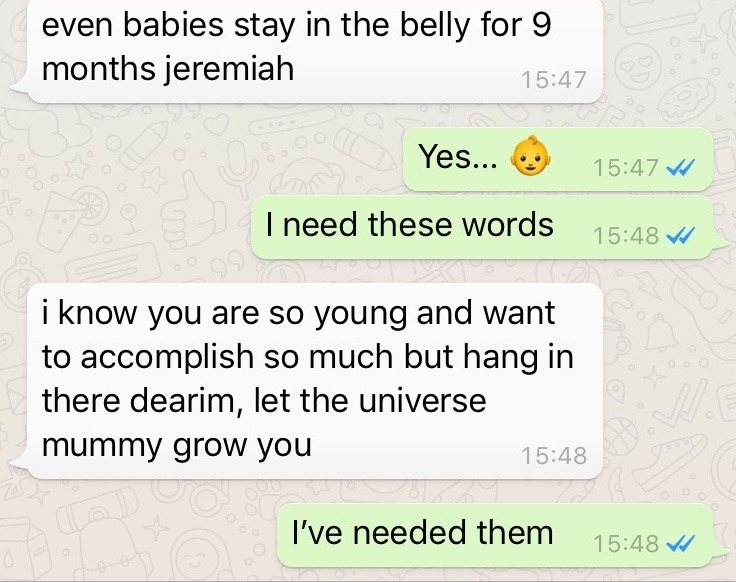
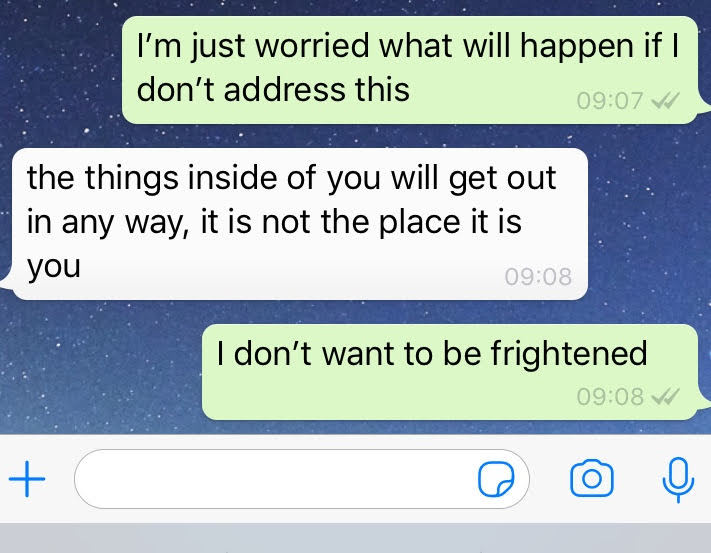
Screenshots

The elation I felt…

Trigger warning: This post deals with issues such as depression and mental/emotional breakdown.

The word “met” refers to metastatic cancer.

The elation I felt after these recent scans was overwhelming! When my oncologist said that we would move the scans to every 6 months, as opposed to the quarterly schedule we had maintained since my stem cell transplant, I cried. When I have broken down in front of him before, which I have done on numerous occasions, it was due to negative news or concerns he had. This time, however, the tears resulted from pure joy and happiness!

I was shocked when he told me this, completely speechless. When he entered his office, I braced myself. The 2nd to last scans performed in August revealed “nonspecific nodular change” on the largest pulmonary mets. Though things were “stable” then, it was still cause for worry.

This is the area where the recurrence was detected in early 2017, so naturally, it was worrisome.

I didn’t tell anyone. Not a soul. I said things were stable, but I didn’t mention the change.

We would “keep an eye on it”; that was the plan. We’d see how things looked in three months and how they appeared after the following scans. These were the parting words after my appointment in August – we’ll just wait and see.

Three months! For three months, I wondered what might be occurring within my lungs.

Those who talk about “being present”, living in the “now”, etc. are full of shit. When you’re told that there is a slight change in size in one of the mets on your lungs and that it might be growing, but we’re not sure, so let’s wait three months to be specific, you’d be leaping into the future and entertaining every possibility imaginable. Anyone would be anywhere BUT “here and now”; their minds would be bedeviled by worry and fear. Even Siddhārtha Gautama would be shitting himself.

Several months ago, an MRI revealed that there was potential growth in the met in my brain, the one that was treated with radiation therapy in 2016. It turned out that it was just swelling and that there wasn’t any growth. My mind kept reminding me of this incident and that perhaps the supposed growth in one of the lung nodules was also the result of swelling…

I was informed of this “nodular change” on September 16th, the day before I departed on what I had hoped would be a nice trip abroad for my birthday. The tickets had been purchased well in advance, and I was going regardless of the news I had just received.

I thought taking a short vacation would be nice. After hearing the news about the nodule change, I felt a sort of urgency to leave – in fact, I wanted to run away and be as far away from everything as possible.

While abroad, I began to “live it up”: lavish AirBnBs & private hotel rooms, extravagant meals at swanky restaurants, fancy new attire for my nights out, etc. My mentality, as morbid as it might sound, was, ‘fuck-it, if this is my last go-‘round, I’m sure as hell gonna enjoy myself!’

I prolonged my stay. I didn’t want to be home; I didn’t want time to sit and think about the possibilities and entertain the what-ifs that have plagued my thoughts since my initial diagnosis.

Naturally, all the fancy hotels and fine dining couldn’t keep the torrent of thoughts and worries at bay. They were creeping in. I was losing sleep, and, as a result, my already fragile psychological and emotional state began to further weaken. I didn’t recognize who I was becoming; I started lashing out at people, hurling accusations at friends, displacing the intense feelings of anger and sadness. I couldn’t bear the thought of a recurrence, of further treatment, and was spiraling out of control from the fear and stress I was experiencing. On top of that, amid this storm sweeping me away, I couldn’t find the words; nothing made sense, and I felt alone.

I just wanted to be held. This desire kept returning to me. This need and wish to be wrapped up and held securely was almost childlike. I didn’t want to dump the emotional weight of my situation onto anyone… I just wanted the comfort of prolonged embraces.

The stress and fear was too much. It ended with a hospitalization in Rodez, France. I experienced a nervous breakdown. After 5 weeks of traveling and doing my utmost to push away the anger, fear, and sadness that had sprouted from recent test results, I fell apart. Touching the scar from my craniotomy set into motion an avalanche of emotions, the likes of which I was entirely unprepared to manage.

My mother was the first person I told. I only spoke about it because the report from the most recent CT results mentioned the stability of all pulmonary nodules, including the one that presented with nonspecific changes 3 months prior. This would have been noted in the findings if it had been grown.

She didn’t understand why I didn’t tell anyone. “It’s too much stress for you, “she said, “you shouldn’t have been alone in this!”

I was alone with this knowledge and knew that a change had been detected in the August scans. I didn’t want to say anything because I didn’t know how. I am not good with communication; I have repeatedly repeated this. It isn’t that I’m not opening up, as some have told me; I just find spoken words strange and cumbersome. They don’t align themselves with my thoughts or emotions. Throughout my entire journey with cancer, I have felt at a loss for words. Even in writing updates and maintaining my blog, I have thought that the words I choose are so close to expressing what I need… but fall short every time. They lack the substance required for specific emotional experiences and psychological states. Before diagnosis, I could easily find the words needed to articulate my feelings and express myself. After being discharged from the hospital in Chicago, after being told I had cancer and that my life had been drastically altered, I immediately discovered that words no longer added up. Initially, I thought it was due to several things: stress, fear, seizures, seizure meds, and sleep deprivation. I considered these while packing my belongings and preparing for my return home for treatment. I was tossing clothes in bags and ditching possessions, all the while I was trying to understand why I couldn’t connect my thoughts and emotions with the words I so greatly desired. This ineptitude has continued and hasn’t diminished with time.  

The knowledge that everything is stable has brought an immense feeling of peace that has evaded me for far too long. The serenity that has arrived has lessened the pressure I have been putting on myself in many aspects of my life. I want nothing more than to find the words needed to feel a sort of connection with others. Perhaps one day, they’ll arrive when the dust from all this has finally settled. This is the area where I live in the “here and now,” where I am fully present. I’ll be with it daily, moment to moment, and I hope the words will eventually harmonize with my thoughts and emotions.

The middle-ground

Cancer is a sort of middle-ground between what was and will eventually be. This middle ground is unstable and forever shifting and changing — often daily. As unstable as it is, it also acts as an anchor. With a diagnosis and subsequent treatment, with life revolving around clinics and tests, trying to grapple with the “new normal” post-cancer, as well as the shift in perspective of life when the dust settles, patients seek refuge on this ground.

This middle ground, however, cannot hold, nor is it meant to.

To acknowledge that one is in remission is to become aware that the steps, however frightening, must be taken to move away from the middle ground to step forward. I have kept myself there in this gray area.

I can stay here forever. There is safety here. I’ll live here. I’ll build a life here.

This middle ground, however, cannot hold, nor is it meant to.

As horrifying as they were the circumstances in France rattled parts of me, they forced me to bear witness to the events that had taken place over the years. I was unprepared to handle the deluge of emotions from observing this. The events snapped me into such intense awareness of all that had come to pass, each and every brutal moment of my journey. The emotional scars became apparent. The physical scars radiated, and I could not look away from either or turn my attention elsewhere. My emotional being couldn’t hold out any longer; I was shedding layers, and the feeling of emotional nudity was unbearable. I was losing the self I had been constructing; who was Jeremiah now? This identity was slipping, try as I might I couldn’t hold it. Everything came to a grinding halt; I was literally and figuratively unable to take another step. Brain surgery had to occur during active treatment; there was no question about the procedure. When everything started to rise to the surface, when the layers were dropping away, the physical and psychological acknowledgment of this particular scar was the trigger that sent me into a tailspin. 

I have been able to meditate on some of the imagery and hallucinations I experienced during my breakdown. There are some images that, until now, have remained mysterious or so tangled in metaphor that I couldn’t decipher them. One in particular was pulling a hair-like substance from my chest. This unnerved me, and I wasn’t ready to interpret it. I had been building an identity around cancer; it engulfed my entire life for so long that I took on that persona, that of a patient. ‘I have cancer’, I’d say to myself, or I speak about it as though it was current, that I still had it, that I was still in the place of treatment. Neither is true. This gesture of pulling this substance from my chest is so clear to me now, so obvious. I was trying to extract this identity, this version of myself that has since passed. The transient persona that I had outgrown yet was fiercely holding onto. From within me, from my core, I was trying to haul this out, to unburden myself of it. Not to rid myself of the memories, good or bad, nor the lessons learned, as there are numerous — a lifetime’s worth! I was trying to purge myself of all that didn’t serve me, holding me back from stepping off the crumbling middle ground.

I had to return to France; Golinhac was calling me. All this came about there; all that dormant within me rose fully to my attention — glaringly so! In return, I would leave the remanence of this deteriorating middle ground and my meticulously crafted persona. I’d keep the new awareness and lessons from the incidences experienced there and feel a sense of certainty in stepping away.

I put a ticket on my charge card and began packing. Just a few weeks after I left France, a complete emotional and psychological mess, I was going back.

Everyone expressed their concerns. They were worried that I was still very vulnerable and returning so soon, in a fragile emotional and psychological state, would be very unwise. Why, after such a short period of time, would I want to return to the site of my breakdown? To the place where, just a few weeks ago, I was admitted to the emergency room after being found screaming and howling in the middle of a footpath just outside of Golinhac. These questions started building in my mind, too. Why would I want to do this? The entire way to Boston, which on the bus felt like an eternity, I was wondering what on earth I was doing. What was I hoping for? I didn’t know the answer to anything. Even during my layover in Lisbon, I still wondered and questioned everything.

I admitted to a dear friend who has been an incredible support this entire time and someone I feel safe confiding in,

“I don’t know what I’m searching for.”

“I don’t either,” she replied.

This is the uncertainty that keeps a cancer survivor remaining in the middle ground. Not only the uncertainty of life, as explained, but that of oneself, the question of who one is — who is this Jeremiah? How has he arrived here?

I don’t need an identity here. I can stay here forever. There is safety here. I’ll live here. I’ll build a life here.

This middle ground, however, cannot hold, nor is it meant to.

I walked east out of Golinhac with ever-increasing anxiety. I had to stop and gather myself to go on a few times. At one point, I even considered returning home, admitting it was too soon for such an undertaking. But I was still drawn onward and slowed considerably, taking deep, slow breaths with each step. I stopped at a certain point, put down my pack, and started emulating the gesture of pulling the hair substance from my chest. Gently, slowly, without the frantic haste of my hallucination, I mimicked the action, one hand then the other in a rhythmic fashion as though softly pulling one long, continuous thread from my chest. The action became ritualized in its repetition, fluidity, and symbolism, bringing a deep sense of peace. I envisioned dismantling the persona that had been constructed around cancer, the identity that no longer served me. Bit by bit, as if pulling a single thread that unweaves a tapestry, I unraveled an identity. I simultaneously entwined a new Jeremiah, no longer the patient, yet holding the memories and lessons – the same thread yet a different weave pattern. 

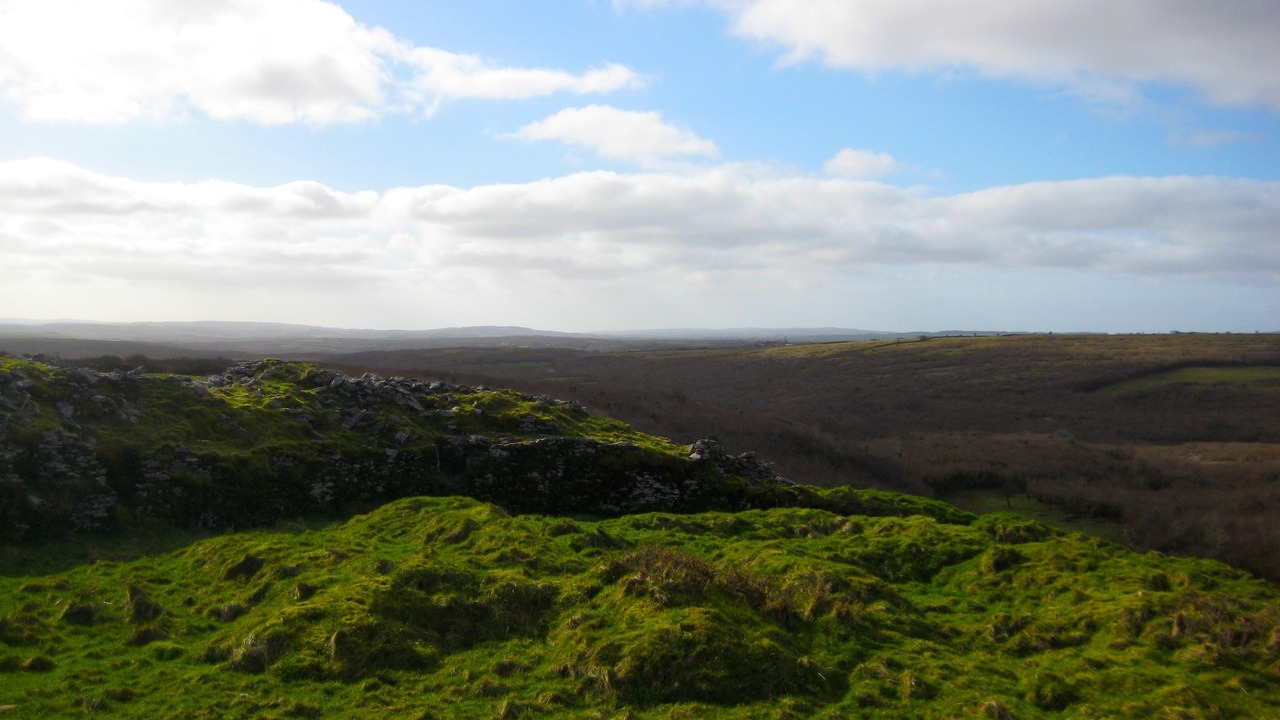
I stood still in the silence of the location and continued taking long, slow breaths. Dusk arrived, and with it, a chill. I retrieved my pack and walked westward back towards Golinhac.  

The peace I felt there has remained. Returning to France, which consisted only of four full days, left me feeling as though I had undergone years of psychotherapy. It isn’t so much that I am thankful for the breakdown itself, as it was terrifying, rather, that I am thankful for that which it revealed to me and the metamorphic shifts that have since followed. 

This is not to say that I have stepped entirely from the teetering middle ground, but I have one foot firmly planted on the other side.

I can build an identity here, one that is linked to (the) cancer via memories and life lessons and not one that is torn between two worlds, two worlds that ultimately hinder the desperately needed stability required for reconstruction.

For the majority of my life, I have relied on art in one way or another

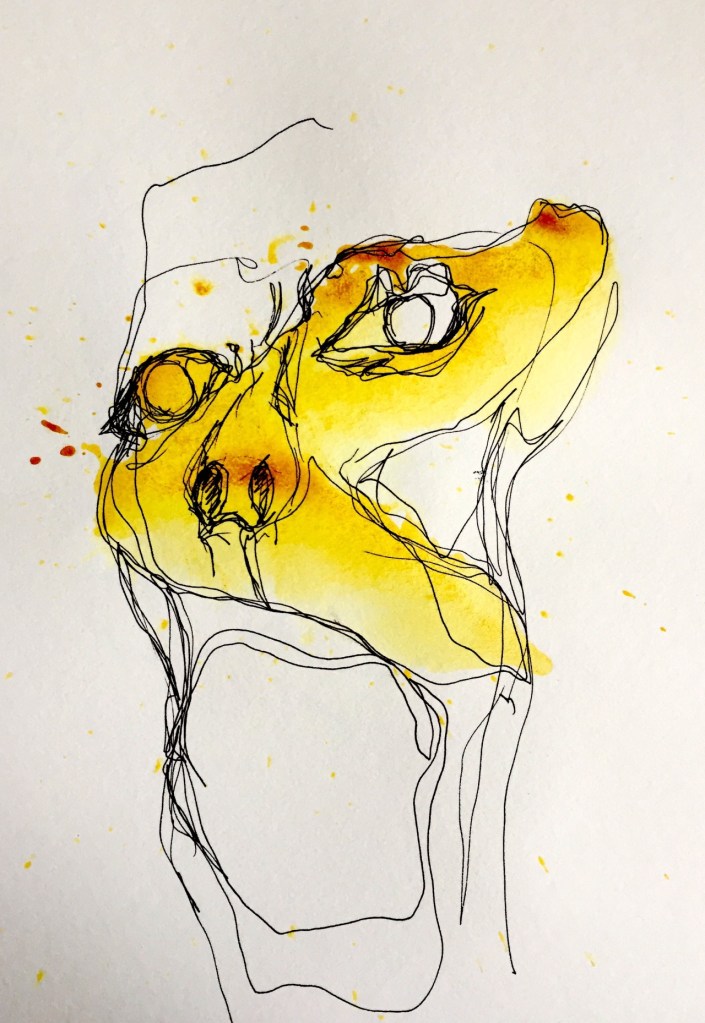
Jeremiah Ray, 2019, Untitled, ink on paper

I have found that, over the years, I have become more and more incapable of fully expressing myself with words. I fancy myself a bit of a wordsmith; however, when I re-read some of my writings, as proud as I am of them as individual pieces, I find that they lack something — some core piece I have yet to extract. When looking back at my regard my emotional and nervous breakdown, the one regarding my time in France and the subsequent “breakdown,” I wonder if that which I was trying to pull from my chest, the substance that was within me, was not a metaphor for trying endlessly to put words to my feelings and emotions. in many ways this makes sense; i didn’t understand what it was then, but i am starting to consider this. Since this occurrence, I have been presented with dreams, little fragments of this particular image. I am standing, open-mouthed, releasing only air while pulling the stringy substance from my chest.

i have relied on art throughout the years — in fact for the majority of my life i have done so. i distinctly remember one pottery class i took when i was 7 or 8 years old. We crafted simple coil pots, glazed them, and, at the next class, looked at our finished works fresh from the kiln. When I was glazing mine, I spent most of my time on the inside of the piece. I remember not paying attention to the work as a whole but working with a sort of feverish intensity on the inside. i have such a vivid memory of painting and painting, glazing and glazing the inner walls of the coil pot. i wanted the walls and, even more o the bottom, to be, upon firing, smooth, glass-like. I recall the bottom of the pot had accumulated so much glaze that a tiny puddle formed.

Of course, I look back now and place all these ideas and theories on why I was doing so, what I was trying to convey, etc. A part of me can’t help but look into this, to study this, not the actual piece; god knows it was that of a child but at my intention. Now, after 6 years of formal art training, most of which consisted of getting my ass kicked when my work was being torn apart during critique sessions, I certainly can’t help myself. The beauty of children, in terms of expressing and creating, is that they don’t drag so much theory and conceptual nonsense into it; a drawing of a dog is just that, a drawing of a dog. A coil pot with a puddle of glaze at the bottom is just that… a coil pot with a puddle of glaze at the bottom.

i wanted the inside to look good. I remember thinking this. There is no theory or conceptual bullshit attached; this is what I remember wanting to do; I was curious about how it would look post-firing. I was also interested in how it might look to others; a coil pot with a bottom rich in color (I chose a deep blue) and as smooth as glass.

Most of the time, I fumble for words. My sister and I have a back-and-forth about this; she wants me to talk, open up, and express what I need now and how said needs can be met. i am left frustrated, trying to manage these emotions upon which i can’t place a label — even though i so desperately want to! Even with my psychologist, with whom I’ve been working weekly since diagnosis, I find myself lacking the appropriate words. Often, we will spend many sessions working through emotion or thought, and then, after a laborious undertaking, we find the words needed… or, rather, some of the words needed.

More often than not, I speak too quickly. Not necessarily in terms of speed, though i did struggle with a stammer as a child as my brain was moving too fast and i couldn’t formulate the words to match the momentum. But I speak without forethought. i fire off a thought without considering how it will be taken or interpreted. This has fucked up more relationships … I cringe now at some of the things I’ve inadvertently said. They weren’t meant to be harsh or cruel, as this is never my intention; they were just unfiltered, unrefined, unpolished, rough-around-the-edges, etc., etc., in an attempt to understand someone or probe a bit to gather more information, I’ll muddle things up to the point of no repair. Equally, I hope to find the appropriate words to express my thoughts or feelings. It’s as if I’m casting a line and doing so in real-time, hoping I’ll reel something closely resembling my current state of mind, my emotions. This, too, can end poorly; going along and sharing, prattling on, seeking words on the fly … …

Then, boom!… the realization of my faux pas is crystal clear.

In my opinion, this is getting worse. i asked my neurologist about various aspects of this in terms of toxicity (multiple chemo agents specifically designed to penetrate the blood/brain barrier) and other physiological damages to the actual brain tissue itself, such as scar tissue, narcotic tissue, etc., not to mention all the psychological shifts that undoubtedly impair various parts of my overall being. His response was reassuring but slightly disheartening. “it’s no wonder you’re functioning as well as you are, jeremiah.”

These psychological (and emotional!) shifts are events, especially considering the recent experience in France and the “breakdown” I experienced there.

After the recent experiences in France, as well as all these experiences as a whole, i am left with so many emotions, almost all of which i can’t articulate. i am left with pain and other emotions i can’t share because i simply don’t have the words! I hope these portraits might, in some small way, express all that I so desperately want to share. They are already revealing so much to me; things are emerging bit by bit, line by line.

For the majority of my life, I have relied on art in one way or another. Now, more than ever, I am turning to it not only as a place of refuge during these times but to aid in my understanding of self and expressing and communicating that which is just under the surface and in need of release.

That which is already being revealed to me through my work, these ink drawings, through these portraits, are little steps toward further healing.

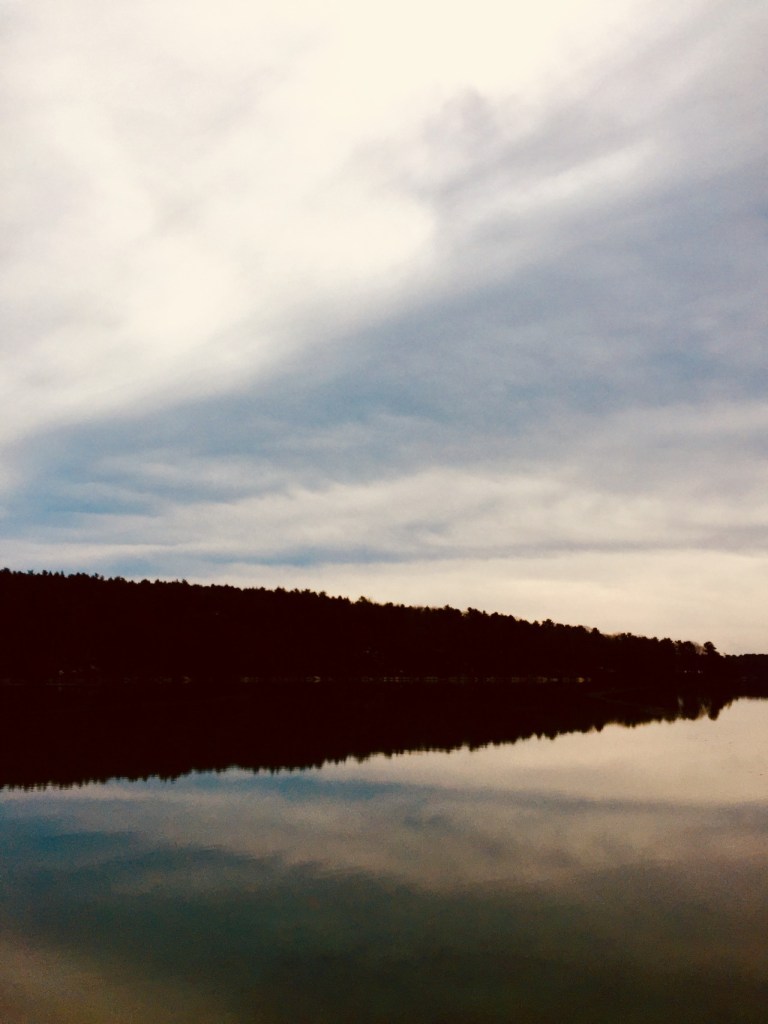
There is sunlight on the wall

There is sunlight on the wall

The wall does not demand that the sunlight stays

Two years ago

Lost

Over a decade ago, when life seemed easier in many ways, partly due to blissful naivety, I left Paris en route to Munich. There, I met with German buddies to make our way on another adventure around the British Isles. Though I had been there a few times prior, I hadn’t traveled by car, and I knew this would add a whole new dimension to our journey. The British Isles, namely Scotland, are my ancestors’ land(s). I was keen on getting off the beaten track, so to speak, and really explore.

The year prior, or perhaps two years prior, we met up in Zurich, where I studied then, and set out to explore Italy. Both journeys were full of spontaneity and, naturally, considering our ages, delicious German beers. Heavy drinking aside, each journey graced us with limitless possibilities. Cliche, perhaps, but we each grew throughout our adventures. Of course, this is only in hindsight, as always, and one looks back on such voyages with a sigh and a smile, retracing not only the steps that we took then but the steps that lead each of us to our current places here and now.

There were many laughs along the way, which weren’t due to the beer; in some two or three cases, it took up more space than our luggage. We encountered some caravan-dwelling folks in Calais who seemed to live in a clown car of sorts, as each time we turned around, there was another… and another… and another. Each one disembarked until their numbers were excellent, and we soon realized that their intentions were not as friendly as we had assumed… blessed naivety. When we needed, which was often, we slept on beaches when the weather was “nice,” an” hud” led under the car, an old Mercedes (which is probably still going vital to this day) when the weather took a fowl turn. One of their friends, studying at Oxford, invited us to stay in his dorm room, which made up for the nights sleeping under the car. We cooked white rice over a camp stove and added ketchup to flavor it… a delectable meal, even if the rice was crunchy. We crossed over the Irish Sea on a late-night ferry from Holyhead. The ferry seemed almost empty at this godforsaken hour, and we sprawled out in the passenger lounge on hard plastic seats to catch a little rest. Rest evaded me as the rocking of the ferry made me queasy.

Somewhere well south of Dublin, we were driving along a double-lane highway which, seemingly instantaneously, turned into a sort of country lane just wide enough for two cars to pass. From there, it tapered off into a single lane, then a dirt road, and then a path that, I presume, was made for a tractor or other such piece of equipment. I am not sure if it ended together in pure Irish countryside or not… Had the roadmap been used more regularly, it would have consisted of major roadways, highways, etc. Still, this little dirt track wasn’t wasn’t make matters more interesting; our dual language road map was perfect for a German- or English-speaking traveler wishing to stay on the main autoroutes. Still, it was not helpful in our current situation. All the signs we could see, some just propped up on rock walls, others, which seemed to point in a random direction and undoubtedly acted more as weathervanes, swiveling this way and that even in the gentlest of breezes, were in Irish (Gaelic).

In the middle of seemingly nowhere, we came upon a small cottage. It was an idyllic, postcard-worthy scene. After a brief discussion, it was decided that, since English was my native tongue, I would speak with whoever was there — if anyone at all. After knocking on the door, I paused momentarily to admire the houses. I also wondered how one might live here in what seemed to be the middle of nowhere. When I was about to leave, the door opened, and an older woman greeted me. I can’t imagine how I looked, considering we had been sleeping under a car and consuming white rice with ketchup-washed-down beer for the better part of 2 weeks. But she didn’t seem to notice or care. I presume she had been watching from a window, studying the car with German plates and the three bedraggled boys.

“Good afternoon,” I said, “I’m sorry to bother you, but we’re lost.”

She smiled warmly.

It wasn’t until later that I began considering my comment and her potential interpretation. Here we were in what I called the “middle of nowhere”, but to”her it was home.

Lost
Past and past participle of loss.
Adjective: lost
Denoting something that has been taken away or cannot be recovered, e.g., a lost opportunity.

It isn’t that this opportunity is lost forever; it is simply that such tidbits of wisdom only arrive when one is ready to receive them. The opportunity will repeat itself in various ways and forms until the knowledge is seen and accepted.

This journey of illness and recovery is an opportunity, right? Occasionally, I get glimpses of this, and a blissful warmth runs over me. Then I slip backward and become bitter at seeing something that has caused so much pain and suffering as a chance to learn and grow. Couldn’t I have learned this differently?

I awoke to a text from a dear friend of mine. She has been a source of endless support, care, and love during these years of both illness and recovery. She spoke about the destination and used the analogy of building a stone path and how I’m looking far ahead to some distant point. In turn, the stones I’m laying down to build the path are being overlooked in my haste, in my desire to arrive at some terminus just out of my reach. The task is daunting, too. Building a path that stretches for miles and miles leaves me angry and thus depleted. I realized the stone path I had been laying could barely be considered a path. It’s a twisting and winding mess leading here and there, running wildly in every direction, chasing every possibility, seeking out any and every venue in hopes that one thing, that anything, will relieve me, nourish me, heal me…

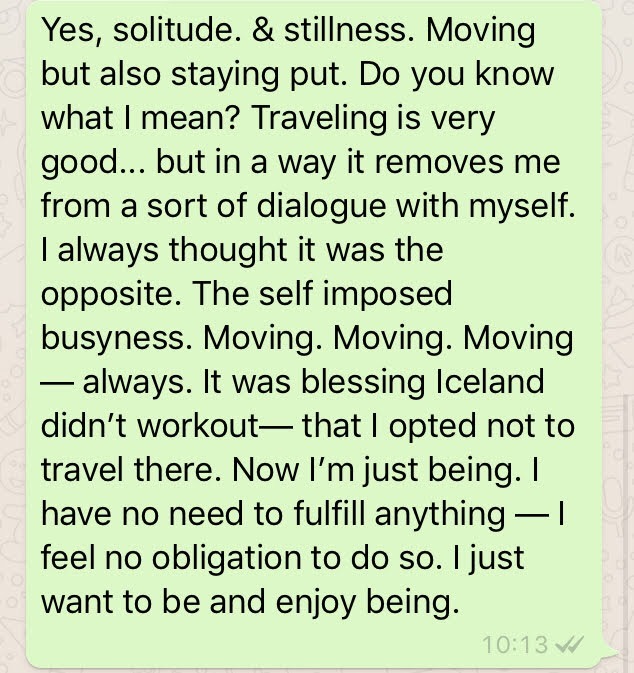
I have been wondering about this notion of being lost, of being somewhere neither here nor there and struggling desperately to find the way — any way, for that matter. How might it be if, by chance, I stopped desperately trying to find a way? Or, rather, as it seems, I’m after one in particular. What if I stopped giving a damn about the stone path all together? What if I stopped giving a damn about direction? If I just sat here, then what?  To me, the construction of a path is a sign of strength and courage, forging boldly ahead in the face of it all. Even if I see the path as rambling madness running off in every which way, I still view it as such. What if I ceased the exhausting construction of this path? What if I just let it be? What if I just was?

Osho, an Indian spiritual guru and philosopher, said, “Be — don’t try to become.” I have spent far too much becoming. Becoming healthy. Becoming happy after such turmoil. Becoming whole again. Becoming. Becoming. Becoming. All of these are so close, just out of reach — just there.

If I become this, then I’ll have that. What a very strange equation.

This is the opportunity, the tidbit of wisdom that has arrived. Perhaps it has come a few times, and I simply wasn’t ready to be open to receiving it.

The warm smile from the older lady in Ireland was reassuring and comforting. Now, after so many years and countless experiences, I wonder if she was smiling because she knew I wasn’t lost then and that, in actuality, there is no such thing as being lost at all.

Epilepsy Monitoring

image
image

The body

For years, I didn’t like my body. For the majority of my life, there was this sense of guilt or shame about how I looked and felt. As a result or product of, I am not sure, there was an internal struggle, a sort of emotional and spiritual dissonance within that which I can only refer to as the soul. 


The body and soul were awkward, each attempting to adjust to one another, the physical and metaphysical working their way into a partnership of sorts. In one’s formative years, this is a time of great physical and emotional/spiritual strife. From my childhood until recently, this lingering sensation of turmoil always seemed to be. 


Much of this stems from the labels and ideas thrust upon us by the society and culture into which we are born. It is hard to adjust and figure out our way through the swamp of ideals and morals, beliefs and philosophies that aren’t necessarily our own – in fact, they seldom are, as we soon discover, they are simply handed down piece by piece. In such a way, they become like the game a telephone might play as a child. One person starts a phrase, and it is passed around or down a line. The end product is usually some bastardized version of the initial statement. The awkwardness of soul and body, this feeling of discontent, eventually brings us to the point of either acceptance of the societal and cultural default settings or forces us to step out in hopes of discovering that to which we are drawn by some force and/or inner seeking. Both take courage, neither one can be deemed good or bad, right or wrong etc. 

Amid treatment, during the first rounds immediately following my diagnosis, I stepped out of the shower one morning and stood before the mirror fixed to the opposite wall. There, in front of me, was my naked body. My hair had long since fallen out on my head and my entire physical being. I looked like some prepubescent boy with the face of a middle-aged man – a face exponentially haggard by exhaustion, stress, anxiety, etc. My eyes were sunken, tired, and sad. They, my eyes, have always held every bit of my worry, fear, joy, passion, etc. I looked at myself; I stared at the body before me. I stood still and let the feelings and sensations (some of which I haven’t found a suitable word for) pulsate from my core. 


I stood there. My fingers traced various lines and ran over my bloated body, puffy from steroids and other drugs administered during active treatment.


The orchiectomy incision looked back at me. I hadn’t looked at it since the operation and commencement of treatment. There was a part of me that didn’t want to look at it, to admit that it existed, or to deny the fact the surgery had taken place. 


Afterward, I let my fingers wander over my body, from the top of my bald head to the sunken sockets holding my eyes, over my flabby belly, and along the scar that marks the right side of my groin. I let my arms fall to my sides. I remember distinctly looking at myself – really looking at myself. I never wanted to. The body, my body, was just something. Embarrassed as I am to say this, I viewed it as some form that I had been plagued by. 


Beyond the fleshy, bloated being is where my gaze eventually fell, where it entered. How could it not? That is where all the lines I traced on my body were leading. As with the physical body, I didn’t think I was ready to honestly look or hold myself in that manner. But given the circumstances, the nand tire situation I was in, how could I not?


I have always been curious about the soul. The notion of it as a thing, for lack of a better word, fascinates me. I see it as something continuous, an ongoing form of energy, something that doesn’t end when the physical body holding it passes. The idea of the soul as something “eternal” stems from my catholic upbringing. As with my physical body and the shame and embarrassment I felt towards/about it, I felt something similar towards my soul. My physical body might lead to sin – to enjoyment and lust. My soul was a mere breath or thought away from damnation. 
Damned might I be should I enjoy my own flesh, my body – the sacred house of my soul! Damned might I be should I steer my soul on a course of my own choosing to embrace the free will I was taught so much about. 

It took me nearly 3 decades to look at myself and appreciate the strength of my body and soul. It took almost 3 decades to look at myself, to behold myself, body and soul, and to give thanks.

Despite the anger and bitterness, and sadness, gratitude exists. Though I might struggle daily with my mental and emotional well-being, I’d be genuinely damned without appreciation.

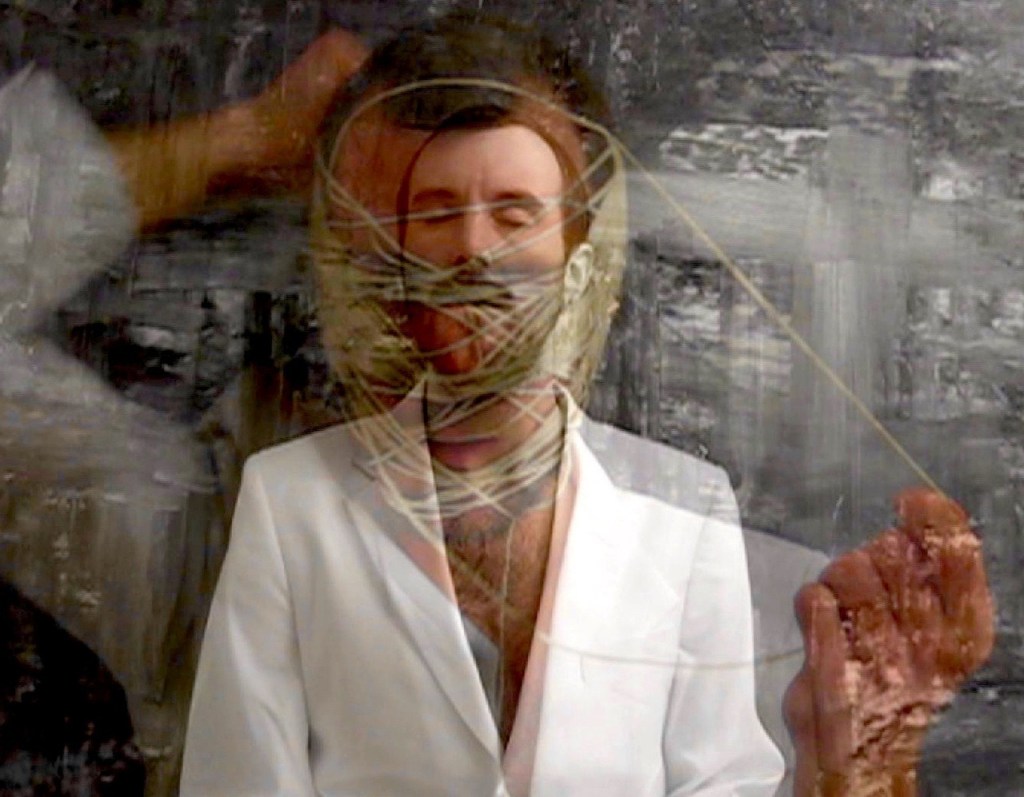
The photo is a still from a performance video I made in 2012. Through my visual art I was always trying to articulate my feelings and beliefs about the physical and metaphysical. Through art I sought to examine this relationship and express that visually which alluded me in every other form of expression and means of communicating. In this video we have two beings; one that remains still, eyes closed. The other worked furiously to wrap and eventually unwrap their head with string. The being with their eyes closed is actually the one seeing, the one that is fully aware of what is going on internally and externally. The other being, the one wrapping their head with the string, is the being trying to figure out their place within everything, to literally untangle the mess and confusion in which they find themselves.