Two years ago, I returned from Mass General Hospital (MGH). My second stem cell transplant had wrecked me; it was brutal. “You really trooped through these!” said my oncologist. Though proud to hear such words, I was out of my mind and ready to be home. I spent the last 3 months in a small, sterile, seal-off hospital room, removed from the world (save for nurses and doctors), removed from fresh air, from direct sunlight… I just wanted to go home!
Initially, I met my oncologist at MGH every week. He was keeping a very close eye on me. Then we met every 2 weeks, every month, every 3 months… I have returned to the care of my oncologist here, in Maine, we currently meet every 6 months.
During this time, I was having scans (CT of my chest, abdomen, and pelvis and an MRI of my brain) every three months. Naturally, having experienced a recurrence just 6 months after the original/initial treatment, every set of scans sends me into a downward spiral of fear, anxiety, anger, etc.
Even now, having bumped my scans out to every 6 months, I am still sent into a tailspin when the time draws near for scans/tests. It’s the same with each round; fear, anxiety, anger. This is common, at least I’m assuming it is, for every cancer patient.
Today, however, two years out from my stem cell transplant, I learned that my CT scans (chest, abdomen, pelvis) are still showing signs of stability! The peace that has set in with this knowledge is immeasurable!
Over a decade ago, when life seemed easier in many ways, partly due to blissful naivety, I left Paris en route to Munich. There, I met with German buddies to make our way on another adventure around the British Isles. Though I had been there a few times prior, I hadn’t traveled by car, and I knew this would add a whole new dimension to our journey. The British Isles, namely Scotland, are my ancestors’ land(s). I was keen on getting off the beaten track, so to speak, and really explore.
The year prior, or perhaps two years prior, we met up in Zurich, where I studied then, and set out to explore Italy. Both journeys were full of spontaneity and, naturally, considering our ages, delicious German beers. Heavy drinking aside, each journey graced us with limitless possibilities. Cliche, perhaps, but we each grew throughout our adventures. Of course, this is only in hindsight, as always, and one looks back on such voyages with a sigh and a smile, retracing not only the steps that we took then but the steps that lead each of us to our current places here and now.
There were many laughs along the way, which weren’t due to the beer; in some two or three cases, it took up more space than our luggage. We encountered some caravan-dwelling folks in Calais who seemed to live in a clown car of sorts, as each time we turned around, there was another… and another… and another. Each one disembarked until their numbers were excellent, and we soon realized that their intentions were not as friendly as we had assumed… blessed naivety. When we needed, which was often, we slept on beaches when the weather was “nice,” an” hud” led under the car, an old Mercedes (which is probably still going vital to this day) when the weather took a fowl turn. One of their friends, studying at Oxford, invited us to stay in his dorm room, which made up for the nights sleeping under the car. We cooked white rice over a camp stove and added ketchup to flavor it… a delectable meal, even if the rice was crunchy. We crossed over the Irish Sea on a late-night ferry from Holyhead. The ferry seemed almost empty at this godforsaken hour, and we sprawled out in the passenger lounge on hard plastic seats to catch a little rest. Rest evaded me as the rocking of the ferry made me queasy.
Somewhere well south of Dublin, we were driving along a double-lane highway which, seemingly instantaneously, turned into a sort of country lane just wide enough for two cars to pass. From there, it tapered off into a single lane, then a dirt road, and then a path that, I presume, was made for a tractor or other such piece of equipment. I am not sure if it ended together in pure Irish countryside or not… Had the roadmap been used more regularly, it would have consisted of major roadways, highways, etc. Still, this little dirt track wasn’t wasn’t make matters more interesting; our dual language road map was perfect for a German- or English-speaking traveler wishing to stay on the main autoroutes. Still, it was not helpful in our current situation. All the signs we could see, some just propped up on rock walls, others, which seemed to point in a random direction and undoubtedly acted more as weathervanes, swiveling this way and that even in the gentlest of breezes, were in Irish (Gaelic).
In the middle of seemingly nowhere, we came upon a small cottage. It was an idyllic, postcard-worthy scene. After a brief discussion, it was decided that, since English was my native tongue, I would speak with whoever was there — if anyone at all. After knocking on the door, I paused momentarily to admire the houses. I also wondered how one might live here in what seemed to be the middle of nowhere. When I was about to leave, the door opened, and an older woman greeted me. I can’t imagine how I looked, considering we had been sleeping under a car and consuming white rice with ketchup-washed-down beer for the better part of 2 weeks. But she didn’t seem to notice or care. I presume she had been watching from a window, studying the car with German plates and the three bedraggled boys.
“Good afternoon,” I said, “I’m sorry to bother you, but we’re lost.”
She smiled warmly.
It wasn’t until later that I began considering my comment and her potential interpretation. Here we were in what I called the “middle of nowhere”, but to”her it was home.
Lost Past and past participle of loss. Adjective: lost Denoting something that has been taken away or cannot be recovered, e.g., a lost opportunity.
It isn’t that this opportunity is lost forever; it is simply that such tidbits of wisdom only arrive when one is ready to receive them. The opportunity will repeat itself in various ways and forms until the knowledge is seen and accepted.
This journey of illness and recovery is an opportunity, right? Occasionally, I get glimpses of this, and a blissful warmth runs over me. Then I slip backward and become bitter at seeing something that has caused so much pain and suffering as a chance to learn and grow. Couldn’t I have learned this differently?
I awoke to a text from a dear friend of mine. She has been a source of endless support, care, and love during these years of both illness and recovery. She spoke about the destination and used the analogy of building a stone path and how I’m looking far ahead to some distant point. In turn, the stones I’m laying down to build the path are being overlooked in my haste, in my desire to arrive at some terminus just out of my reach. The task is daunting, too. Building a path that stretches for miles and miles leaves me angry and thus depleted. I realized the stone path I had been laying could barely be considered a path. It’s a twisting and winding mess leading here and there, running wildly in every direction, chasing every possibility, seeking out any and every venue in hopes that one thing, that anything, will relieve me, nourish me, heal me…
I have been wondering about this notion of being lost, of being somewhere neither here nor there and struggling desperately to find the way — any way, for that matter. How might it be if, by chance, I stopped desperately trying to find a way? Or, rather, as it seems, I’m after one in particular. What if I stopped giving a damn about the stone path all together? What if I stopped giving a damn about direction? If I just sat here, then what? To me, the construction of a path is a sign of strength and courage, forging boldly ahead in the face of it all. Even if I see the path as rambling madness running off in every which way, I still view it as such. What if I ceased the exhausting construction of this path? What if I just let it be? What if I just was?
Osho, an Indian spiritual guru and philosopher, said, “Be — don’t try to become.” I have spent far too much becoming. Becoming healthy. Becoming happy after such turmoil. Becoming whole again. Becoming. Becoming. Becoming. All of these are so close, just out of reach — just there.
If I become this, then I’ll have that. What a very strange equation.
This is the opportunity, the tidbit of wisdom that has arrived. Perhaps it has come a few times, and I simply wasn’t ready to be open to receiving it.
The warm smile from the older lady in Ireland was reassuring and comforting. Now, after so many years and countless experiences, I wonder if she was smiling because she knew I wasn’t lost then and that, in actuality, there is no such thing as being lost at all.
My first anti-convulsant med helped keep me seizure-free for over a year. As the seizures started, it was slowly increased in dosage to no avail. My neurologist changed that medication out for another, which has seemingly stopped working, too. Each medication has reduced the frequency of my seizures; however, I have experienced two severe episodes in the last few months. Each time, I tumbled pretty hard. The second time, I fell several steps and eventually went to the ER, wondering if I had a cracked rib. Thankfully, neither incident caused much harm. The wound, however, is more emotional and psychological. Yes, my entire torso might have been covered in bruises, but the real damage is in my psychological state. I want to move forward, and it seems the only real thing preventing doing just that is the seizure activity. I can manage the anxiety, kind of. The fatigue requires a good midday nap. The seizures are detrimental. My neurologist suggested that I enter an epilepsy monitoring unit (EMU) to understand the brain activity further and see if we might find a way to manage the seizures. He had mentioned this in the past, too. Initially, the thought of being inpatient (yet again!) in a neuroscience ward where I would not only be monitored 24/7 by a team of doctors and techs trying to induce seizures sounded horrific and barbaric. However, with the increase in activity, it seems the best option is to undergo monitoring to comprehend the root cause of the brain activity. Perhaps this will entail surgery or some other form of intervention. Right now, that is very much a mystery. The only thing that is understood is that this is hurting my emotional healing and recovery.
For years, I didn’t like my body. For the majority of my life, there was this sense of guilt or shame about how I looked and felt. As a result or product of, I am not sure, there was an internal struggle, a sort of emotional and spiritual dissonance within that which I can only refer to as the soul.
The body and soul were awkward, each attempting to adjust to one another, the physical and metaphysical working their way into a partnership of sorts. In one’s formative years, this is a time of great physical and emotional/spiritual strife. From my childhood until recently, this lingering sensation of turmoil always seemed to be.
Much of this stems from the labels and ideas thrust upon us by the society and culture into which we are born. It is hard to adjust and figure out our way through the swamp of ideals and morals, beliefs and philosophies that aren’t necessarily our own – in fact, they seldom are, as we soon discover, they are simply handed down piece by piece. In such a way, they become like the game a telephone might play as a child. One person starts a phrase, and it is passed around or down a line. The end product is usually some bastardized version of the initial statement. The awkwardness of soul and body, this feeling of discontent, eventually brings us to the point of either acceptance of the societal and cultural default settings or forces us to step out in hopes of discovering that to which we are drawn by some force and/or inner seeking. Both take courage, neither one can be deemed good or bad, right or wrong etc. Amid treatment, during the first rounds immediately following my diagnosis, I stepped out of the shower one morning and stood before the mirror fixed to the opposite wall. There, in front of me, was my naked body. My hair had long since fallen out on my head and my entire physical being. I looked like some prepubescent boy with the face of a middle-aged man – a face exponentially haggard by exhaustion, stress, anxiety, etc. My eyes were sunken, tired, and sad. They, my eyes, have always held every bit of my worry, fear, joy, passion, etc. I looked at myself; I stared at the body before me. I stood still and let the feelings and sensations (some of which I haven’t found a suitable word for) pulsate from my core.
It was the first time in my entire that I felt a sort of love, admiration, and acceptance for myself – for both my body and There was an incredible level of sadness and anger, and there still is – of course. Only a fool will tell you that love ousts hate or that bravery trumps cowardice. One cannot exist without the other, and their equality and power are matched 1:1. Ultimately, about all personal decisions.
I stood there. My fingers traced various lines and ran over my bloated body, puffy from steroids and other drugs administered during active treatment.
The orchiectomy incision looked back at me. I hadn’t looked at it since the operation and commencement of treatment. There was a part of me that didn’t want to look at it, to admit that it existed, or to deny the fact the surgery had taken place.
Afterward, I let my fingers wander over my body, from the top of my bald head to the sunken sockets holding my eyes, over my flabby belly, and along the scar that marks the right side of my groin. I let my arms fall to my sides. I remember distinctly looking at myself – really looking at myself. I never wanted to. The body, my body, was just something. Embarrassed as I am to say this, I viewed it as some form that I had been plagued by.
Beyond the fleshy, bloated being is where my gaze eventually fell, where it entered. How could it not? That is where all the lines I traced on my body were leading. As with the physical body, I didn’t think I was ready to honestly look or hold myself in that manner. But given the circumstances, the nand tire situation I was in, how could I not?
I have always been curious about the soul. The notion of it as a thing, for lack of a better word, fascinates me. I see it as something continuous, an ongoing form of energy, something that doesn’t end when the physical body holding it passes. The idea of the soul as something “eternal” stems from my catholic upbringing. As with my physical body and the shame and embarrassment I felt towards/about it, I felt something similar towards my soul. My physical body might lead to sin – to enjoyment and lust. My soul was a mere breath or thought away from damnation. Damned might I be should I enjoy my own flesh, my body – the sacred house of my soul! Damned might I be should I steer my soul on a course of my own choosing to embrace the free will I was taught so much about.
It took me nearly 3 decades to look at myself and appreciate the strength of my body and soul. It took almost 3 decades to look at myself, to behold myself, body and soul, and to give thanks.
Despite the anger and bitterness, and sadness, gratitude exists. Though I might struggle daily with my mental and emotional well-being, I’d be genuinely damned without appreciation.
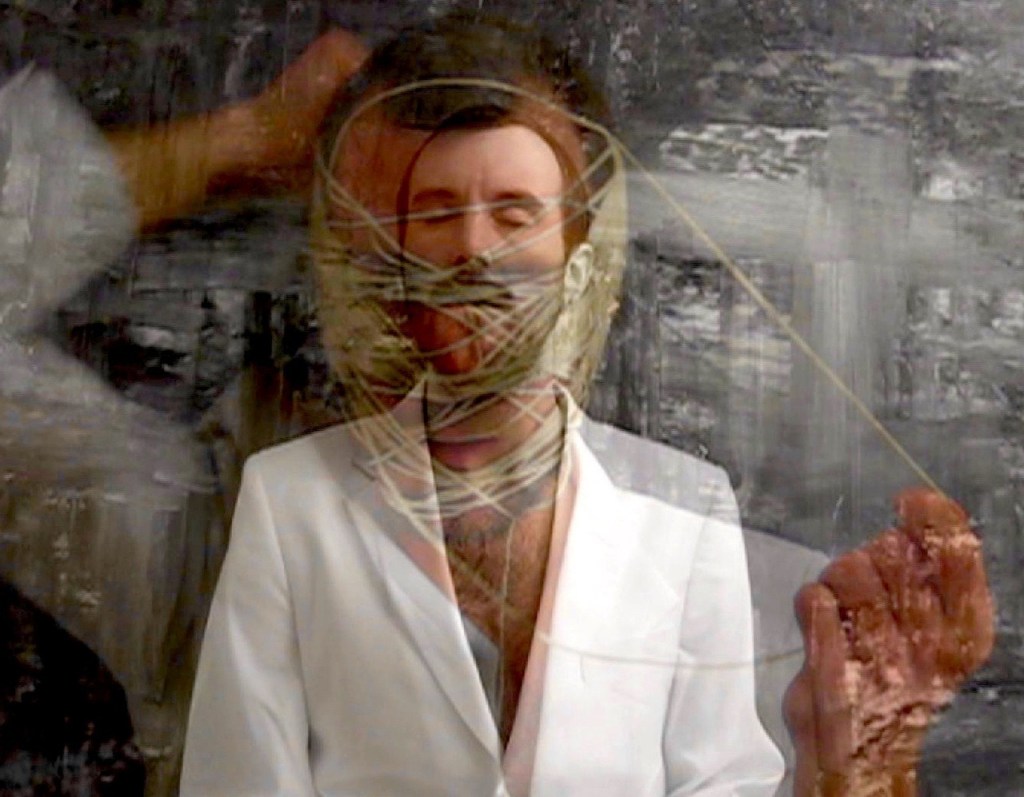
The photo is a still from a performance video I made in 2012. Through my visual art I was always trying to articulate my feelings and beliefs about the physical and metaphysical. Through art I sought to examine this relationship and express that visually which alluded me in every other form of expression and means of communicating. In this video we have two beings; one that remains still, eyes closed. The other worked furiously to wrap and eventually unwrap their head with string. The being with their eyes closed is actually the one seeing, the one that is fully aware of what is going on internally and externally. The other being, the one wrapping their head with the string, is the being trying to figure out their place within everything, to literally untangle the mess and confusion in which they find themselves.
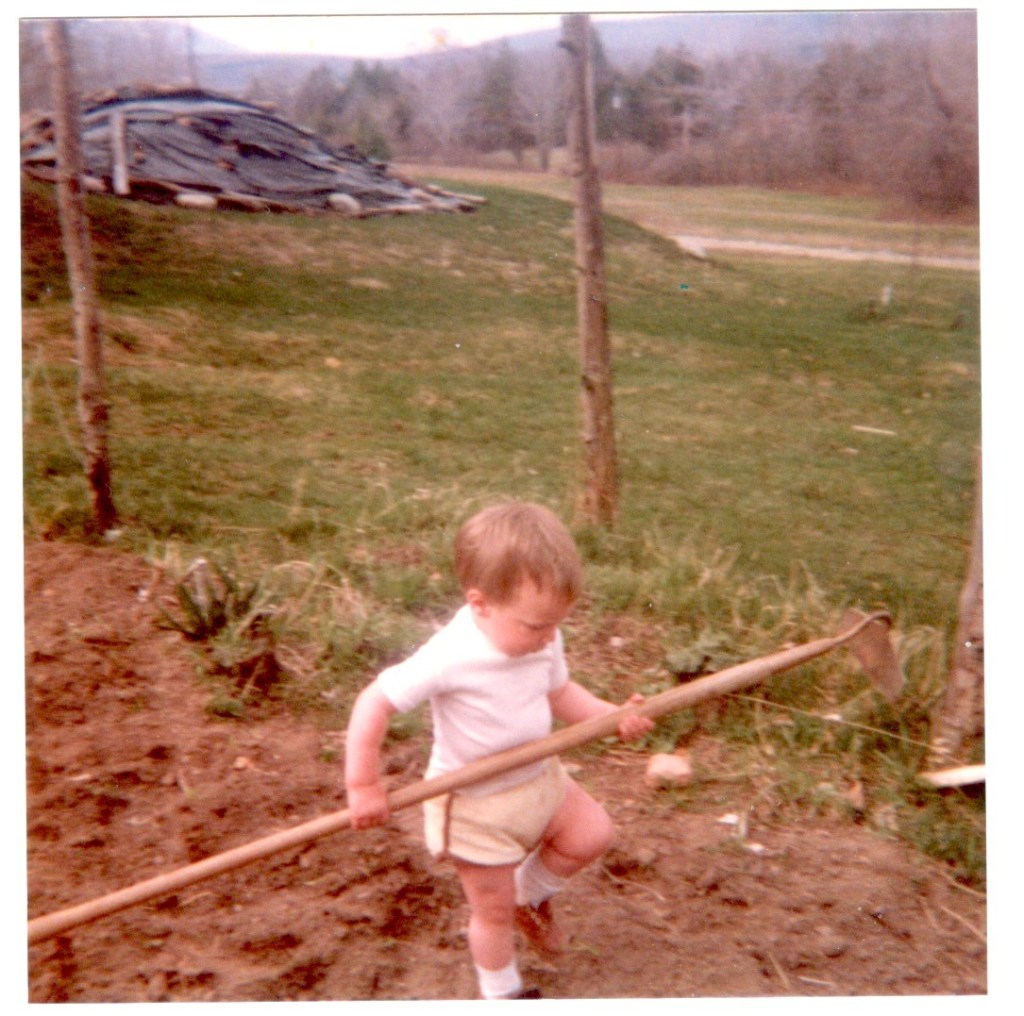
There is a photo of me as a young child sitting in a rhubarb patch, looking content. I like telling people I was born on a farm in Vermont. This, of course, is true. Born to parents who went “back to the land” a couple decades after the peace-&-love generation & decades before the trendy, neo-hippy movement of today. Displaced, so to speak; the idealized, flower-power mentality after its heyday had come and gone, and way too soon to sell “Vermont-made” handicrafts on Etsy. Sitting in a rhubarb patch as a child, I was in a little garden paradise, blissfully unaware of the lack of cultural stimulation, full-time employment, and the reality of being 16 miles from the nearest supermarket.
Gardening is a form of regression back to this innocent state, not entirely of course, as I am no longer a child in a rhubarb patch, but enough so that allows for certain worries and concerns to be gently washed away.
In the summer months between semesters, I would landscape. It wasn’t lucrative or as lucrative as I would have liked considering my upcoming needs as a full-time student, but I found myself repeatedly drawn to it. The long hours of labor, the sun and sweat, and the feeling of contentment after a day or a long week were completed. I needed this connection to labor and the earth in those summer months. It was a reprieve from the bullshit of academia, a world I was beginning to loathe. I worked with men who, as children, labored alongside their brothers and sisters, mothers and fathers, in the potato fields in Maine. I had worked with them for several summers. Each summer, I’d return, and they were there, seemingly untouched; country music playing in the shop, lunchtime at noon on the dot, and crass jokes when the situation presented itself. Whereas they saw the job as a means to an end, I saw it as a desperate need to return to the land, like my parents, and get my hands in the dirt regardless of how the future might unfold.
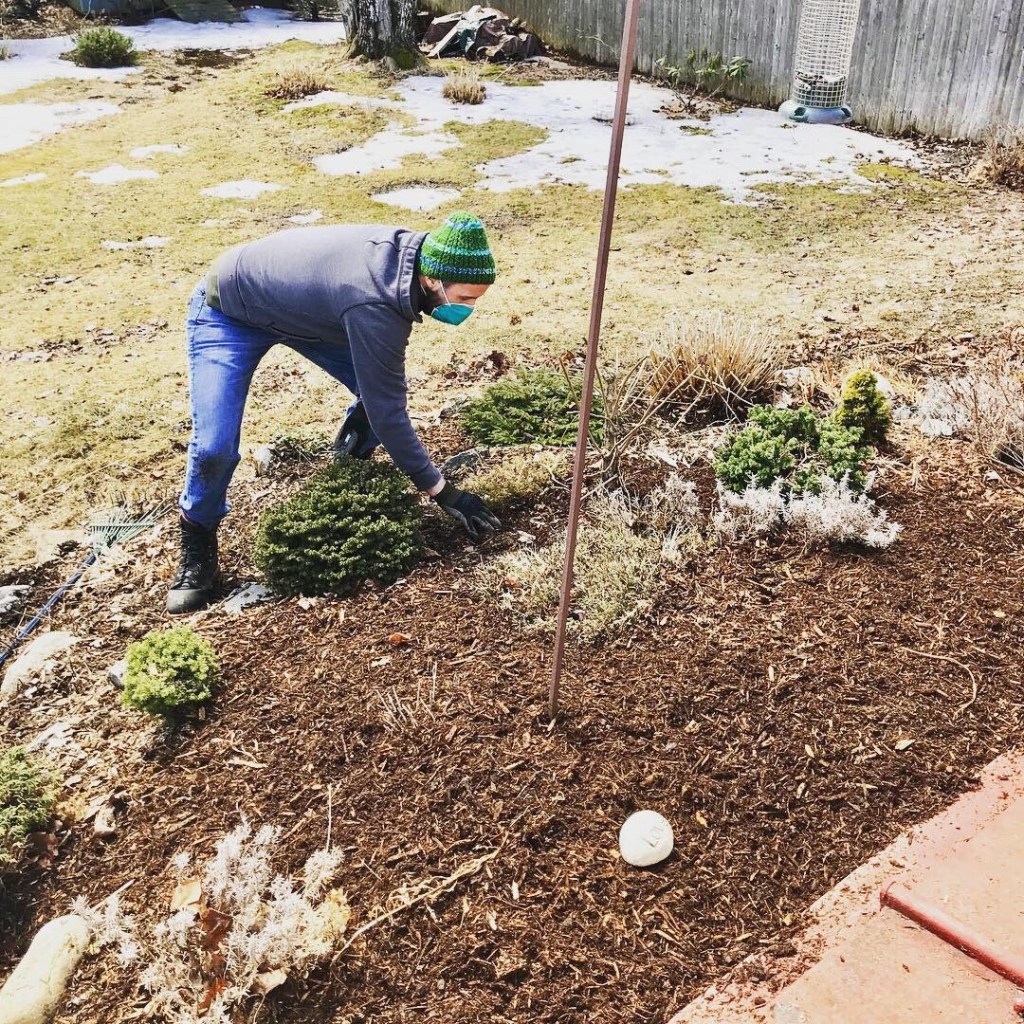
During the initial treatment I completed in July 2016, I was too ill to venture outside to do any gardening. The following summer I was at Mass General undergoing stem cell transplants which, after being discharged, left me with essentially no immunity as well as energy levels that constantly hung well below normal. 2018 allowed for light yard work. I would venture out and, as usual, due to my stubborn nature, would push myself too hard and end up exhausted to the point of tears. Nonetheless, it felt good! I have started early garden cleaning this season. Raking the leaves, spreading a little mulch, trimming back anything that was too lanky last season. These seemingly little pleasures make me happy. Yes, I have to wear the N95, the same type I needed to wear whenever I roamed the halls at Mass General. The sterile smell conjures up numerous memories and nauseates even to this day.
I have been contemplating the reasoning behind my love of gardens and the earth itself. This post (or update) has remained unfinished for some time as I wasn’t sure how to end it — rather, how to articulate the power gardening has over me. What I came to realize is that I can’t fully articulate it, I can’t express it in words as there are none. After my weeks of trying to find the great “why” we perpetually ask ourselves as humans, I do know that there is honesty in gardening, in the earth. A single garden bed has no masks to hide behind; it is more direct and honest than most humans ever will be. A return to the earth, to the garden(s), is the kindling of a relationship that, for me, surpasses the relationships I have/had with my own species. I feel safe within gardens and the earth itself. I can be joyful and happy or sad and mad; the garden, the earth, accepts this and is joyful with me or soothes my sadness.
I didn’t understand this connection for the longest time. In fact, as stated, it took serious contemplation to even recognize the reasoning behind my feelings for both gardens and the earth. Looking back, I can trace this feeling of comfort and safety throughout the years and through the many gardens I have worked in and spent time in. I wonder about that photo of me as a young boy sitting in a rhubarb patch. I don’t want to taint that memory with the ideas and philosophies I have now as an adult, but I can’t help wondering.
I had a recent and brief exchange with my uncle after a recent post about life, its potential pointlessness, and the struggle to find meaning.
(Chris) Interesting ruminations! I think that Tolstoy’s outlook is pretty pessimistic. I believe that life has a purpose, but I don’t necessarily believe that your illness has anything to do with it. Your purpose may be to help someone later in life, maybe to have kids, work with people experiencing poverty, invent, write, or draw something important. Maybe this three-year period is just a detour that has nothing to do with that. I don’t know!!! much love,
(Jeremiah) His outlook certainly was pessimistic… but I feel that was the impetus for his spiritual pursuits/awakening. He had to fall into that place of despair to arrive. I guess, the way I look at it, I was already en route to these things; in my last semester of grad school, I was going through interviews with the Peace Corps to work (with people with low incomes, perhaps) in Albania. I was writing … I was drawing. I think that a detour that goes on for three years is a bit excessive. It isn’t the physical journey but that of the mind, psyche, etc. As I have written, the toll that all this has taken is very significant. Yes, my oncologist can say, “You look great!” But he doesn’t see the damage on the inside. Of course, his objective is to treat the patient, so externally, I look “great.” I don’t know where I am going with this. I do that this illness, and the longevity of it, MUST have something to do with it / with life. I have to think like this; otherwise, what’s the point? If all my struggling physically and psychologically was all for naught … I can’t go that route in thinking… I spiral out of control…
Chris Naturally, everything we go through leads us to be who we are at any moment. So you are, and will be, a very different person than you would have been had you not gotten cancer. But that doesn’t mean (in my mind) that it is directly related to your purpose in life.
The irony of being diagnosed with advanced cancer on April Fools’ Day doesn’t escape me. Though I had been told I “might have” cancer several days prior, the diagnosis didn’t actually arrive until this day in 2016. The doctor at the walk-in clinic said that it might be cancerous, but I would need a biopsy to be sure. It wasn’t denial so much as prioritization; I had a thesis to write, a show to install, exams to finish, etc. I assumed a biopsy could wait. Several days later, I woke up in the back of an ambulance, completely disoriented and unaware of my own name. After multiple tests, surgery, etc., I was informed that, yes, it was, in fact, cancer. After such news, under such circumstances, priorities change; a thesis, exams, papers… these would have to wait. Obviously.
I replay this scenario again and again. All of it, not just the initial diagnosis… but every aspect of the last three years. It’s not so much rumination as it is an attempt to understand and make sense of it all. I am looking for something tangible, some meaning…
The truth is, there is none.
Tolstoy said, “The only absolute knowledge attainable by man is that life is meaningless.”
Initial consideration of this philosophical mindset might lead one into deep despair. However, I must agree wholeheartedly.
Tolstoy, however, did find meaning in his life. After publishing Anna Karenina, Tolstoy slipped into a great existential crisis and became increasingly paralyzed by the fear of death. This fear was all-consuming, but perhaps it was a catalyst, pushing him toward finding meaning. He pursued religion and spirituality with the same intensity and fiery passion with which he wrote. His beliefs leaned towards Christianity, but he found that the church, which in his eyes was a corrupt institution, was falsifying the teachings of Jesus. He was inspired by many saints, notably St. Francis of Assisi and others who forsook wealth and worldly goods to pursue a deeper kinship and connection with god.
I want there to be meaning within this, within my journey. I want to find meaning. Looking back over these three years, I am not in a good place tonight. Sitting here trying to pull a couple threads of sense out of the insane tapestry draped before me. That’s all I want; a couple of strands to grasp hold and say, “Look here, I found two reasons! Here are two reasons why!”
I suppose, like Tolstoy, I will have to find my own meaning within all this — to make meaning from it. Maybe one day, when time has softened all this, I’ll find those two strands of meaning and begin to weave my tapestry.
After drinking one liter of contrast dye and being poked numerous times to place an IV, my chest/abdomen/thorax show stability! No new developments – things are as they were and have been – stable!
Now, the task is sorting out these seizures. My anticonvulsant med has been increased, so we’re hoping this holds. However, if it doesn’t, the next step would be inpatient epilepsy monitoring. Several months ago, this was the initial idea; however, my neurologist didn’t want to jump into that. As he said, “Let’s leave well enough alone.” At the time, it had been a few months since my last seizure, and the hope was that the medication was holding. After my recent seizure, however, it was decided that, should another episode occur, I would enter the EMU (epilepsy monitoring unit) at Maine Medical Neuroscience Institute to get a very clear idea of the seizure activity.
Part of me wants to enter the unit right now to really understand the root cause of these debilitating seizures. The flip side is that I am exhausted, and the thought of being impatient for any reason makes me angry and sick to my stomach.
I want to return to normal, and this bullshit idea of this being the “new normal” greatly annoys me! This mentality is far too easy to put forth from people who haven’t spent 3 years trying to stabilize themselves, right themselves, adapt, and readjust every moment of every day.
The positive news is that my lungs/thorax/etc. Are stable overjoys me… but I celebrate halfheartedly, always wondering what might be lurking, waiting for me to let my guard down. History has shown that with every up, with every moment of elation, is followed by a horrific down, a paralyzing fall. What is seen as pessimism, or something similar, is me trying to minimize the letdown, the fall from too great a height. Being in this constant state of emotional and psychological neutrality is a shame.
As part of my psychotherapy, I was asked to write about the initial seizure and subsequent diagnosis from the 3rd person’s perspective. I have buried a lot; I haven’t wanted to return to that particular day, but I know it is present. It is there, in my mind, lurking. It appears in dreams; it presents itself when I let my guard down. In my unconscious states, the presentation in these moments is sometimes cloaked in metaphors and surreal imagery, but I wake knowing where it is tethered. This is human nature; this is our survival mode kicking in.
Jeremiah Ray, untitled, 2013, oil, acrylic, charcoal, dirt, on canvas
Jeremiah did not feel well upon waking. Perhaps it was stress or another late night of working on his thesis… he could not tell.
After a shower, he felt slightly better, but there was a tiredness that he could not shake and a queasy feeling in his gut.
He exited his basement apartment and stood on the stoop. The dappled sunlight flooded over him. The air was still cool, as it was barely April, but the sun was growing strong. He closed his eyes and stood still, ‘yes,’ he thought, ‘sunlight will nourish me.’
Stepping down, he dodged the uniformed children making their way to an elementary school just west of his apartment. He noticed, almost daily, that their uniforms had a military look to them. Neatly pressed shirts and pants, leather shoes, etc. They didn’t look like the catholic school uniforms he had worn in his youth.
Jeremiah arrived at the corner of Broadway and Thorndale. It was a busy morning, and, like the school children rushing to make their classes, the cars that whizzed past had an urgency to them. Jeremiah didn’t have such an urgency. He stood on the corner and let the unhindered sun fall over him. The traffic and pedestrians danced around him. He seemed to be at a standstill; he was, in fact, and this made him seem out of place within the whirlwind of the morning commotion.
He had no real urgency, he had none in fact. That morning, his only plan was to go to the park and meet Eda. They had arranged to soak in the sun in Millennium Park. It was, he noted again, a perfect day for such an occasion. Also, he wanted to see more of Eda, she was attractive, intelligent and a good conversationalist. They were still in the early stages of getting to know one another. He liked this time, the explorative and exciting time of a potential relationship.
Part of Jeremiah’s attention was preoccupied with the lingering feeling he had had since he awoke. It wasn’t nausea per se, and he knew the sensation of stress; thus, he could also rule that out. The other part simply wanted to enjoy the sun. He remained in a neutral zone, letting neither sensation nor desire pull the entirety of his attention.
Jeremiah had waited through two rounds of red lights & two rounds of green crosswalk signals beckoning him to join the others in their haste. He decided to go across Broadway to the Thorndale Red Line Station and join in the morning rush. He disliked these morning commutes but loathed the afternoon and evening ones. Depending on the day, the northbound trains leaving downtown anytime between 4 and 8pm were like cattle cars. The morning commute was less crowded; Thorndale was only a few stops before the end of the red line, a perk of living so far out of the city.
The schoolchildren ran past him as he stepped out to cross the four lanes that made up the intersection of Broadway and Thorndale. Broadway was one of those streets that ran a great distance, miles and miles of ever-changing facades; CVS pharmacies, mattress stores, seedy restaurants, the flip side being trendy coffee shops, hipster bars, Whole Foods, etc. Jeremiah was used to New England streets, even the city streets like those in Boston, that curved around this way and that, intersections that confused tourists and locals alike, and one-way streets that began randomly. The city had no real planning and just grew with the expansion of the population, which grew due to the Industrial Revolution and the massive changes it brought with it. It was as if the city reached out in all directions, sending runners here and there that shaped the city with some chaotic beauty. On the other hand, Chicago was systematic; streets would run for miles and miles, and the flatness of the Midwest let them stretch to no end.
The sound of the schoolchildren became slightly muffled, as if there was some sort of ringing in his ears or that they had water in them. Sunlight bounced off of a storefront window and blinded him. It was a flash, like an explosion, a bolt of lightning. The schoolchildren ran about, laughing gleefully. Looking down Jeremiah saw the shadows of everyone going to and fro, it was an insane dance upon the sidewalk; bodies blending and merging, figures morphing into multi-limbed creatures that split apart, multiplying and dividing. Again, an explosion as the sunlight bounced off another storefront window. He had kept his gaze down, mesmerized by the multi-limbed shadows. As the blast of light occurred, the shadows dispersed as if running from it, as if scared. Then, when the lightning flash passed in the blink of an eye, the shadows returned and resumed their odd dance.
Overhead, the northbound Red Line slowed at the station. The thunderous wheels rolled to a stop and then began again, generating this metallic cacophony that quickened until it was swallowed up by the southbound train. The two sounds were dissonant and jarring. The northbound train was picking up speed as the southbound train began to slow. The sounds pulled at one another, tearing an ugly hole in the peaceful morning.
Clack clack claclaclaclaclaclclcl the northbound train ran away.
A hiss of sorts sounded out; there, above him on the trestle that stretched over Thorndale, was the southbound train. It stretched many cars and seemed to loom almost imposingly above him. The doors opened and then closed, and it moved south like its northbound counterpart as if tugged by some unknown force. The sunlight broke through the train cars; at first, it was slow, shadow-light-shadow-light. Then, as the train increased speed, the timing generated a hypnotic sensation even behind closed eyes, shadow-light-shadow-li-sha—l-sh-l-s.
Jeremiah’s stomach turned, the queasiness rose up inside him, and there was almost this desire to wretch. He was unsure at that moment if he was standing still. Was he moving? Others around him took no notice; they flowed about him like a river moving around a large rock. Unlike the rock holding its own in the torrents of raging water, he began to give way, to slip. A sneaking sensation of paranoia crept up within him. It crawled up his spine and filled his mind with questions: Are you ok? Are these people aware of you? Are you having a panic attack? His awareness of self made his eyes move about pinpointing someone or something that might be an anchor he could hold. There was no one. There was nothing.
The feeling of queasiness moved from his gut to his head, and there became a pressure. As it ventured from his gut to his head, it curled its fingers about his throat, then wrenched his jaw open with such force. It felt dislocated, swinging there, disjointed, resting on its hinges. Then, the fingers crawled into his brain. His eyes fluttered. They fluttered again. The two trains arrived simultaneously, northbound and southbound, directly across from one another on the narrow, wooden platform that separated the two trains. The doors opened at the same time, and both departed at the same time. The metallic clanging was almost symphonic and then again became dissonant as the two ran off in separate directions, each moving at different speeds.
His unhinged jaw swung open and locked in that position, ajar and painful. His stomach burned, his legs unsteady. Jeremiah’s right hand began curling inward, fingers to palms. He had no control of this movement, none whatsoever. The southbound train arrived, and the shadows flickered until they slowed to a stop. His eyes fluttered in a syncopated rhythm; eye open, shadow, eye closed, light, etc.
His ears filled with every sound, every car, every child running off to school, every footstep, every flash of light… Then, there was not a single sound at all. Like the shadows upon the ground that moments before had transfixed his attention, so too did the motion of everything and everyone, just a blur of beings and objects in various colors and shapes, coming in and out of lights and shadows. Then there was stillness and just a whooshing sound in his ears.
His curling hand turned inward and was drawn upward towards his open jaw, then further to his head. He cupped it as best he could with his rigid hand. It wasn’t pain that he felt; he didn’t know the words. There was simply a lack of control. He could not say no to stop this, to return his hand to his side and close his jaw. The whooshing sound disappeared, but the world still remained motionless. A sound came from him, from within him. It wasn’t a word or a plea for help. It was a word to him yet outside his vocabulary. A moan escaped him as a sigh, as a yawn might. A long, extended moan. Then his body fell, his legs gave way, and his being slipped downward into some hole, into some sort of abyss that opened underneath him, a trapdoor in the earth.
Where was he? Who was he? Just blackness that engulfed him; rich, thick darkness in which no light was present, no words were uttered, nothing. His sigh had left, the morning commotion had gone, and the trains no longer sounded out. Nothing. No one.





 healing is a circular path