
As part of my psychotherapy, I was asked to write about the initial seizure and subsequent diagnosis from the 3rd person’s perspective. I have buried a lot; I haven’t wanted to return to that particular day, but I know it is present. It is there, in my mind, lurking. It appears in dreams; it presents itself when I let my guard down. In my unconscious states, the presentation in these moments is sometimes cloaked in metaphors and surreal imagery, but I wake knowing where it is tethered. This is human nature; this is our survival mode kicking in.

Jeremiah did not feel well upon waking. Perhaps it was stress or another late night of working on his thesis… he could not tell.
After a shower, he felt slightly better, but there was a tiredness that he could not shake and a queasy feeling in his gut.
He exited his basement apartment and stood on the stoop. The dappled sunlight flooded over him. The air was still cool, as it was barely April, but the sun was growing strong. He closed his eyes and stood still, ‘yes,’ he thought, ‘sunlight will nourish me.’
Stepping down, he dodged the uniformed children making their way to an elementary school just west of his apartment. He noticed, almost daily, that their uniforms had a military look to them. Neatly pressed shirts and pants, leather shoes, etc. They didn’t look like the catholic school uniforms he had worn in his youth.
Jeremiah arrived at the corner of Broadway and Thorndale. It was a busy morning, and, like the school children rushing to make their classes, the cars that whizzed past had an urgency to them. Jeremiah didn’t have such an urgency. He stood on the corner and let the unhindered sun fall over him. The traffic and pedestrians danced around him. He seemed to be at a standstill; he was, in fact, and this made him seem out of place within the whirlwind of the morning commotion.
He had no real urgency, he had none in fact. That morning, his only plan was to go to the park and meet Eda. They had arranged to soak in the sun in Millennium Park. It was, he noted again, a perfect day for such an occasion. Also, he wanted to see more of Eda, she was attractive, intelligent and a good conversationalist. They were still in the early stages of getting to know one another. He liked this time, the explorative and exciting time of a potential relationship.
Part of Jeremiah’s attention was preoccupied with the lingering feeling he had had since he awoke. It wasn’t nausea per se, and he knew the sensation of stress; thus, he could also rule that out. The other part simply wanted to enjoy the sun. He remained in a neutral zone, letting neither sensation nor desire pull the entirety of his attention.
Jeremiah had waited through two rounds of red lights & two rounds of green crosswalk signals beckoning him to join the others in their haste. He decided to go across Broadway to the Thorndale Red Line Station and join in the morning rush. He disliked these morning commutes but loathed the afternoon and evening ones. Depending on the day, the northbound trains leaving downtown anytime between 4 and 8pm were like cattle cars. The morning commute was less crowded; Thorndale was only a few stops before the end of the red line, a perk of living so far out of the city.
The schoolchildren ran past him as he stepped out to cross the four lanes that made up the intersection of Broadway and Thorndale. Broadway was one of those streets that ran a great distance, miles and miles of ever-changing facades; CVS pharmacies, mattress stores, seedy restaurants, the flip side being trendy coffee shops, hipster bars, Whole Foods, etc. Jeremiah was used to New England streets, even the city streets like those in Boston, that curved around this way and that, intersections that confused tourists and locals alike, and one-way streets that began randomly. The city had no real planning and just grew with the expansion of the population, which grew due to the Industrial Revolution and the massive changes it brought with it. It was as if the city reached out in all directions, sending runners here and there that shaped the city with some chaotic beauty. On the other hand, Chicago was systematic; streets would run for miles and miles, and the flatness of the Midwest let them stretch to no end.
The sound of the schoolchildren became slightly muffled, as if there was some sort of ringing in his ears or that they had water in them. Sunlight bounced off of a storefront window and blinded him. It was a flash, like an explosion, a bolt of lightning. The schoolchildren ran about, laughing gleefully. Looking down Jeremiah saw the shadows of everyone going to and fro, it was an insane dance upon the sidewalk; bodies blending and merging, figures morphing into multi-limbed creatures that split apart, multiplying and dividing. Again, an explosion as the sunlight bounced off another storefront window. He had kept his gaze down, mesmerized by the multi-limbed shadows. As the blast of light occurred, the shadows dispersed as if running from it, as if scared. Then, when the lightning flash passed in the blink of an eye, the shadows returned and resumed their odd dance.
Overhead, the northbound Red Line slowed at the station. The thunderous wheels rolled to a stop and then began again, generating this metallic cacophony that quickened until it was swallowed up by the southbound train. The two sounds were dissonant and jarring. The northbound train was picking up speed as the southbound train began to slow. The sounds pulled at one another, tearing an ugly hole in the peaceful morning.
Clack clack claclaclaclaclaclclcl the northbound train ran away.
A hiss of sorts sounded out; there, above him on the trestle that stretched over Thorndale, was the southbound train. It stretched many cars and seemed to loom almost imposingly above him. The doors opened and then closed, and it moved south like its northbound counterpart as if tugged by some unknown force. The sunlight broke through the train cars; at first, it was slow, shadow-light-shadow-light. Then, as the train increased speed, the timing generated a hypnotic sensation even behind closed eyes, shadow-light-shadow-li-sha—l-sh-l-s.
Jeremiah’s stomach turned, the queasiness rose up inside him, and there was almost this desire to wretch. He was unsure at that moment if he was standing still. Was he moving? Others around him took no notice; they flowed about him like a river moving around a large rock. Unlike the rock holding its own in the torrents of raging water, he began to give way, to slip. A sneaking sensation of paranoia crept up within him. It crawled up his spine and filled his mind with questions: Are you ok? Are these people aware of you? Are you having a panic attack? His awareness of self made his eyes move about pinpointing someone or something that might be an anchor he could hold. There was no one. There was nothing.
The feeling of queasiness moved from his gut to his head, and there became a pressure. As it ventured from his gut to his head, it curled its fingers about his throat, then wrenched his jaw open with such force. It felt dislocated, swinging there, disjointed, resting on its hinges. Then, the fingers crawled into his brain. His eyes fluttered. They fluttered again. The two trains arrived simultaneously, northbound and southbound, directly across from one another on the narrow, wooden platform that separated the two trains. The doors opened at the same time, and both departed at the same time. The metallic clanging was almost symphonic and then again became dissonant as the two ran off in separate directions, each moving at different speeds.
His unhinged jaw swung open and locked in that position, ajar and painful. His stomach burned, his legs unsteady. Jeremiah’s right hand began curling inward, fingers to palms. He had no control of this movement, none whatsoever. The southbound train arrived, and the shadows flickered until they slowed to a stop. His eyes fluttered in a syncopated rhythm; eye open, shadow, eye closed, light, etc.
His ears filled with every sound, every car, every child running off to school, every footstep, every flash of light… Then, there was not a single sound at all. Like the shadows upon the ground that moments before had transfixed his attention, so too did the motion of everything and everyone, just a blur of beings and objects in various colors and shapes, coming in and out of lights and shadows. Then there was stillness and just a whooshing sound in his ears.
His curling hand turned inward and was drawn upward towards his open jaw, then further to his head. He cupped it as best he could with his rigid hand. It wasn’t pain that he felt; he didn’t know the words. There was simply a lack of control. He could not say no to stop this, to return his hand to his side and close his jaw. The whooshing sound disappeared, but the world still remained motionless. A sound came from him, from within him. It wasn’t a word or a plea for help. It was a word to him yet outside his vocabulary. A moan escaped him as a sigh, as a yawn might. A long, extended moan. Then his body fell, his legs gave way, and his being slipped downward into some hole, into some sort of abyss that opened underneath him, a trapdoor in the earth.
Where was he? Who was he? Just blackness that engulfed him; rich, thick darkness in which no light was present, no words were uttered, nothing. His sigh had left, the morning commotion had gone, and the trains no longer sounded out. Nothing. No one.
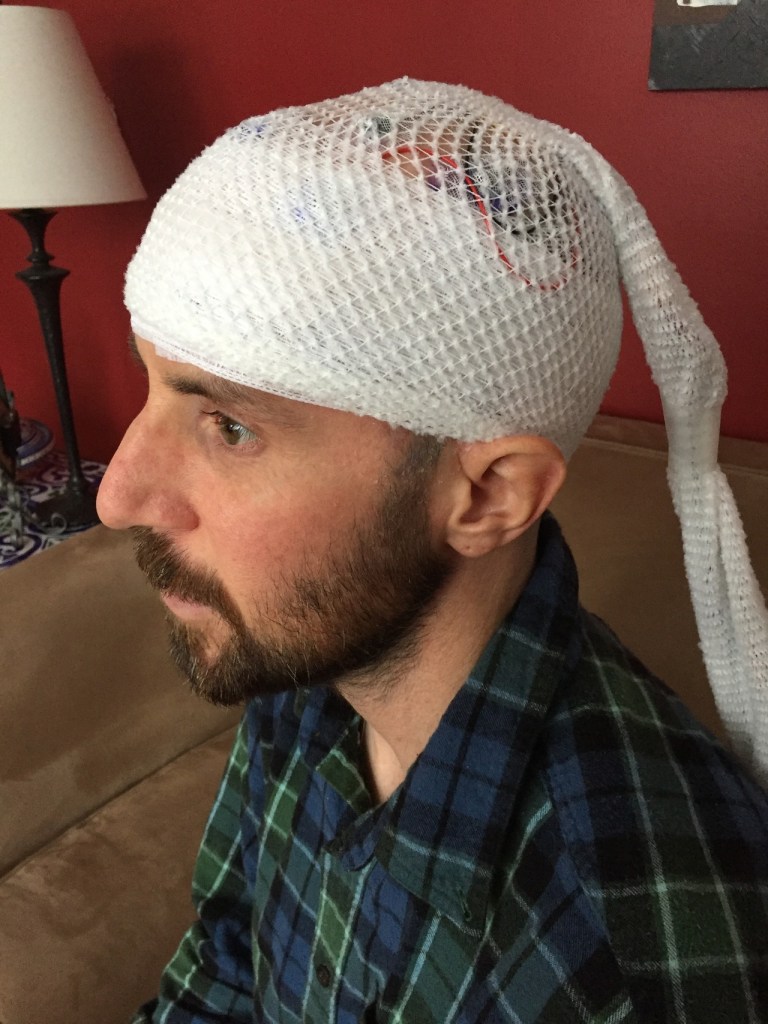
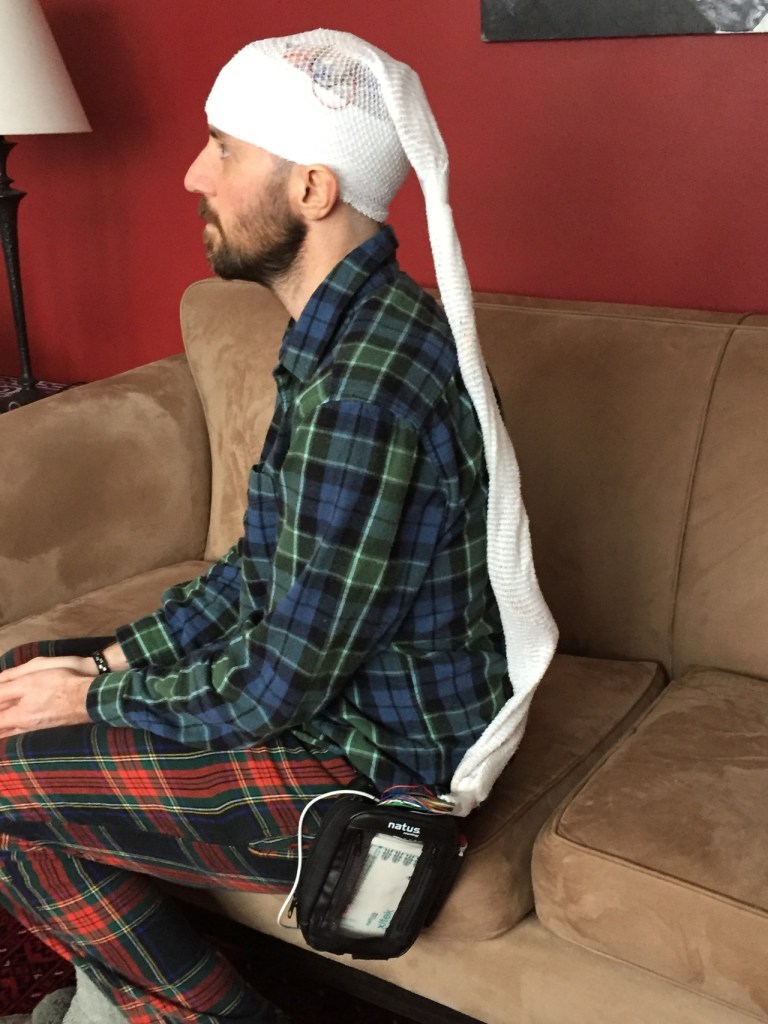

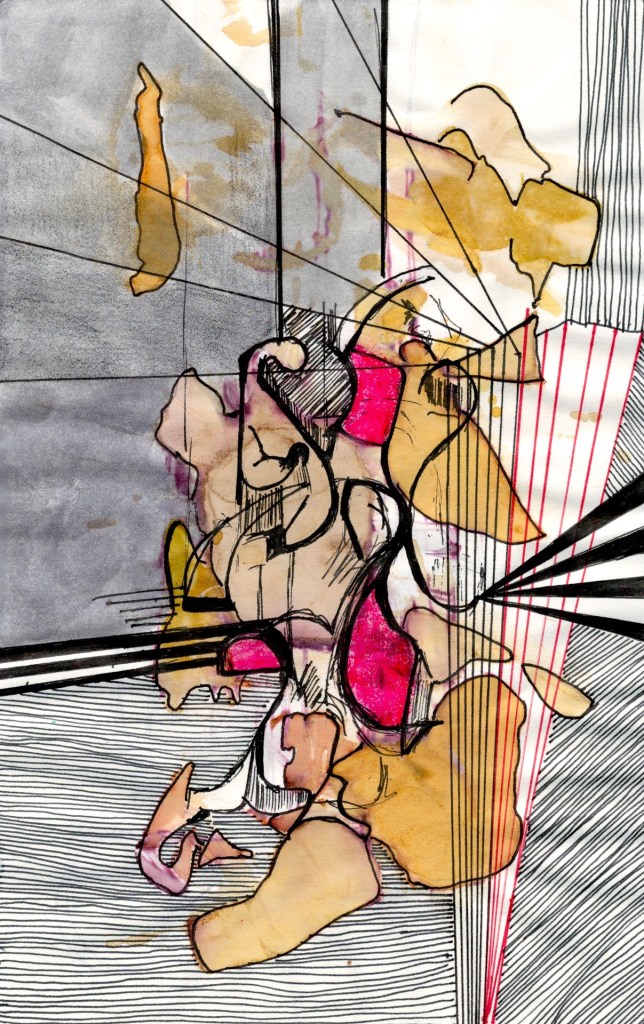
 healing is a circular path