Featured

A Journey

The middle-ground

Cancer is a sort of middle-ground between what was and will eventually be. This middle ground is unstable and forever shifting and changing — often daily. As unstable as it is, it also acts as an anchor. With a diagnosis and subsequent treatment, with life revolving around clinics and tests, trying to grapple with the “new normal” post-cancer, as well as the shift in perspective of life when the dust settles, patients seek refuge on this ground.

This middle ground, however, cannot hold, nor is it meant to.

To acknowledge that one is in remission is to become aware that the steps, however frightening, must be taken to move away from the middle ground to step forward. I have kept myself there in this gray area.

I can stay here forever. There is safety here. I’ll live here. I’ll build a life here.

This middle ground, however, cannot hold, nor is it meant to.

As horrifying as they were the circumstances in France rattled parts of me, they forced me to bear witness to the events that had taken place over the years. I was unprepared to handle the deluge of emotions from observing this. The events snapped me into such intense awareness of all that had come to pass, each and every brutal moment of my journey. The emotional scars became apparent. The physical scars radiated, and I could not look away from either or turn my attention elsewhere. My emotional being couldn’t hold out any longer; I was shedding layers, and the feeling of emotional nudity was unbearable. I was losing the self I had been constructing; who was Jeremiah now? This identity was slipping, try as I might I couldn’t hold it. Everything came to a grinding halt; I was literally and figuratively unable to take another step. Brain surgery had to occur during active treatment; there was no question about the procedure. When everything started to rise to the surface, when the layers were dropping away, the physical and psychological acknowledgment of this particular scar was the trigger that sent me into a tailspin. 

I have been able to meditate on some of the imagery and hallucinations I experienced during my breakdown. There are some images that, until now, have remained mysterious or so tangled in metaphor that I couldn’t decipher them. One in particular was pulling a hair-like substance from my chest. This unnerved me, and I wasn’t ready to interpret it. I had been building an identity around cancer; it engulfed my entire life for so long that I took on that persona, that of a patient. ‘I have cancer’, I’d say to myself, or I speak about it as though it was current, that I still had it, that I was still in the place of treatment. Neither is true. This gesture of pulling this substance from my chest is so clear to me now, so obvious. I was trying to extract this identity, this version of myself that has since passed. The transient persona that I had outgrown yet was fiercely holding onto. From within me, from my core, I was trying to haul this out, to unburden myself of it. Not to rid myself of the memories, good or bad, nor the lessons learned, as there are numerous — a lifetime’s worth! I was trying to purge myself of all that didn’t serve me, holding me back from stepping off the crumbling middle ground.

I had to return to France; Golinhac was calling me. All this came about there; all that dormant within me rose fully to my attention — glaringly so! In return, I would leave the remanence of this deteriorating middle ground and my meticulously crafted persona. I’d keep the new awareness and lessons from the incidences experienced there and feel a sense of certainty in stepping away.

I put a ticket on my charge card and began packing. Just a few weeks after I left France, a complete emotional and psychological mess, I was going back.

Everyone expressed their concerns. They were worried that I was still very vulnerable and returning so soon, in a fragile emotional and psychological state, would be very unwise. Why, after such a short period of time, would I want to return to the site of my breakdown? To the place where, just a few weeks ago, I was admitted to the emergency room after being found screaming and howling in the middle of a footpath just outside of Golinhac. These questions started building in my mind, too. Why would I want to do this? The entire way to Boston, which on the bus felt like an eternity, I was wondering what on earth I was doing. What was I hoping for? I didn’t know the answer to anything. Even during my layover in Lisbon, I still wondered and questioned everything.

I admitted to a dear friend who has been an incredible support this entire time and someone I feel safe confiding in,

“I don’t know what I’m searching for.”

“I don’t either,” she replied.

This is the uncertainty that keeps a cancer survivor remaining in the middle ground. Not only the uncertainty of life, as explained, but that of oneself, the question of who one is — who is this Jeremiah? How has he arrived here?

I don’t need an identity here. I can stay here forever. There is safety here. I’ll live here. I’ll build a life here.

This middle ground, however, cannot hold, nor is it meant to.

I walked east out of Golinhac with ever-increasing anxiety. I had to stop and gather myself to go on a few times. At one point, I even considered returning home, admitting it was too soon for such an undertaking. But I was still drawn onward and slowed considerably, taking deep, slow breaths with each step. I stopped at a certain point, put down my pack, and started emulating the gesture of pulling the hair substance from my chest. Gently, slowly, without the frantic haste of my hallucination, I mimicked the action, one hand then the other in a rhythmic fashion as though softly pulling one long, continuous thread from my chest. The action became ritualized in its repetition, fluidity, and symbolism, bringing a deep sense of peace. I envisioned dismantling the persona that had been constructed around cancer, the identity that no longer served me. Bit by bit, as if pulling a single thread that unweaves a tapestry, I unraveled an identity. I simultaneously entwined a new Jeremiah, no longer the patient, yet holding the memories and lessons – the same thread yet a different weave pattern. 

I stood still in the silence of the location and continued taking long, slow breaths. Dusk arrived, and with it, a chill. I retrieved my pack and walked westward back towards Golinhac.  

The peace I felt there has remained. Returning to France, which consisted only of four full days, left me feeling as though I had undergone years of psychotherapy. It isn’t so much that I am thankful for the breakdown itself, as it was terrifying, rather, that I am thankful for that which it revealed to me and the metamorphic shifts that have since followed. 

This is not to say that I have stepped entirely from the teetering middle ground, but I have one foot firmly planted on the other side.

I can build an identity here, one that is linked to (the) cancer via memories and life lessons and not one that is torn between two worlds, two worlds that ultimately hinder the desperately needed stability required for reconstruction.

The body

For years, I didn’t like my body. For the majority of my life, there was this sense of guilt or shame about how I looked and felt. As a result or product of, I am not sure, there was an internal struggle, a sort of emotional and spiritual dissonance within that which I can only refer to as the soul. 


The body and soul were awkward, each attempting to adjust to one another, the physical and metaphysical working their way into a partnership of sorts. In one’s formative years, this is a time of great physical and emotional/spiritual strife. From my childhood until recently, this lingering sensation of turmoil always seemed to be. 


Much of this stems from the labels and ideas thrust upon us by the society and culture into which we are born. It is hard to adjust and figure out our way through the swamp of ideals and morals, beliefs and philosophies that aren’t necessarily our own – in fact, they seldom are, as we soon discover, they are simply handed down piece by piece. In such a way, they become like the game a telephone might play as a child. One person starts a phrase, and it is passed around or down a line. The end product is usually some bastardized version of the initial statement. The awkwardness of soul and body, this feeling of discontent, eventually brings us to the point of either acceptance of the societal and cultural default settings or forces us to step out in hopes of discovering that to which we are drawn by some force and/or inner seeking. Both take courage, neither one can be deemed good or bad, right or wrong etc. 

Amid treatment, during the first rounds immediately following my diagnosis, I stepped out of the shower one morning and stood before the mirror fixed to the opposite wall. There, in front of me, was my naked body. My hair had long since fallen out on my head and my entire physical being. I looked like some prepubescent boy with the face of a middle-aged man – a face exponentially haggard by exhaustion, stress, anxiety, etc. My eyes were sunken, tired, and sad. They, my eyes, have always held every bit of my worry, fear, joy, passion, etc. I looked at myself; I stared at the body before me. I stood still and let the feelings and sensations (some of which I haven’t found a suitable word for) pulsate from my core. 


I stood there. My fingers traced various lines and ran over my bloated body, puffy from steroids and other drugs administered during active treatment.


The orchiectomy incision looked back at me. I hadn’t looked at it since the operation and commencement of treatment. There was a part of me that didn’t want to look at it, to admit that it existed, or to deny the fact the surgery had taken place. 


Afterward, I let my fingers wander over my body, from the top of my bald head to the sunken sockets holding my eyes, over my flabby belly, and along the scar that marks the right side of my groin. I let my arms fall to my sides. I remember distinctly looking at myself – really looking at myself. I never wanted to. The body, my body, was just something. Embarrassed as I am to say this, I viewed it as some form that I had been plagued by. 


Beyond the fleshy, bloated being is where my gaze eventually fell, where it entered. How could it not? That is where all the lines I traced on my body were leading. As with the physical body, I didn’t think I was ready to honestly look or hold myself in that manner. But given the circumstances, the nand tire situation I was in, how could I not?


I have always been curious about the soul. The notion of it as a thing, for lack of a better word, fascinates me. I see it as something continuous, an ongoing form of energy, something that doesn’t end when the physical body holding it passes. The idea of the soul as something “eternal” stems from my catholic upbringing. As with my physical body and the shame and embarrassment I felt towards/about it, I felt something similar towards my soul. My physical body might lead to sin – to enjoyment and lust. My soul was a mere breath or thought away from damnation. 
Damned might I be should I enjoy my own flesh, my body – the sacred house of my soul! Damned might I be should I steer my soul on a course of my own choosing to embrace the free will I was taught so much about. 

It took me nearly 3 decades to look at myself and appreciate the strength of my body and soul. It took almost 3 decades to look at myself, to behold myself, body and soul, and to give thanks.

Despite the anger and bitterness, and sadness, gratitude exists. Though I might struggle daily with my mental and emotional well-being, I’d be genuinely damned without appreciation.

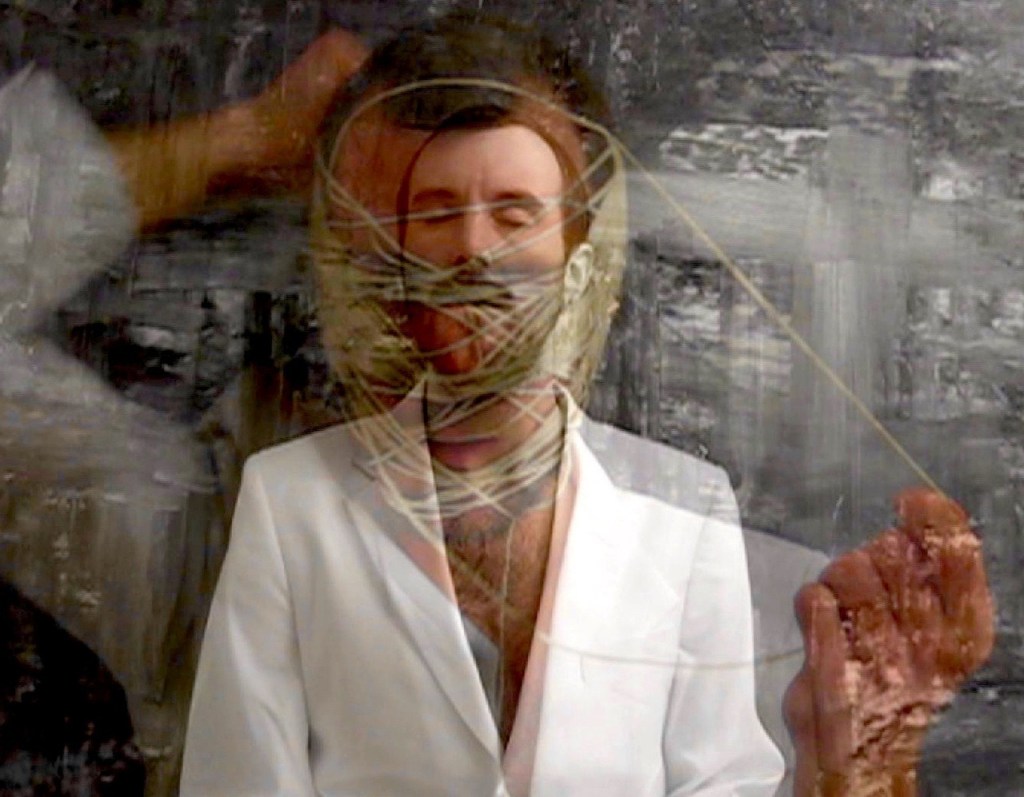
The photo is a still from a performance video I made in 2012. Through my visual art I was always trying to articulate my feelings and beliefs about the physical and metaphysical. Through art I sought to examine this relationship and express that visually which alluded me in every other form of expression and means of communicating. In this video we have two beings; one that remains still, eyes closed. The other worked furiously to wrap and eventually unwrap their head with string. The being with their eyes closed is actually the one seeing, the one that is fully aware of what is going on internally and externally. The other being, the one wrapping their head with the string, is the being trying to figure out their place within everything, to literally untangle the mess and confusion in which they find themselves.

“Living one day at a time…”

image

Epilepsy monitoring

After weeks, perhaps months, of trying to decide whether or not to undergo the epilepsy monitoring, I elected to take the needed steps and proceed. Even after registering and meeting the doctor and team of techs I was still ready. Then, however, something shifted and I didn’t feel prepared (emotionally/psychologically) anymore — I even started to wonder if I ever was. Perhaps it was the hospital setting and the rising anxiety that these institutions produce. Or the clinical smell that permeates my unconscious mind, leaving me with a sick feeling in my gut. Or the veggie burger I ate that tasted exactly like the one I would consume at Mass General. Maybe it was the person in the next room who was moaning and crying while amid a seizure and/or experiencing post-seizure horror that caused a terrifying delirium, which is inexplicable. Maybe it was a combination of all these elements, but I decided to postpone the study… in fact, I was almost desperate to leave the hospital as fast as possible.

The process post-study didn’t sound as easy as I hoped. Afterward, Post data collection, I would undergo several neurological tests, i.e., language, cognitive function, etc., to ensure the safety of potential surgical resection. Then, a team of neurologists and neurosurgeons would get together and review ALL the information and decide if I was even a candidate for surgical intervention. This testing/deliberation could take 4-6 months. Though I knew it wouldn’t be so cut-and-dry (no pun intended), I certainly didn’t think it would take that long.

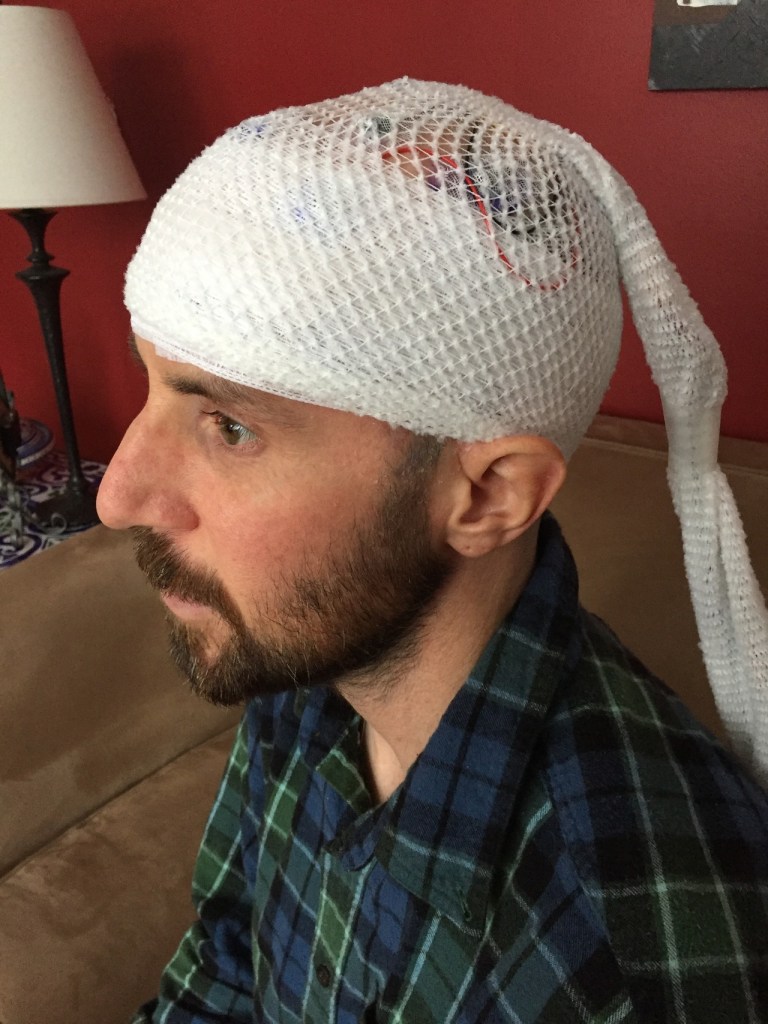
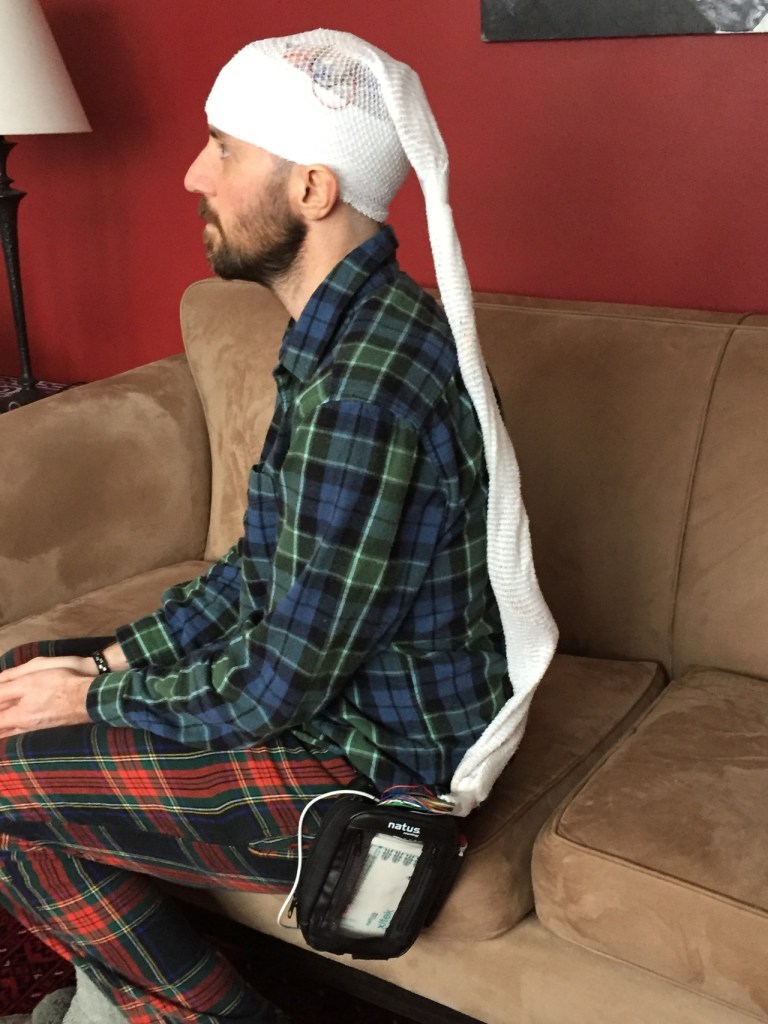
For the time being, I decided to take baby steps. I left the hospital with what’s called an ambulatory EEG. This allowed me to return home to continue resting and healing — both of which are desperately needed after years of treatment and the emotional, psychological, and physical stress this entire ordeal caused. Before leaving the hospital, a dozen diodes were glued to my scalp. These are then connected to a small box that gathers information 24/7. I was also given a camcorder meant to be left on while I’m sleeping, sitting reading, writing, playing guitar, cooking in the kitchen, etc. — basically any place I might be for several minutes. The intention is to capture any possible seizure-like activity via brain waves and on film.
Perhaps this monitoring will shed some light on certain elements and reveal potential seizure activity.

Baby steps. Slow and steady…

I’m trying to race through all these tests, not just those related to the seizures, but every single test (blood labs, CT scans, MRIs, etc.), desperately hoping to return… but to where I know not. There is some kernel of normalcy out there — there must be, right? Although I am trying to find it in the past, I know, beyond a shadow of a doubt, that this normalcy I seek, this peace of mind and, dare I say, acceptance, is found right here and now.

I just haven’t gotten there; I haven’t arrived. Acceptance of what is, that ability to live (more) presently, is just beyond my grasp. I know I could easily take hold it, maybe lean just a little farther out, bravely extending, trusting myself in doing so, but I’m held back. The bitterness and anger pull me the other way, back into the known. I am seeking normalcy in this place, in the past, but all that remains some visions and daydreams lead to the bitterness and anger felt presently. I often wonder, when in a moment of clarity, how much I polish those memories to better serve my current state of anger, sadness, etc. This is where the emotional and psychological exhaustion, or at least the majority, stems from; the continuous construction of a palatial past to which a return is impossible.  

A Return

black and white photo of the woods in the winter

PTSD

I’m not going to die…

Measuring time

I measure time in interesting ways now. A row of trees (“green giants”) were planted in my backyard roughly two years ago. As they grow, like most trees, they send these vertical shoots (for lack of a better word) straight up, and then those, in turn, begin to fill out with horizon branches. They have not only sent up their shoots, but they have also begun to fill out. This is the intention of such trees; they are used as a natural wall. They are close to becoming impenetrable.

I think about when my dear friend visited. They put cream on my hands; it was a lovely gesture and made me feel safe and secure. When they came to visit, we went to get gelato. My hair fell out. They noticed it on my pillow but didn’t want to say anything, but I knew. When I left Chicago, I took their suitcase. It had a little Travelocity gnome on the handle. When I returned home to Maine, I left the suitcase in my room and lived out of it. Not that I couldn’t settle into my room in my mother’s house; I just didn’t think I’d be here long enough to have to. It wasn’t naivety, just wishful thinking and the assumption this would be over and done with by mid-summer. The suitcase was there, just resting in my doorway. I would wash my clothing and put them back in the suitcase, folding the pants and shirts neatly so they would fit. The little gnome smiled up at me, bidding me to take off, to go boldly out there, wherever there was. Slowly I unpacked, however. I washed my clothing, folded it, and began to fill my drawers. Then the suitcase was put in our basement, the little gnome still there, hanging off the top. That was over two years ago.

I want a 9-5 job. I want to go out on the weekends. I want to point the finger at someone or something. I ate organic food for the majority of my life. I was a vegetarian, didn’t touch GMOs, and tried to eat locally when possible. I drank green tea and coffee — but only organic, of course. I was raised on a farm in Vermont — I was an earth-loving flower child before earth-loving flower children became trendy and commercialized. I meditate regularly and exercise 4+ days a week. So why am I still fighting this this fucking disease?

Yes, that’s right, fuck. Fuck this, fuck that… fuck!

There’s shame in all this, too. As with my diet and lifestyle, how on earth did I get cancer, considering how I  tried to be diligent (almost militant!) about the choices I was making? Or is that guilt? I am not sure I fully understand the two: shame and guilt. Do I feel ashamed when I let out the pain and anger from this ongoing battle? Or is that guilt? Do I feel guilty that I feel as though I am burdening someone with it all this? Or is that a shame?

We have a tendency to glorify these people who go through cancer with some sort of sage or guru or saintly-like bravery and stoicism. The talks and books, the inspirational speeches, and blah blah blah. But that person who marches through it all doesn’t exist. Yes, they do, but I can guarantee they cracked, broke down, and screamed. Yes, the inspirational speeches are full of beautiful sentiments about this or that, about how cancer was “the little friend I needed.” The majority, though, I’m assuming, are like me in the sense that they can’t right themselves long enough to step away from the looming shadow that is cancer.

My oncologist said I should get a job. I’m not sure if that was a joke or not.
My other oncologist said, when I had ongoing back pain recently and asked for an MRI (it turned out to be an inflamed disk), “that’s the trouble with doing scans, it seems you always find something wrong.” Excuse me? Fuck you.

Those green giants have indeed filled in. They have made a lovely wall. Inside that wall, on my side, there are plants, flowers, and endless beauty for the eyes to behold. I will admit my gardens are beautiful. Our gardens are beautiful. I spent endless summers crafting them when I was at home from school or had free time from work, etc. When I lacked stamina due to treatment and willpower, my mother took over and put her unique touch on them. But I’m not there, not fully present on our side. I am standing with my friend’s suitcase, with the little gnome on the handle, ready to travel, trying desperately to get beyond the wall of green giants. I am certain that on the other side is a 9-5 job, weekend drinks, and conversations that don’t feel like a burden to others. On the other side, hand massages are simply hand massages and not about squelching intense fear that transcends words.

Shadows larger than life

Sometimes, I feel as though I have a very clear idea of what I want to write and what ideas and emotions I’m trying to convey. Other times, I don’t know where to begin and hope that fumbling along will eventually string together enough thoughts to create something solid. This is the former. However, the idea is clear but the words haven’t yet formed.

Recently, I have wondered if this is all worth it. By this, I mean the cumulative fear, stress, and anger that have spanned the last 2.5 years of my life.

With cancer, there is no reprieve. I always wonder if something is lurking. The experience with the recurrence took me so off guard. Now, I always wonder what’s there, just under the surface? What’s going on within me?

In a way, I have become very childlike, existing in this world where shadows are larger than life and wondering about my health every second.

The scans I had 3 months ago were clean. (I will have another round in early August.) The knowledge of clean scans permits me a little time to feel good, safe, and breathe. Then the show starts all over again. The build-up begins weeks (if not months) before the actual test dates; sleepless nights, raw emotions/emotional outbursts, heightened sensitivity to noise or sudden movements, and irritability. There is a pervasive feeling of dread that blankets everything. It’s not so simple to label it as depression; it is too multifaceted. (By the way, I take antidepressants and anti-anxiety medication. In addition, I also take a daily regimen of herbal remedies and supplements to combat all sorts of things mood-related.)

This is my existence, and I have honestly been wondering if it’s all worth it and if I can hold on. If I can hold out for that one day when I’ll awake, the nagging fear, the chronic anxiety, and endless worrying will have slipped away in the night.

In June (2018), when I saw my oncologist at Mass General, they asked how I was doing. I felt more and more comfortable with them and knew they were asking on a deeper level (i.e., not just inquiring about fatigue levels, appetite, etc.). I said, “I feel hopeless.” It is a word I hadn’t used much before, if at all. Hopeless: despair, desperate, forlorn, pessimistic, resigned… these words don’t describe who I am. Who was I becoming? What had all this illness done to me? The weight of that word fell upon me.

For me, a state of hopelessness is reached rather gradually. In considering my journey, in relative hindsight, it is akin to wading out into a body of water — just one step, then the other, and so on. I think the longevity of my journey was a sort of cresting wave; the initial diagnosis, the recurrence, the stem cell transplant. Everything consumed me in between the various tests that took place, the preparations, the scheduling of this or that. I had little time to even consider what state I was in. Naturally, there was great sadness, frustration, etc. I never thought these emotions would culminate in hopelessness, or perhaps they were slipping under the radar. The cresting wave broke; it fell upon me. The body of water, the floor of which I could just barely touch amidst everything, was no longer there. Try as I might, I couldn’t touch the bottom. Then, another wave broke and another. I surfaced and looked for the shore, but the swells were too great, too high. All these moments of fear or anxiety, anger or sadness, amounted to a state of hopelessness.

For those unsure of what I’m saying, I will be blunt; I have often wondered about ending my own life. Also, for those who are also wondering how or why I would go through years of cancer-related treatment only to contemplate taking my own life — it is not, nor will it ever be, that simple.

As I said before, I’m holding out for that day when I will wake to even the slightest hint of normalcy.