Perhaps this is survivor’s guilt.

Our situations were identical in almost every way. 

He was diagnosed with testicular cancer. His staging was the same as mine. He, too, experienced a recurrence that presented as a brain lesion and opted for a stem cell transplant. 

This is where our paths split apart. Shortly after his high-dose chemo treatment commenced, prepping his body for the transplant, he became increasingly confused and disoriented. After sets of scans were performed, it became evident that, though the heavy rounds of treatment were well underway, several more lesions had presented themselves in his brain. The decision was made to stop treatment and return home, enter hospice care, and be around loved ones. Shortly after he decision was made, he passed away. 

Even in writing this, I don’t know where to begin opening up my emotional state regarding his journey and mine and where they veered off and split from one another. I shudder thinking about the fact that my lesions could have multiplied, too. Or, for that matter, the one that did present itself could have been in such an area that it was deemed inoperable, leaving me with more complications than just a stroke and a paralyzed arm. (“Just a stroke…”) What damage could my tumor have caused had it been slightly to the left, to the right, etc? Was I naive to postpone my 2nd round of salvage chemo and head out to visit Dr. Einhorn in Indianapolis to get a second opinion? Was this delay dangerous in such a way that… it’s too much to think about. 

These questions haunt me. They wake me in the middle of the night. Even more so is one I can’t escape asking repeatedly: why am I here and he isn’t? Why am I alive and he … and he isn’t? 

I never understood survivors’ guilt. I had heard about it but never truly understood it. Yes, on a larger scale, anyone who survives cancer thinks about all those who haven’t and, in one way or another, has that feeling. In most cases, guilt might be too harsh, but this particular scenario is apt. 

I loop my posts back around. With my last sentences or so, I always seek to return to the overall idea. Is this good writing? I’m not sure. I do so to keep everyone along the way. My writing tends to drift a little far out, so bringing things full circle will hopefully lead people to say, “Oh, now I understand why he wrote…”  However, with this post and the subject matter herein, I can’t. How do I bring this back around? What closing line or thought can I inject here? Nothing can sum this up or deliver on one’s need for coherency as none of this makes sense… 

Perhaps this is survivor’s guilt. Maybe it isn’t so much about feeling remorse for those who have passed at the hand of this insidious disease, but rather the inability to make sense of it, to articulate it to ourselves and others. As with this post, I want to bring it back around so it feels wholly desperate and there is some understanding to accept the madness of this life and the injustices that rear their heads. But I can’t. Everything is left hanging, nothing but loose ends, dangling strands that I keep tugging at…   

Be well on your journey, Alex

June 13, 1994 ~ June 30, 2020 (age 26)

3rd anniversary of my stem cell transplant

National Cancer Survivor Day

Life is Like Jazz

The elation I felt…

Trigger warning: This post deals with issues such as depression and mental/emotional breakdown.

The word “met” refers to metastatic cancer.

The elation I felt after these recent scans was overwhelming! When my oncologist said that we would move the scans to every 6 months, as opposed to the quarterly schedule we had maintained since my stem cell transplant, I cried. When I have broken down in front of him before, which I have done on numerous occasions, it was due to negative news or concerns he had. This time, however, the tears resulted from pure joy and happiness!

I was shocked when he told me this, completely speechless. When he entered his office, I braced myself. The 2nd to last scans performed in August revealed “nonspecific nodular change” on the largest pulmonary mets. Though things were “stable” then, it was still cause for worry.

This is the area where the recurrence was detected in early 2017, so naturally, it was worrisome.

I didn’t tell anyone. Not a soul. I said things were stable, but I didn’t mention the change.

We would “keep an eye on it”; that was the plan. We’d see how things looked in three months and how they appeared after the following scans. These were the parting words after my appointment in August – we’ll just wait and see.

Three months! For three months, I wondered what might be occurring within my lungs.

Those who talk about “being present”, living in the “now”, etc. are full of shit. When you’re told that there is a slight change in size in one of the mets on your lungs and that it might be growing, but we’re not sure, so let’s wait three months to be specific, you’d be leaping into the future and entertaining every possibility imaginable. Anyone would be anywhere BUT “here and now”; their minds would be bedeviled by worry and fear. Even Siddhārtha Gautama would be shitting himself.

Several months ago, an MRI revealed that there was potential growth in the met in my brain, the one that was treated with radiation therapy in 2016. It turned out that it was just swelling and that there wasn’t any growth. My mind kept reminding me of this incident and that perhaps the supposed growth in one of the lung nodules was also the result of swelling…

I was informed of this “nodular change” on September 16th, the day before I departed on what I had hoped would be a nice trip abroad for my birthday. The tickets had been purchased well in advance, and I was going regardless of the news I had just received.

I thought taking a short vacation would be nice. After hearing the news about the nodule change, I felt a sort of urgency to leave – in fact, I wanted to run away and be as far away from everything as possible.

While abroad, I began to “live it up”: lavish AirBnBs & private hotel rooms, extravagant meals at swanky restaurants, fancy new attire for my nights out, etc. My mentality, as morbid as it might sound, was, ‘fuck-it, if this is my last go-‘round, I’m sure as hell gonna enjoy myself!’

I prolonged my stay. I didn’t want to be home; I didn’t want time to sit and think about the possibilities and entertain the what-ifs that have plagued my thoughts since my initial diagnosis.

Naturally, all the fancy hotels and fine dining couldn’t keep the torrent of thoughts and worries at bay. They were creeping in. I was losing sleep, and, as a result, my already fragile psychological and emotional state began to further weaken. I didn’t recognize who I was becoming; I started lashing out at people, hurling accusations at friends, displacing the intense feelings of anger and sadness. I couldn’t bear the thought of a recurrence, of further treatment, and was spiraling out of control from the fear and stress I was experiencing. On top of that, amid this storm sweeping me away, I couldn’t find the words; nothing made sense, and I felt alone.

I just wanted to be held. This desire kept returning to me. This need and wish to be wrapped up and held securely was almost childlike. I didn’t want to dump the emotional weight of my situation onto anyone… I just wanted the comfort of prolonged embraces.

The stress and fear was too much. It ended with a hospitalization in Rodez, France. I experienced a nervous breakdown. After 5 weeks of traveling and doing my utmost to push away the anger, fear, and sadness that had sprouted from recent test results, I fell apart. Touching the scar from my craniotomy set into motion an avalanche of emotions, the likes of which I was entirely unprepared to manage.

My mother was the first person I told. I only spoke about it because the report from the most recent CT results mentioned the stability of all pulmonary nodules, including the one that presented with nonspecific changes 3 months prior. This would have been noted in the findings if it had been grown.

She didn’t understand why I didn’t tell anyone. “It’s too much stress for you, “she said, “you shouldn’t have been alone in this!”

I was alone with this knowledge and knew that a change had been detected in the August scans. I didn’t want to say anything because I didn’t know how. I am not good with communication; I have repeatedly repeated this. It isn’t that I’m not opening up, as some have told me; I just find spoken words strange and cumbersome. They don’t align themselves with my thoughts or emotions. Throughout my entire journey with cancer, I have felt at a loss for words. Even in writing updates and maintaining my blog, I have thought that the words I choose are so close to expressing what I need… but fall short every time. They lack the substance required for specific emotional experiences and psychological states. Before diagnosis, I could easily find the words needed to articulate my feelings and express myself. After being discharged from the hospital in Chicago, after being told I had cancer and that my life had been drastically altered, I immediately discovered that words no longer added up. Initially, I thought it was due to several things: stress, fear, seizures, seizure meds, and sleep deprivation. I considered these while packing my belongings and preparing for my return home for treatment. I was tossing clothes in bags and ditching possessions, all the while I was trying to understand why I couldn’t connect my thoughts and emotions with the words I so greatly desired. This ineptitude has continued and hasn’t diminished with time.  

The knowledge that everything is stable has brought an immense feeling of peace that has evaded me for far too long. The serenity that has arrived has lessened the pressure I have been putting on myself in many aspects of my life. I want nothing more than to find the words needed to feel a sort of connection with others. Perhaps one day, they’ll arrive when the dust from all this has finally settled. This is the area where I live in the “here and now,” where I am fully present. I’ll be with it daily, moment to moment, and I hope the words will eventually harmonize with my thoughts and emotions.

The body

For years, I didn’t like my body. For the majority of my life, there was this sense of guilt or shame about how I looked and felt. As a result or product of, I am not sure, there was an internal struggle, a sort of emotional and spiritual dissonance within that which I can only refer to as the soul. 


The body and soul were awkward, each attempting to adjust to one another, the physical and metaphysical working their way into a partnership of sorts. In one’s formative years, this is a time of great physical and emotional/spiritual strife. From my childhood until recently, this lingering sensation of turmoil always seemed to be. 


Much of this stems from the labels and ideas thrust upon us by the society and culture into which we are born. It is hard to adjust and figure out our way through the swamp of ideals and morals, beliefs and philosophies that aren’t necessarily our own – in fact, they seldom are, as we soon discover, they are simply handed down piece by piece. In such a way, they become like the game a telephone might play as a child. One person starts a phrase, and it is passed around or down a line. The end product is usually some bastardized version of the initial statement. The awkwardness of soul and body, this feeling of discontent, eventually brings us to the point of either acceptance of the societal and cultural default settings or forces us to step out in hopes of discovering that to which we are drawn by some force and/or inner seeking. Both take courage, neither one can be deemed good or bad, right or wrong etc. 

Amid treatment, during the first rounds immediately following my diagnosis, I stepped out of the shower one morning and stood before the mirror fixed to the opposite wall. There, in front of me, was my naked body. My hair had long since fallen out on my head and my entire physical being. I looked like some prepubescent boy with the face of a middle-aged man – a face exponentially haggard by exhaustion, stress, anxiety, etc. My eyes were sunken, tired, and sad. They, my eyes, have always held every bit of my worry, fear, joy, passion, etc. I looked at myself; I stared at the body before me. I stood still and let the feelings and sensations (some of which I haven’t found a suitable word for) pulsate from my core. 


I stood there. My fingers traced various lines and ran over my bloated body, puffy from steroids and other drugs administered during active treatment.


The orchiectomy incision looked back at me. I hadn’t looked at it since the operation and commencement of treatment. There was a part of me that didn’t want to look at it, to admit that it existed, or to deny the fact the surgery had taken place. 


Afterward, I let my fingers wander over my body, from the top of my bald head to the sunken sockets holding my eyes, over my flabby belly, and along the scar that marks the right side of my groin. I let my arms fall to my sides. I remember distinctly looking at myself – really looking at myself. I never wanted to. The body, my body, was just something. Embarrassed as I am to say this, I viewed it as some form that I had been plagued by. 


Beyond the fleshy, bloated being is where my gaze eventually fell, where it entered. How could it not? That is where all the lines I traced on my body were leading. As with the physical body, I didn’t think I was ready to honestly look or hold myself in that manner. But given the circumstances, the nand tire situation I was in, how could I not?


I have always been curious about the soul. The notion of it as a thing, for lack of a better word, fascinates me. I see it as something continuous, an ongoing form of energy, something that doesn’t end when the physical body holding it passes. The idea of the soul as something “eternal” stems from my catholic upbringing. As with my physical body and the shame and embarrassment I felt towards/about it, I felt something similar towards my soul. My physical body might lead to sin – to enjoyment and lust. My soul was a mere breath or thought away from damnation. 
Damned might I be should I enjoy my own flesh, my body – the sacred house of my soul! Damned might I be should I steer my soul on a course of my own choosing to embrace the free will I was taught so much about. 

It took me nearly 3 decades to look at myself and appreciate the strength of my body and soul. It took almost 3 decades to look at myself, to behold myself, body and soul, and to give thanks.

Despite the anger and bitterness, and sadness, gratitude exists. Though I might struggle daily with my mental and emotional well-being, I’d be genuinely damned without appreciation.

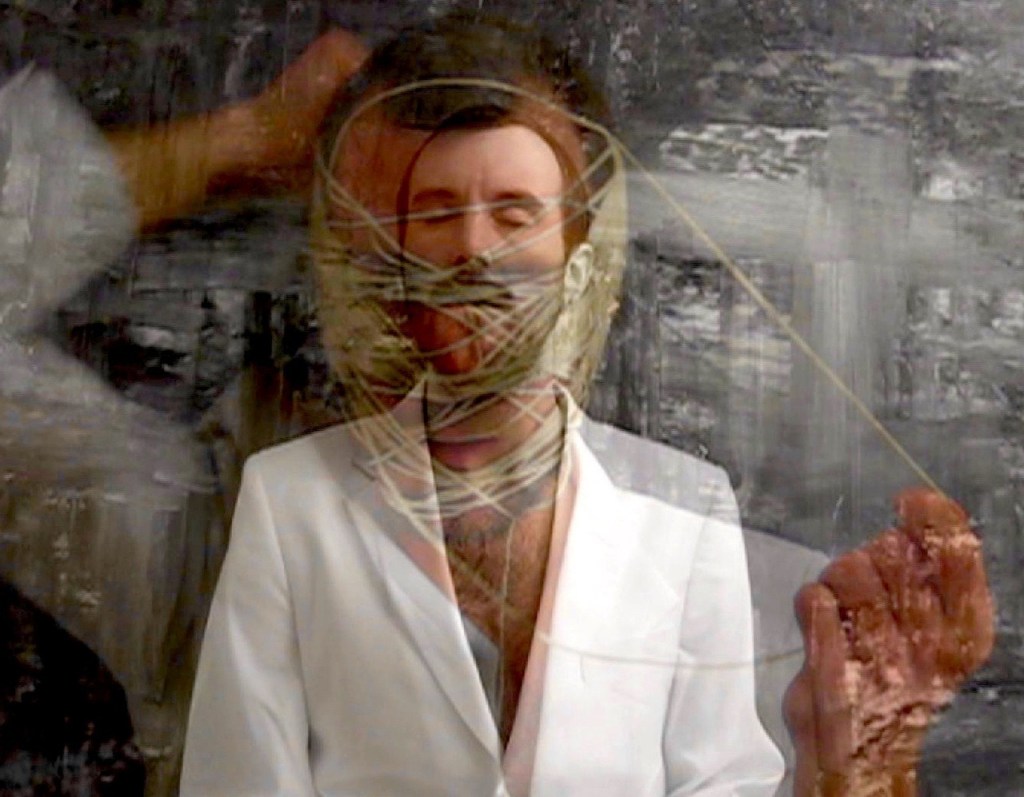
The photo is a still from a performance video I made in 2012. Through my visual art I was always trying to articulate my feelings and beliefs about the physical and metaphysical. Through art I sought to examine this relationship and express that visually which alluded me in every other form of expression and means of communicating. In this video we have two beings; one that remains still, eyes closed. The other worked furiously to wrap and eventually unwrap their head with string. The being with their eyes closed is actually the one seeing, the one that is fully aware of what is going on internally and externally. The other being, the one wrapping their head with the string, is the being trying to figure out their place within everything, to literally untangle the mess and confusion in which they find themselves.

The “new normal”

After drinking one liter of contrast dye and being poked numerous times to place an IV, my chest/abdomen/thorax show stability! No new developments – things are as they were and have been – stable!

Now, the task is sorting out these seizures. My anticonvulsant med has been increased, so we’re hoping this holds. However, if it doesn’t, the next step would be inpatient epilepsy monitoring. Several months ago, this was the initial idea; however, my neurologist didn’t want to jump into that. As he said, “Let’s leave well enough alone.” At the time, it had been a few months since my last seizure, and the hope was that the medication was holding. After my recent seizure, however, it was decided that, should another episode occur, I would enter the EMU (epilepsy monitoring unit) at Maine Medical Neuroscience Institute to get a very clear idea of the seizure activity.

Part of me wants to enter the unit right now to really understand the root cause of these debilitating seizures. The flip side is that I am exhausted, and the thought of being impatient for any reason makes me angry and sick to my stomach.

I want to return to normal, and this bullshit idea of this being the “new normal” greatly annoys me! This mentality is far too easy to put forth from people who haven’t spent 3 years trying to stabilize themselves, right themselves, adapt, and readjust every moment of every day.

The positive news is that my lungs/thorax/etc. Are stable overjoys me… but I celebrate halfheartedly, always wondering what might be lurking, waiting for me to let my guard down. History has shown that with every up, with every moment of elation, is followed by a horrific down, a paralyzing fall. What is seen as pessimism, or something similar,  is me trying to minimize the letdown, the fall from too great a height. Being in this constant state of emotional and psychological neutrality is a shame.

Perhaps that is my “new normal”.

image

Epilepsy monitoring

After weeks, perhaps months, of trying to decide whether or not to undergo the epilepsy monitoring, I elected to take the needed steps and proceed. Even after registering and meeting the doctor and team of techs I was still ready. Then, however, something shifted and I didn’t feel prepared (emotionally/psychologically) anymore — I even started to wonder if I ever was. Perhaps it was the hospital setting and the rising anxiety that these institutions produce. Or the clinical smell that permeates my unconscious mind, leaving me with a sick feeling in my gut. Or the veggie burger I ate that tasted exactly like the one I would consume at Mass General. Maybe it was the person in the next room who was moaning and crying while amid a seizure and/or experiencing post-seizure horror that caused a terrifying delirium, which is inexplicable. Maybe it was a combination of all these elements, but I decided to postpone the study… in fact, I was almost desperate to leave the hospital as fast as possible.

The process post-study didn’t sound as easy as I hoped. Afterward, Post data collection, I would undergo several neurological tests, i.e., language, cognitive function, etc., to ensure the safety of potential surgical resection. Then, a team of neurologists and neurosurgeons would get together and review ALL the information and decide if I was even a candidate for surgical intervention. This testing/deliberation could take 4-6 months. Though I knew it wouldn’t be so cut-and-dry (no pun intended), I certainly didn’t think it would take that long.

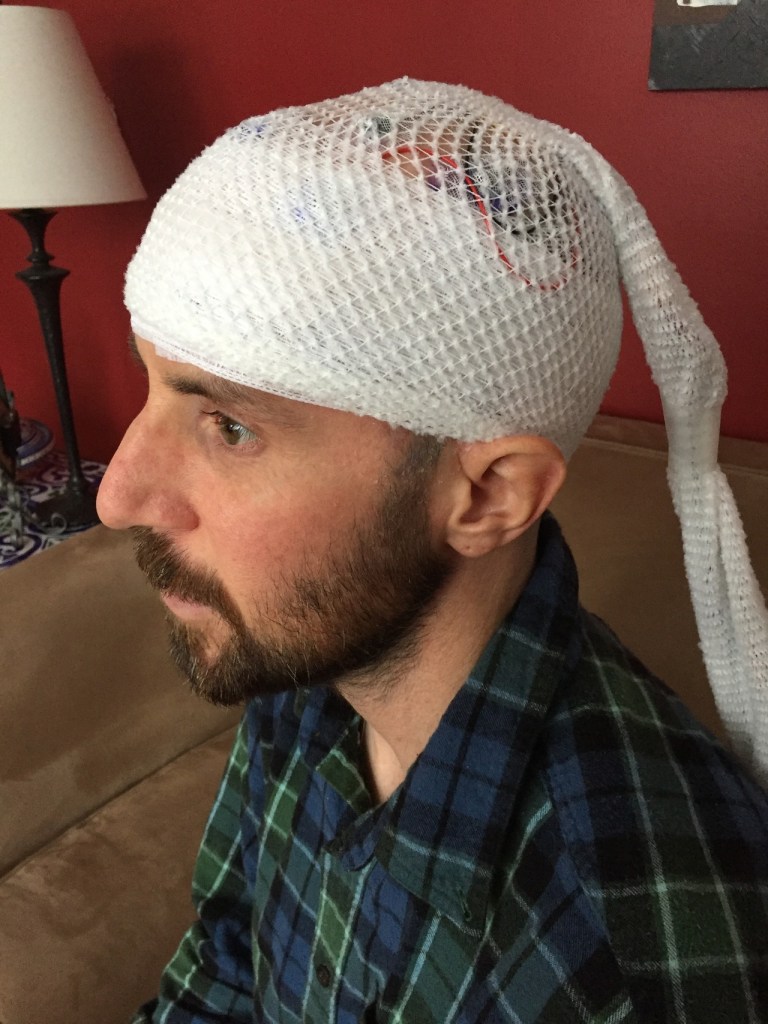
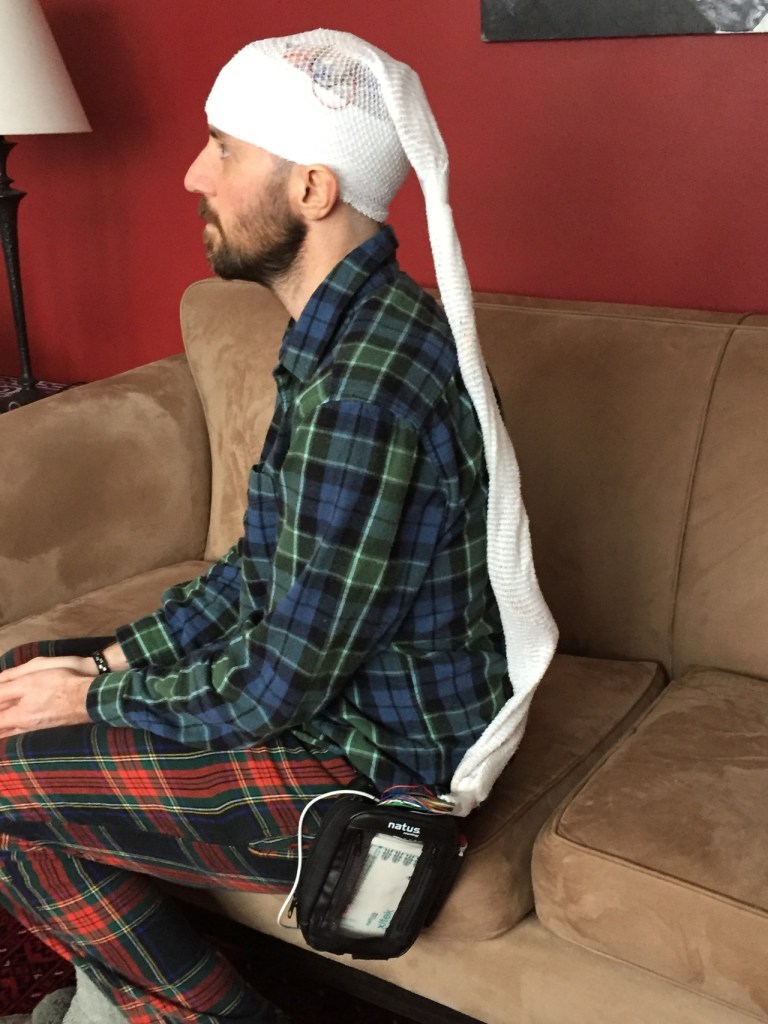
For the time being, I decided to take baby steps. I left the hospital with what’s called an ambulatory EEG. This allowed me to return home to continue resting and healing — both of which are desperately needed after years of treatment and the emotional, psychological, and physical stress this entire ordeal caused. Before leaving the hospital, a dozen diodes were glued to my scalp. These are then connected to a small box that gathers information 24/7. I was also given a camcorder meant to be left on while I’m sleeping, sitting reading, writing, playing guitar, cooking in the kitchen, etc. — basically any place I might be for several minutes. The intention is to capture any possible seizure-like activity via brain waves and on film.
Perhaps this monitoring will shed some light on certain elements and reveal potential seizure activity.

Baby steps. Slow and steady…

I’m trying to race through all these tests, not just those related to the seizures, but every single test (blood labs, CT scans, MRIs, etc.), desperately hoping to return… but to where I know not. There is some kernel of normalcy out there — there must be, right? Although I am trying to find it in the past, I know, beyond a shadow of a doubt, that this normalcy I seek, this peace of mind and, dare I say, acceptance, is found right here and now.

I just haven’t gotten there; I haven’t arrived. Acceptance of what is, that ability to live (more) presently, is just beyond my grasp. I know I could easily take hold it, maybe lean just a little farther out, bravely extending, trusting myself in doing so, but I’m held back. The bitterness and anger pull me the other way, back into the known. I am seeking normalcy in this place, in the past, but all that remains some visions and daydreams lead to the bitterness and anger felt presently. I often wonder, when in a moment of clarity, how much I polish those memories to better serve my current state of anger, sadness, etc. This is where the emotional and psychological exhaustion, or at least the majority, stems from; the continuous construction of a palatial past to which a return is impossible.  

I’m not going to die…

Expressive writing

Stress, trauma, and unexpected life developments — such as a cancer
diagnosis, a car accident, or a layoff — can throw people off stride
emotionally and mentally. Writing about thoughts and feelings that arise
from a traumatic or stressful life experience — called expressive
writing — may help some people cope with the emotional fallout of such
events. But it’s not a cure-all, and it won’t work for everyone.
Expressive writing appears to be more effective for people who are not
also struggling with ongoing or severe mental health challenges, such as
major depression or post-traumatic stress disorder.”

It sounds like I am beating a dead horse when I talk about “getting over” things. In many ways, and I do recognize this, I am. It isn’t that I’m obsessed with this idea, or beating myself up… it is simply that I am trying to come to terms, accept, move onward.

My fear is, and this too might be glaringly obvious, I worry about getting stuck there. Perhaps this is why I’m so keen on stepping forward and into the present.

I ruminate. I think and overthink and re-think… I try to work something out, see it from every angle and point of view. This has served me well and has helped in many ways. However, in regards to cancer and cancer treatment, I worry that it might be too great a focal point.

The above quote, published by Harvard Health, interests me. I fancy myself a wordsmith, even though my spelling and grammar are rather questionable (thank you neurotoxicity!). With writing, especially that which isn’t fiction, I grapple with subjects and, as with my other rumination skills, pick at it, dissect it, scrutinize it.

What I’m beginning to understand, and this quote really gets to the heart of it, is that my trauma from these many experiences had over the past two years, might be hindering me from working through something and thus letting it go. (Perhaps I am even overthinking this…)