Over a decade ago, when life seemed easier in many ways, partly due to blissful naivety, I left Paris en route to Munich. There, I met with German buddies to make our way on another adventure around the British Isles. Though I had been there a few times prior, I hadn’t traveled by car, and I knew this would add a whole new dimension to our journey. The British Isles, namely Scotland, are my ancestors’ land(s). I was keen on getting off the beaten track, so to speak, and really explore.
The year prior, or perhaps two years prior, we met up in Zurich, where I studied then, and set out to explore Italy. Both journeys were full of spontaneity and, naturally, considering our ages, delicious German beers. Heavy drinking aside, each journey graced us with limitless possibilities. Cliche, perhaps, but we each grew throughout our adventures. Of course, this is only in hindsight, as always, and one looks back on such voyages with a sigh and a smile, retracing not only the steps that we took then but the steps that lead each of us to our current places here and now.
There were many laughs along the way, which weren’t due to the beer; in some two or three cases, it took up more space than our luggage. We encountered some caravan-dwelling folks in Calais who seemed to live in a clown car of sorts, as each time we turned around, there was another… and another… and another. Each one disembarked until their numbers were excellent, and we soon realized that their intentions were not as friendly as we had assumed… blessed naivety. When we needed, which was often, we slept on beaches when the weather was “nice,” an” hud” led under the car, an old Mercedes (which is probably still going vital to this day) when the weather took a fowl turn. One of their friends, studying at Oxford, invited us to stay in his dorm room, which made up for the nights sleeping under the car. We cooked white rice over a camp stove and added ketchup to flavor it… a delectable meal, even if the rice was crunchy. We crossed over the Irish Sea on a late-night ferry from Holyhead. The ferry seemed almost empty at this godforsaken hour, and we sprawled out in the passenger lounge on hard plastic seats to catch a little rest. Rest evaded me as the rocking of the ferry made me queasy.
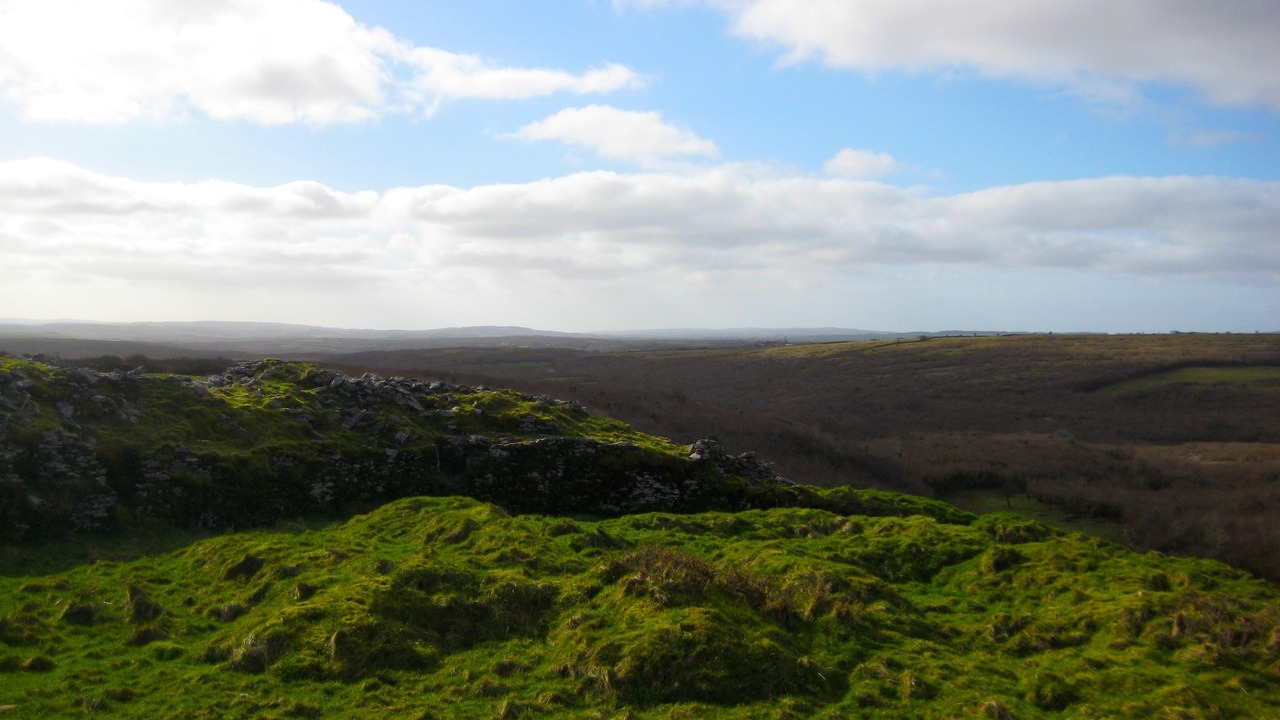
Somewhere well south of Dublin, we were driving along a double-lane highway which, seemingly instantaneously, turned into a sort of country lane just wide enough for two cars to pass. From there, it tapered off into a single lane, then a dirt road, and then a path that, I presume, was made for a tractor or other such piece of equipment. I am not sure if it ended together in pure Irish countryside or not… Had the roadmap been used more regularly, it would have consisted of major roadways, highways, etc. Still, this little dirt track wasn’t wasn’t make matters more interesting; our dual language road map was perfect for a German- or English-speaking traveler wishing to stay on the main autoroutes. Still, it was not helpful in our current situation. All the signs we could see, some just propped up on rock walls, others, which seemed to point in a random direction and undoubtedly acted more as weathervanes, swiveling this way and that even in the gentlest of breezes, were in Irish (Gaelic).
In the middle of seemingly nowhere, we came upon a small cottage. It was an idyllic, postcard-worthy scene. After a brief discussion, it was decided that, since English was my native tongue, I would speak with whoever was there — if anyone at all. After knocking on the door, I paused momentarily to admire the houses. I also wondered how one might live here in what seemed to be the middle of nowhere. When I was about to leave, the door opened, and an older woman greeted me. I can’t imagine how I looked, considering we had been sleeping under a car and consuming white rice with ketchup-washed-down beer for the better part of 2 weeks. But she didn’t seem to notice or care. I presume she had been watching from a window, studying the car with German plates and the three bedraggled boys.
“Good afternoon,” I said, “I’m sorry to bother you, but we’re lost.”
She smiled warmly.
It wasn’t until later that I began considering my comment and her potential interpretation. Here we were in what I called the “middle of nowhere”, but to”her it was home.
Lost
Past and past participle of loss.
Adjective: lost
Denoting something that has been taken away or cannot be recovered, e.g., a lost opportunity.
It isn’t that this opportunity is lost forever; it is simply that such tidbits of wisdom only arrive when one is ready to receive them. The opportunity will repeat itself in various ways and forms until the knowledge is seen and accepted.
This journey of illness and recovery is an opportunity, right? Occasionally, I get glimpses of this, and a blissful warmth runs over me. Then I slip backward and become bitter at seeing something that has caused so much pain and suffering as a chance to learn and grow. Couldn’t I have learned this differently?
I awoke to a text from a dear friend of mine. She has been a source of endless support, care, and love during these years of both illness and recovery. She spoke about the destination and used the analogy of building a stone path and how I’m looking far ahead to some distant point. In turn, the stones I’m laying down to build the path are being overlooked in my haste, in my desire to arrive at some terminus just out of my reach. The task is daunting, too. Building a path that stretches for miles and miles leaves me angry and thus depleted. I realized the stone path I had been laying could barely be considered a path. It’s a twisting and winding mess leading here and there, running wildly in every direction, chasing every possibility, seeking out any and every venue in hopes that one thing, that anything, will relieve me, nourish me, heal me…
I have been wondering about this notion of being lost, of being somewhere neither here nor there and struggling desperately to find the way — any way, for that matter. How might it be if, by chance, I stopped desperately trying to find a way? Or, rather, as it seems, I’m after one in particular. What if I stopped giving a damn about the stone path all together? What if I stopped giving a damn about direction? If I just sat here, then what? To me, the construction of a path is a sign of strength and courage, forging boldly ahead in the face of it all. Even if I see the path as rambling madness running off in every which way, I still view it as such. What if I ceased the exhausting construction of this path? What if I just let it be? What if I just was?
Osho, an Indian spiritual guru and philosopher, said, “Be — don’t try to become.” I have spent far too much becoming. Becoming healthy. Becoming happy after such turmoil. Becoming whole again. Becoming. Becoming. Becoming. All of these are so close, just out of reach — just there.
If I become this, then I’ll have that. What a very strange equation.
This is the opportunity, the tidbit of wisdom that has arrived. Perhaps it has come a few times, and I simply wasn’t ready to be open to receiving it.
The warm smile from the older lady in Ireland was reassuring and comforting. Now, after so many years and countless experiences, I wonder if she was smiling because she knew I wasn’t lost then and that, in actuality, there is no such thing as being lost at all.


 healing is a circular path